
A Season to Recharge
Don’t let solar energy go to waste this fall
By Brian Dougherty
Everyone has probably dealt with a dead car battery at some point. It doesn’t matter how big the battery is; eventually it will go dead if the alternator doesn’t recharge it.
Soil works the same way. It is the battery of life, and it is recharged by plants capturing solar energy via photosynthesis. A plant is a solar panel. It’s the only thing we have that can take energy from sunlight and put it into a form the soil can use. There is no substitute for this miracle of life. Think of it like the battery in your tractor. You can have a large battery (like having a large amount of organic matter in your soil) but if the battery does not stay charged up your tractor will not start. On the flip side, you can have a fairly small battery, but if it stays fully charged (like having lots of readily available carbon to feed soil microbes) your tractor will still start. Most of us are running our fields on a low battery and wondering why nothing works the way it should.
I want to walk through what actually charges your soil battery, why it matters more than anything we measure, and why the months your ground sits bare are the most expensive months on your farm.
Plants are solar panels
Start with the equations everybody saw in junior high science class and promptly forgot:
Photosynthesis: 6 CO₂ + 6 H₂O → C₆H₁₂O₆ + 6 O₂
Respiration: 6 CO₂ + 6 H₂O ← C₆H₁₂O₆ + 6 O₂
It’s the same equation going in two different directions. Photosynthesis takes sunlight and packs that energy into the bonds of a sugar molecule. Respiration takes it back out to do work. The carbon atom is charged (takes on electrons) or discharged (gives up electrons) in the process.
What “charge” actually means in the soil
Here’s where it gets interesting and extremely important to you as a farmer or rancher.
When chemists talk about a molecule being “oxidized” or “reduced” they’re talking about electrons. An electron is just a tiny particle that carries a negative electrical charge. Electrons flowing through the wire are what makes the light bulb turn on when you flip the switch. Reduction means gaining electrons. Oxidation means losing them. Together we call these “redox” reactions. Photosynthesis is the primary reduction reaction on Earth. It is literally the process of stuffing electrons and protons (hydrogen or H+ from water) into carbon molecules that started as CO2. That is the charging step, and it’s the only free one we’ve got.
Soil scientists measure this as redox potential, or Eh, in millivolts. It can be measured with a probe, just like pH. Low Eh means the soil is electron-rich and reduced. High Eh means it’s electron-poor and oxidized. Corrected to pH 7, the electrical neutral point is around 400 mV. Above that you have an oxidized environment in the soil. Below it you have a reduced environment2.
We have spent more than a century treating pH as the master variable of soil chemistry and essentially ignoring Eh. pH describes proton activity, Eh describes electron activity. Agronomists have been depriving themselves of half the picture. Dr. Olivier Husson’s conclusion, after pulling together literature from soil science, plant physiology, and microbial ecology, was that Eh and pH don’t just influence soil; they jointly drive the whole soil-plant-microorganism system1.
Roots are the battery charger
So how does the charge get from the leaf into the ground? Through the roots, as root exudates. A plant doesn’t just make biomass with the sugar it produces. It pumps a portion of it through the roots into the soil. This can vary from as little as 5% to as much as 95% of what it produces depending on species, growth stage, and how well the plant is photosynthesizing.
Those exudates are carbon compounds loaded with electrons. When a plant does this, it is literally pumping charge into the root zone. Some of that shifts soil Eh directly. Most of it works through the microbes, which eat the exudates and shuttle electrons around as they respire, ferment, cycle nutrients, and get eaten. Husson’s model describes the loop plainly: plants release exudates → exudates alter rhizosphere Eh and pH → altered Eh and pH conditions determine which microbes thrive there → those microbes alter conditions further.
Plants actively “engineer” the root zone to make the conditions more favorable for their growth, just as we modify our habitat by building a house to live in. Researchers have put microelectrodes in soil and observed plants push Eh up to oxidize overly reduced soil or down or reduce overly oxidized soil near the root zone. The plant is managing the electrical condition of its root zone like you’d manage a thermostat. It has a range it needs to operate in, and it will spend photosynthetic energy to move into that range.
Why redox is important
Once you see soil as an electrical system, a lot of things that seemed unrelated start to connect.
- Redox decides who lives there. Every organism has an Eh-pH range it can function in. Change the range and you change the soil community.
- Redox determines what form your nutrients are in. Manganese and iron are only plant-available in their reduced forms. This is why you can have plenty of manganese on a soil test and a deficiency showing up on a tissue or sap test. The nutrient is there, but the soil is too oxidized to release it. Nitrate dominates in dry, oxidized, alkaline soil; ammonium dominates in reduced soil. This has a huge impact on nitrogen use efficiency, plant health, and environmental losses.
- Redox is related to disease pressure. Husson and colleagues published a paper arguing that pests and pathogens occupy specific Eh-pH zones3. Most pathogenic fungi thrive in oxidized conditions above 400 mV. Their hypothesis for why some soils are naturally disease-suppressive is that good structure creates a variety of different Eh-pH microsites within soil aggregates, which supports a diverse microbial community, which in turn prevents any single organism from taking over. We know this phenomenon to be generally true in nature as part of an ecosystem process called community dynamics. The soil is no exception.
Why should you care about this science stuff? A plant growing in favorable conditions spends more of its photosynthetic energy on growing leaves, roots, and grain or fruit. A plant growing in unfavorable conditions has to put more energy into correcting Eh and pH around its roots just to keep functioning. That energy comes out of the total budget. Every “dollar” of photosynthate spent fixing a soil problem is a dollar not spent making a crop. You are paying for degraded soil in lost productivity.
Draining your soil battery
Tillage floods the soil with oxygen. Oxygen is the strongest oxidizing agent there is. This causes microbial activity to spike, organic compounds in the soil are consumed, and carbon leaves as CO₂, just like the respiration equation above shows. In electrical terms, we are discharging the soil battery. Sometimes this is necessary, but tillage should never be done without a very good purpose for doing it, and without a plan for how you will recharge the battery afterwards.
Husson and colleagues measured this across four contrasting soil types3. Conventionally managed fields showed oxidation and acidification of the surface horizon. Conservation agriculture fields showed the opposite. They had lower Eh at the surface than in the horizons below it, a completely reversed profile compared to conventional. The conservation systems moved back toward favorable Eh-pH conditions for plant growth. Think about what that means. In a healthy soil, the most biologically active, charged-up zone is at the top where the roots are. In a heavily tilled soil, it’s upside down.
Overapplying nitrogen does the same thing. Add a lot of readily available nitrogen with no carbon to go with it and microbes multiply rapidly, then seek out carbon (their food source) to balance it out. They eat root exudates first. If they run out of those, they eat the biotic glues that hold aggregates together and they break down organic matter that is foundational for soil function. The result is the same as with tillage; a discharge of the soil battery.
A window of lost opportunity
Energy flow is one of the four ecosystem processes, and it is different from the others. Water cycles. Minerals cycle. Solar energy does not cycle. It flows in one direction, from the sun to the earth, and it either gets captured by something green or it hits bare soil. A corn or soybean crop captures sunlight for around 120 days. In moderate climates, that leaves roughly 150 days of opportunity. On bare ground, that energy is lost as heat. Nothing is captured and nothing is stored.
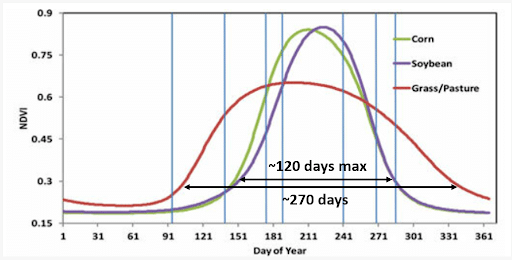
Meanwhile the soil is still respiring CO2 and discharging its battery because it’s not plugged in. The soil battery is off the charger for eight months, and then we are disappointed in May when it won’t crank the engine and produce vigorous early growth.
An overwintering cover crop fixes this for the price of seed and an equipment pass. Living roots means exudates. Exudates mean electrons moving into the soil and food going to the microbes that build aggregates. It means the surface horizon staying reduced and biologically active instead of oxidized and burnt out. It means nitrate getting taken up and held in living tissue instead of moving to the tile line or groundwater. It means armor on the surface to prevent erosion in the spring.
If you’ve got time and a good window, plant a diverse mix with different root architectures working at different depths. If it’s late in the season, a simple single species cover crop will still charge the battery. When in doubt, get it out. And remember the compounding rule: nothing on a farm or ranch is neutral. Every time you leave ground bare over the winter it compounds against you. Every fall you get something growing after harvest it compounds for you.
The sun is going to shine on your fields whether you catch it or not. That energy is free. You don’t have to buy it, haul it, or apply it. You just have to have a green plant to use it. Leaving the ground bare guarantees you get none of it.
Reach out to an Understating Ag consultant to learn how to effectively keep your soil battery charged and ready to go for next year.

References
1 Husson, O. 2013. Redox potential (Eh) and pH as drivers of soil/plant/microorganism systems: a transdisciplinary overview pointing to integrative opportunities for agronomy. Plant and Soil 362:389–417. https://link.springer.com/article/10.1007/s11104-012-1429-7
2 Husson, O., J. Benada, and M. Henry. 2016. Practical improvements in soil redox potential (Eh) measurement for characterisation of soil properties. Analytica Chimica Acta 906.
3 Husson, O., A. Brunet, D. Babre, H. Charpentier, M. Durand, and J.-P. Sarthou. 2018. Conservation Agriculture systems alter the electrical characteristics (Eh, pH and EC) of four soil types in France. Soil and Tillage Research 176:57–68.
4 Husson, O., et al. 2021. Soil and plant health in relation to dynamic sustainment of Eh and pH homeostasis: A review. Plant and Soil. https://doi.org/10.1007/s11104-021-05047-z
The post Soil Battery appeared first on Understanding Ag.


