College Costs: The Cost of Raising a Graduate
Earning a college degree is a long-term financial commitment. Understanding college costs can help families prepare for the expenses of raising a child, funding an education, and supporting the journey to graduation.
Created in partnership with New York Life Investment Management, this visual provides context on the college costs families may face and the role that early financial planning can play.
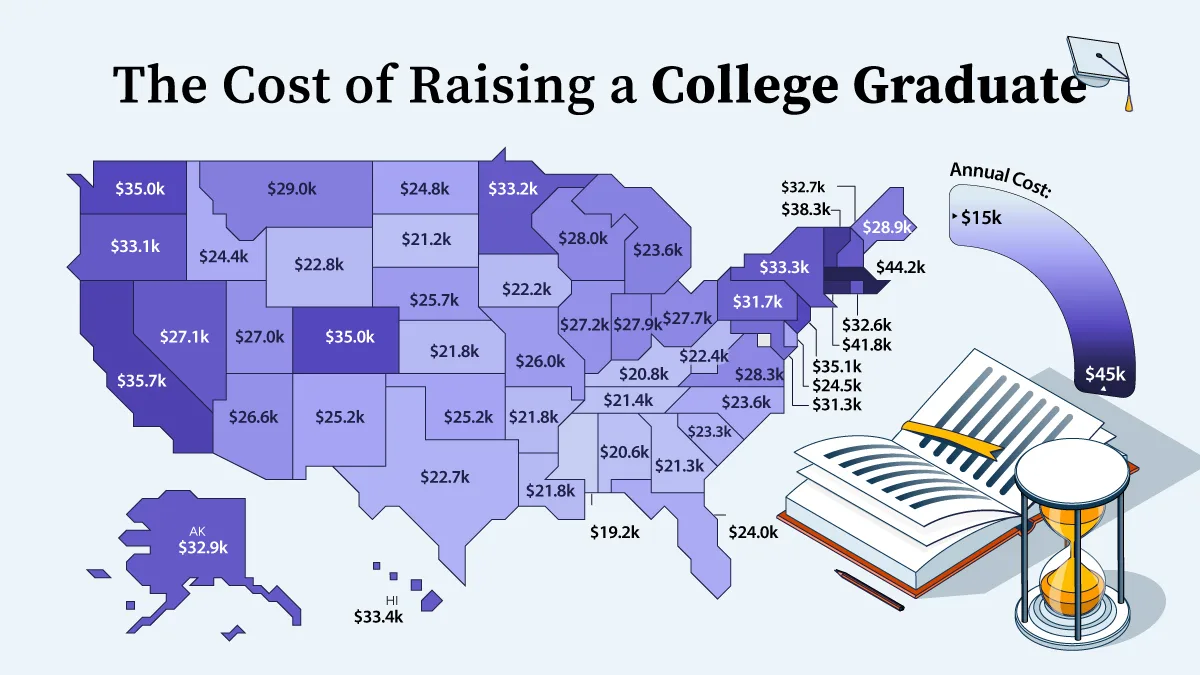
The Cost of Raising a Child by State
The financial journey begins long before college. Families must first navigate years of housing, childcare, food, transportation, healthcare, and other everyday expenses.
Where a family lives can make a dramatic difference. The annual cost of raising a child ranges from roughly $19,000 to $44,000 across the United States. Housing and childcare drive much of this variation.
| Rank | State | Annual Cost ($ thousands) |
|---|---|---|
| 1 | Massachusetts | $44.2 |
| 2 | Connecticut | $41.8 |
| 3 | Vermont | $38.3 |
| 4 | California | $35.7 |
| 5 | New Jersey | $35.1 |
| 6 | Washington | $35.0 |
| 7 | Colorado | $35.0 |
| 8 | Hawaii | $33.4 |
| 9 | New York | $33.3 |
| 10 | Minnesota | $33.2 |
| 11 | Oregon | $33.1 |
| 12 | Alaska | $32.9 |
| 13 | New Hampshire | $32.7 |
| 14 | Rhode Island | $32.6 |
| 15 | Pennsylvania | $31.7 |
| 16 | Maryland | $31.3 |
| 17 | Montana | $29.0 |
| 18 | Maine | $28.9 |
| 19 | Virginia | $28.3 |
| 20 | Wisconsin | $28.0 |
| 21 | Indiana | $27.9 |
| 22 | Ohio | $27.7 |
| 23 | Illinois | $27.2 |
| 24 | Nevada | $27.1 |
| 25 | Utah | $27.0 |
| 26 | Arizona | $26.6 |
| 27 | Missouri | $26.0 |
| 28 | Nebraska | $25.7 |
| 29 | New Mexico | $25.2 |
| 30 | Oklahoma | $25.2 |
| 31 | North Dakota | $24.8 |
| 32 | Delaware | $24.5 |
| 33 | Idaho | $24.4 |
| 34 | Florida | $24.0 |
| 35 | North Carolina | $23.6 |
| 36 | Michigan | $23.6 |
| 37 | South Carolina | $23.3 |
| 38 | Wyoming | $22.8 |
| 39 | Texas | $22.7 |
| 40 | West Virginia | $22.4 |
| 41 | Iowa | $22.2 |
| 42 | Arkansas | $21.8 |
| 43 | Louisiana | $21.8 |
| 44 | Kansas | $21.8 |
| 45 | Tennessee | $21.4 |
| 46 | Georgia | $21.3 |
| 47 | South Dakota | $21.2 |
| 48 | Kentucky | $20.8 |
| 49 | Alabama | $20.6 |
| 50 | Mississippi | $19.2 |
Families may face different costs depending on where they live. However, nearly everyone has one challenge in common: rising college costs relative to wages.
College Costs Are Getting Harder to Cover
College tuition and fees have risen much faster than wages over the past four decades. As a result, families must devote more of their earnings to cover one year of school.
In 1986, one year of tuition and fees at a public four-year college was equivalent to about 11 weeks of median wages. Today, it represents nearly 30 weeks of pay.
| Year | Week’s Worth of Wages to Pay For | ||
|---|---|---|---|
| Public Two-Year | Public Four-Year | Private Nonprofit Four-Year | |
| 1986 | 5.7 | 11.3 | 49.6 |
| 1987 | 6.2 | 12.2 | 51.1 |
| 1988 | 6.7 | 12.7 | 56.4 |
| 1989 | 6.9 | 13.2 | 57.2 |
| 1990 | 7.4 | 14.0 | 60.7 |
| 1991 | 8.5 | 15.6 | 62.5 |
| 1992 | 8.0 | 16.5 | 65.4 |
| 1993 | 8.4 | 17.0 | 65.9 |
| 1994 | 8.8 | 17.9 | 68.9 |
| 1995 | 9.4 | 18.4 | 70.9 |
| 1996 | 9.7 | 18.9 | 73.2 |
| 1997 | 9.8 | 19.4 | 75.4 |
| 1998 | 9.5 | 19.4 | 75.5 |
| 1999 | 9.4 | 19.2 | 75.8 |
| 2000 | 9.5 | 18.9 | 77.1 |
| 2001 | 9.4 | 19.5 | 80.4 |
| 2002 | 9.9 | 20.9 | 82.9 |
| 2003 | 10.7 | 23.0 | 84.6 |
| 2004 | 11.3 | 24.5 | 87.2 |
| 2005 | 11.7 | 25.6 | 90.3 |
| 2006 | 11.8 | 26.1 | 92.9 |
| 2007 | 11.4 | 27.3 | 92.0 |
| 2008 | 11.4 | 28.0 | 94.4 |
| 2009 | 11.8 | 29.2 | 96.4 |
| 2010 | 12.5 | 31.0 | 100.0 |
| 2011 | 13.2 | 32.8 | 102.3 |
| 2012 | 13.8 | 33.6 | 103.7 |
| 2013 | 14.1 | 34.0 | 105.9 |
| 2014 | 14.3 | 34.5 | 107.8 |
| 2015 | 14.4 | 34.7 | 109.1 |
| 2016 | 14.3 | 34.7 | 111.0 |
| 2017 | 14.2 | 34.6 | 112.4 |
| 2018 | 14.2 | 34.4 | 111.8 |
| 2019 | 14.0 | 34.2 | 111.6 |
| 2020 | 13.3 | 32.3 | 106.1 |
| 2021 | 13.3 | 32.4 | 106.6 |
| 2022 | 12.8 | 31.0 | 103.7 |
| 2023 | 12.5 | 30.1 | 104.7 |
| 2024 | 12.2 | 29.6 | 104.2 |
| 2025 | 12.1 | 29.3 | 103.7 |
This growing gap makes it harder to cover college costs using current income alone. It also strengthens the case for starting to save before the first tuition bill arrives.
The Full Cost of College
Tuition tells only part of the story. Total college costs also include housing, food, transportation, books, supplies, and other personal expenses.
For the 2025–26 academic year, the average student budget ranges from $30,990 for an in-state student at a public four-year college to $65,470 at a private nonprofit college. Housing and food alone average nearly $14,000 at public colleges and almost $16,000 at private nonprofit schools.
| Sector | Tuition and Fees | Housing and Food | Books and Supplies | Transportation | Other Expenses | Total Budget |
|---|---|---|---|---|---|---|
| Private Nonprofit Four-Year On-Campus | $45,000 | $15,920 | $1,340 | $1,190 | $2,020 | $65,470 |
| Public Four-Year Out-of-State On-Campus | $31,880 | $13,900 | $1,330 | $1,380 | $2,430 | $50,920 |
| Public Four-Year In-State On-Campus | $11,950 | $13,900 | $1,330 | $1,380 | $2,430 | $30,990 |
At some prestigious colleges—including the University of Chicago, Harvey Mudd College, and Barnard College—tuition and fees alone exceed $75,000 per year.
How Families Save for College Costs
Many families combine several funding sources to prepare for a future education. These include 529 plans, savings accounts, investments, and retirement funds.
Among families using each source, 529 plans hold an average of $9,900. Parents have also saved an average of $5,800 through other savings and investments and $5,400 through retirement accounts. Students contribute too, with an average of $2,900 in savings and another $2,300 in other savings or investments.
| Average College Savings by Source | $ thousands |
|---|---|
| College Savings Plan (529) | 9.9 |
| Parent Savings or Investments (non-529) | 5.8 |
| Parent Retirement Savings | 5.4 |
| Student Savings | 2.9 |
| Other Student Savings or Investments | 2.3 |
Starting early gives families more time to contribute and benefit from potential investment growth.
Planning for Future College Costs
Every family’s path is different. Some begin saving shortly after a child is born. Others start when college is only a few years away.
No matter the timeline, a clear strategy can help families balance college costs with their broader financial goals. A financial advisor can help assess the options, set priorities, and build a plan for what comes next.

Explore more insights from New York Life Investments
-
 Economy1 month ago
Investing Through Financial Distress
Financial stress is rising, but history shows why staying invested through market volatility can help investors reach their long-term goals.
-

 Markets3 months ago
Top 5 Reasons Private Equity Is Drawing Investor Interest in 2026
Private equity is becoming a core allocation for investors seeking long-term growth and diversification beyond public markets.
-

 Investor Education6 months ago
5 Ways Women Are Reshaping Investing
Women investors are redefining the investment landscape, driven by entrepreneurial momentum, expanding wealth, and evolving generational influence.