
Chinese fast fashion company Shein has finally debuted on the Hong Kong stock market, giving investors insight into one of the largest online fashion retailers. However, the fashion giant is facing slower growth, stricter trade rules, and a significant emissions footprint.
Shein began trading on September 1, 2026, under stock code 0625 on the Hong Kong Stock Exchange. The company priced its IPO at HK$48.56 per share, raising about HK$13.6 billion (US$1.7 billion) and valuing the business at roughly US$26.5 billion.
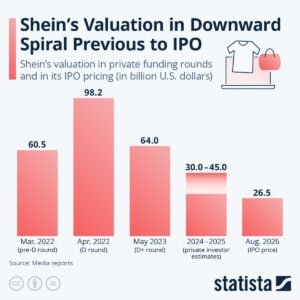
That valuation is far below Shein’s US$98.2 billion private valuation in 2022, a drop of about 73%.
The weaker valuation reflects slower growth and growing pressure on Shein’s business model. At the same time, the company faces another challenge: cutting emissions across a global supply chain that produces most of its carbon footprint.
Shein’s $98 Billion Valuation Comes Crashing Down
Shein’s public debut marks a major reset in how investors value the company.
Private investors valued Shein at US$98.2 billion in April 2022. That fell to about US$64 billion in 2023 and later to roughly US$45 billion to US$55 billion in 2024 and 2025 private transactions.
The Hong Kong IPO values the company at about US$26.5 billion. Shein offered about 280 million Class B shares at HK$48.56 each.
The lower valuation comes as Shein faces weaker growth, rising costs, and changes to low-value import rules in key markets. These factors have put pressure on the fast-fashion model that helped drive its rapid expansion.
Growth Slows as Profits Take a Hit
Shein generated US$41.85 billion in revenue in 2025, up about 8% from 2024. That was much slower than the 20.7% growth recorded in 2024.
Profit also weakened. Net income fell 38.7% to US$2.06 billion in 2025, from US$3.37 billion in 2024.
The slowdown continued in early 2026. First-quarter revenue rose just 1.1% to US$9.05 billion, while Shein reported a US$99 million net loss. A US$328 million fair-value loss linked to convertible preferred shares was a major factor in that loss.
The U.S. market became a particular challenge. Shein’s U.S. revenue fell 14.3% to US$2.04 billion in the first quarter of 2026. The U.S. accounted for 22.5% of quarterly revenue, down from 29.4% of annual revenue in 2023.
However, slower growth does not automatically mean a smaller environmental footprint. Shein still operates at a very large scale, also increasing its carbon footprint.
Shein Sets a 2050 Net-Zero Goal
Shein has set climate targets approved by the Science Based Targets initiative (SBTi). The company aims to reach net-zero greenhouse gas emissions across its value chain by 2050, using 2023 as its base year.
By 2030, Shein plans to:
- Cut absolute Scope 1 and 2 emissions by 42%
- Cut absolute Scope 3 emissions by 25%
- Source 100% of electricity used in directly managed operations from renewable sources
By 2050, Shein aims to cut absolute Scope 1 and 2 emissions by 90% and Scope 3 emissions by 90%, before addressing remaining emissions in line with the SBTi framework.
The targets cover emissions from Shein’s operations as well as its supply chain, including purchased goods, transport, waste and sold products.
The Supply Chain Drives Shein’s Carbon Footprint
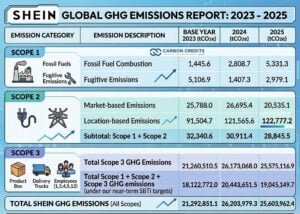
Shein’s biggest climate challenge sits outside its own facilities. The company says purchased goods and services and upstream transportation and distribution accounted for about 96% of emissions covered by its near-term Scope 3 targets in 2025. That includes emissions from producing fabrics and garments and moving products through the supply chain.
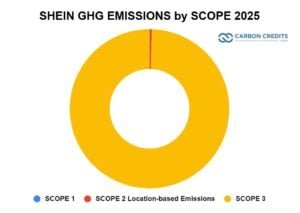
Across all years, from 2023 to 2025, Scope 3 emissions comprise nearly 99.9% of Shein’s entire corporate carbon footprint. This means the vast majority of their climate impact occurs outside their direct operations.
The fashion retailer reported progress in 2025:
- Its measures in purchased goods and services were estimated to avoid 316,842.8 tonnes of CO2e, up 59.2% from 2024.
- Transport-related measures produced estimated avoided emissions of 604,868.0 tonnes of CO2e in 2025, down from 668,800 tonnes in 2024.
These are estimated emissions avoided through specific projects, not a reduction in Shein’s total Scope 3 emissions.
Renewable Electricity Reaches 85%
Shein is also cutting emissions from its own facilities. The company used 275,723.2 MWh of electricity across its globally managed operations in 2025, up 13.3% from 2024.
The share of electricity purchased from renewable sources rose to 85.1%, from 76% in 2024. Shein also expanded its solar capacity to 93.9 MW across 16 facilities by the end of 2025, a 66.8% increase from 2024.
The company consumed 36,909.5 MWh of solar electricity in 2025 and estimated that it avoided 19,576.4 tonnes of CO2e.
Shein also introduced 78 energy-efficiency measures across 22 facilities in China. It estimates those measures saved 33,581 MWh of electricity and cut emissions by 19,934.1 tonnes of CO2e in 2025.
Shein Targets Materials, Packaging and Freight
The company is also targeting emissions tied to its products and logistics. In 2025, 9.2% of polyester directly sourced for Shein-branded products was recycled, up from 6.7% in 2024. Shein estimates this reduced emissions by 48,664.2 tonnes of CO2e.
For packaging, 19.7% of plastic packaging purchased for Shein-branded products contained at least 50% recycled polyethylene, up from 17.0% in 2024. Shein estimates this work avoided 5,647 tonnes of virgin plastic.
The company also shifted some deliveries from air freight to sea freight and trucking and used 125 electric or lower-fuel-consumption vehicles in warehousing and distribution in 2025.
Shein also tested 187.3 tonnes of sustainable aviation fuel across 14 Atlas Air charter flights, which it estimates avoided 579.1 tonnes of CO2e.
Carbon Removals Wait Until the Endgame
Shein’s net-zero strategy does not rely on carbon credits as its main way to meet near-term targets. The company says it plans to reduce emissions deeply across its operations and value chain first. It expects to address remaining emissions through carbon removals as it approaches its 2050 goal.
That approach fits the SBTi net-zero framework, which places deep emissions reductions ahead of neutralizing residual emissions.
For carbon markets, Shein could eventually become a buyer of high-quality carbon removal credits. But its future demand will depend on how much residual emissions remain after it meets its reduction targets.
Public Investors Will Watch Climate Progress
Shein’s IPO brings greater public attention to its environmental performance. The company says its 2025 Scope 1, 2 and 3 inventory received independent verification from Bureau Veritas under ISO 14064-1:2018 and the GHG Protocol.
The fashion giant also says it is working with suppliers on energy efficiency and renewable power and developing a wider decarbonization roadmap. Its scale makes that work significant. Shein served about 273 million active customers across roughly 160 markets in 2025.
The company therefore faces a difficult balance. It must maintain growth while reducing emissions across a supply chain that it does not fully control.
Shein’s IPO Is Also a Climate Test
Shein’s Hong Kong debut has put a public market value on a company whose valuation has fallen sharply from its US$98.2 billion peak in 2022 to about US$26.5 billion.
At the same time, Shein has committed to cut Scope 1 and 2 emissions by 42% and Scope 3 emissions by 25% by 2030, followed by 90% reductions across both categories by 2050.
The biggest challenge will be its supply chain, where most of its emissions occur.
As Shein enters public markets, investors will have more data to assess whether its sustainability efforts keep pace with the scale of its business. The key test will be whether Shein can deliver continued growth while making real, measurable cuts across the supply chain behind its global fast-fashion business.
- READ MORE: France’s New Law to Curb Fast Fashion Carbon Footprint: A Closer Look at SHEIN, Temu, and Inditex
The post Shein Goes Public at $26.5B, a 73% Drop in Valuation as Fashion Giant Faces a Net-Zero Test appeared first on Carbon Credits.


