

Solar PV-based mini-grids are integral to achieving universal electricity access in the West African nations of Burkina Faso, Mali, Nigeria and Senegal, according to a new report by the International Renewable Energy Agency (IRENA).
Titled “Unlocking battery storage potential for sustainable mini-grid electrification in West Africa,” IRENA’s report assesses the potential of solar-storage mini-grids to deliver affordable electricity access in the four nations. It says solar power is best suited to serving more than 98% of all sites identified as suitable for mini-grids, with hydropower serving less than 2% and wind suitable for less than 0.1%.
IRENA’s analysis finds solar PV mini-grids represent a near-term market of 568 MW across the four countries, with a minimum addressable market of about 42,700 settlements, serving around 21 million people.
Nigeria makes up the largest share of this near-term market capacity, at almost 400 MW of PV, followed by Burkina Faso (91.7 MW), Mali (56.3 MW) and Senegal (20.3 MW). To put these figures into wider context, IRENA says Africa’s solar PV mini-grid capacity stood at 149 MW as of last year.
IRENA’s assessment covers multiple electricity supply scenarios based on demand scenarios, referred to in the report as tiers 1-5, grid expansion and mini-grid cost assumptions.
Standalone solar systems play the largest role in low-demand scenarios, the report says, serving 70-122 million people, but minigrids become dominant from tier 3 and above, when standalone PV systems remain only for the most remote and sparsely populated areas.
Mini-grids are expected to be particularly critical in scenarios where grid expansion is constrained by recurring difficulties faced by power utilities. Under restricted grid expansion scenarios, IRENA says mini-grids have the potential to provide electricity access to 60–110 million people. Additional analysis says approximately 397,270 settlements could be served by mini-grids with batteries across the four countries.
Delivering universal supply to tier 2 demand levels by 2030 would require around 2.25 GWh of battery storage across the four countries, IRENA says, consisting of 1.59 MWh in Nigeria, 367 MWh in Burkina Faso, 220 MWh in Mali and 75 MWh in Senegal. The report says the total is equivalent to 815,217 units of a typical lithium iron phosphate technology of 2.76 kWh/51.2 volts on the market.
The report also introduces a “value of storage” metric which is defined as the difference between the total discounted life-cycle cost of a hybrid solar PV-diesel mini-grid with battery storage, and the corresponding cost of an equivalent system without battery storage, where flexibility comes solely from diesel generators.
It says that, using an example of two mini-grid systems, one with batteries and one without, for a typical community of approximately 500 inhabitants, storage offers a discounted lifetime value of approximately $20,000.
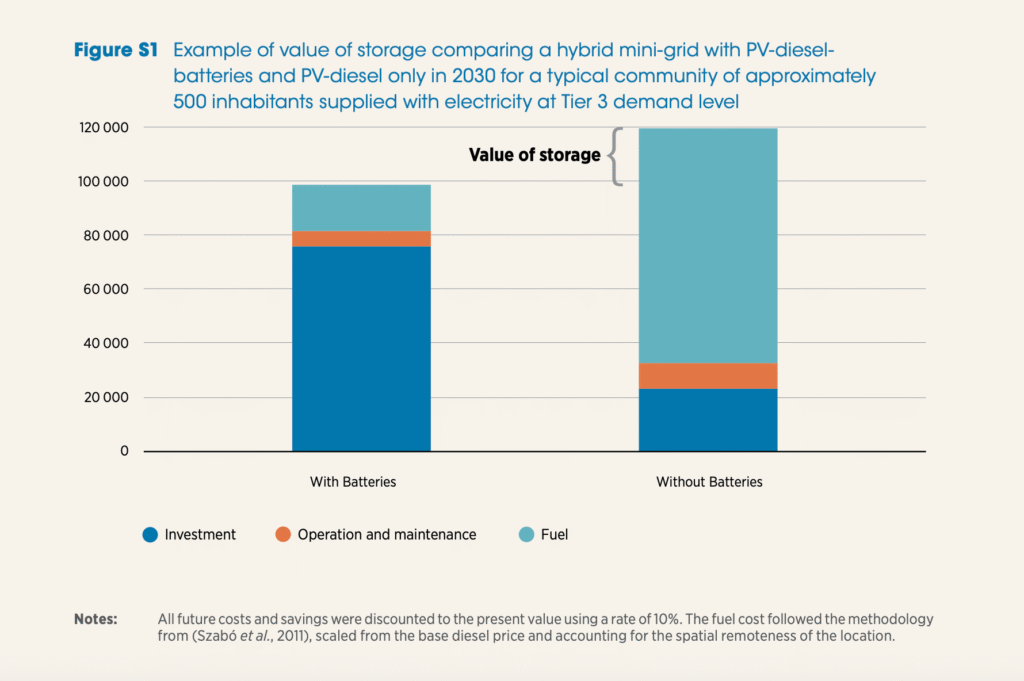
“Although the system with batteries requires a higher upfront investment, these costs are offset by the fuel savings resulting from reduced diesel consumption,” the report explains. “This analysis provides empirical evidence that integrating batteries can lead to cost savings.”
IRENA’s report also emphasises that achieving universal electricity access will require an unprecedented deployment effort that surpasses recent growth rates. It offers a series of policy recommendations based off its findings, including integrating off-grid solutions into national electrification strategies, strengthening geospatial electrification planning and mobilising finance, business model and de-risking mechanisms.
It also recommends the featured countries create an enabling environment for solar mini-grids with batteries through actions including developing technical skills, expanding certification programmes, establishing safety standards and promoting open metering systems as their markets matures. Governments are also urged to pursue local content development policies, tailored to their resource availability, to begin producing products locally.
IRENA adds that the report launches at a critical time amid volatile diesel prices, persistent fossil fuel dependency and an electricity access crisis that constitutes both a development and climate emergency.
“These challenges are particularly acute in landlocked countries, where the overland transport of fuel from coastal ports adds significant cost and supply risk to every kilowatt hour (kWh) of diesel-based electricity,” the report explaines.
“In this context, battery storage can play a strategic role in enhancing energy security, lowering system costs and accelerating the transition away from diesel dependence.”
The post Batteries key to mini-grid electrification in Burkina Faso, Mali, Nigeria, Senegal appeared first on pv magazine Global.


