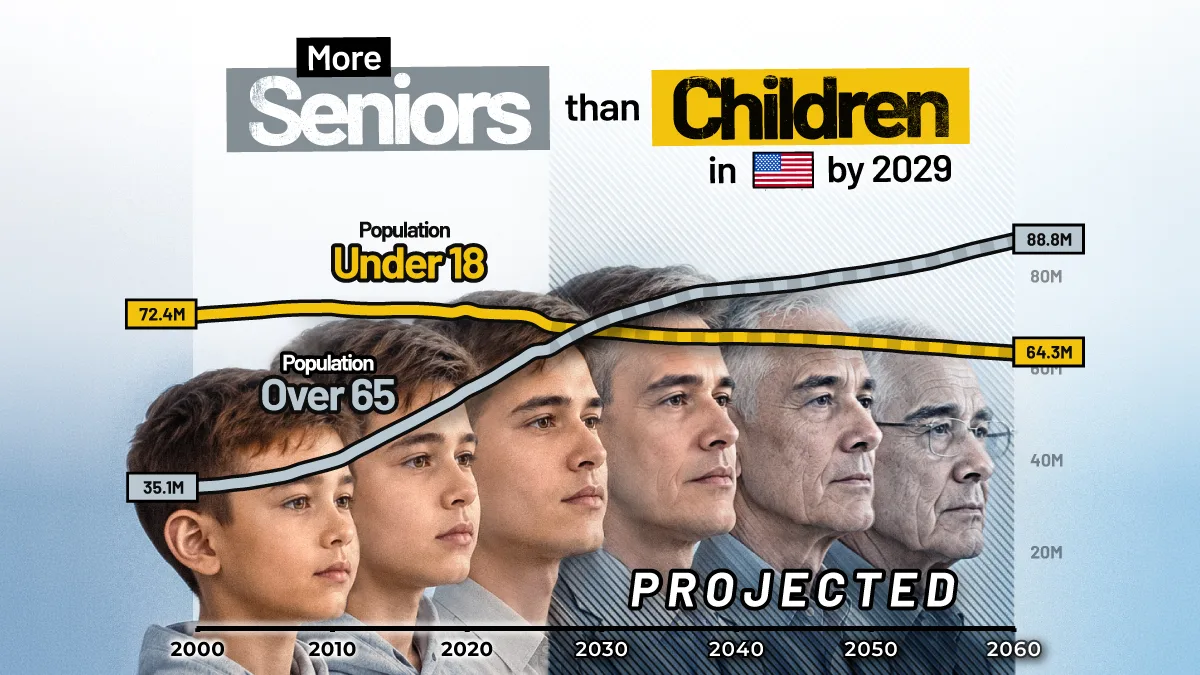
The U.S. Will Have More Seniors Than Children by 2029
Key Takeaways
- Americans age 65 and older are projected to outnumber children under 18 for the first time in 2029.
- Census projections have moved the crossover forward significantly; 2017 projections placed it around 2034.
- Even in different immigration scenarios, the crossover is still projected to occur between 2028 and 2030.
America is approaching a major shift in its age structure.
The aging of the baby boom generation, combined with a long-term slowdown in U.S. births, is rapidly closing the gap between the country’s youngest and oldest age groups.
This visualization shows how dramatically that balance has changed since 2000, when children under 18 outnumbered Americans age 65 and older by more than two to one.
The data for this visualization comes from the U.S. Census Bureau and its 2023 National Population Projections.
The Crossover Arrives in 2029
In 2000, the under-18 population stood at 72.4 million, compared with just 35.1 million people age 65 and older.
| Year | U.S. Population Under 18 (millions) |
U.S. Population Age 65 and Over (millions) |
|---|---|---|
| 2000 | 72.4 | 35.1 |
| 2001 | 72.7 | 35.3 |
| 2002 | 72.9 | 35.5 |
| 2003 | 73.1 | 35.9 |
| 2004 | 73.3 | 36.2 |
| 2005 | 73.5 | 36.7 |
| 2006 | 73.8 | 37.2 |
| 2007 | 74.0 | 37.8 |
| 2008 | 74.1 | 38.8 |
| 2009 | 74.1 | 39.6 |
| 2010 | 74.2 | 40.4 |
| 2011 | 73.9 | 41.4 |
| 2012 | 73.7 | 43.1 |
| 2013 | 73.6 | 44.6 |
| 2014 | 73.6 | 46.2 |
| 2015 | 73.7 | 47.7 |
| 2016 | 73.7 | 49.2 |
| 2017 | 73.6 | 50.8 |
| 2018 | 73.4 | 52.4 |
| 2019 | 73.1 | 54.0 |
| 2020 | 73.7 | 56.0 |
| 2021 | 73.0 | 57.5 |
| 2022 | 72.8 | 59.1 |
| 2023 | 72.7 | 61.0 |
| 2024 | 72.6 | 62.8 |
| 2025 | 72.0 | 64.6 |
| 2026 | 70.4 | 65.1 |
| 2027 | 69.9 | 66.8 |
| 2028 | 69.6 | 68.4 |
| 2029 | 69.3 | 69.9 |
| 2030 | 69.1 | 71.2 |
| 2031 | 68.9 | 72.3 |
| 2032 | 68.6 | 73.2 |
| 2033 | 68.3 | 74.1 |
| 2034 | 68.1 | 74.9 |
| 2035 | 67.9 | 75.8 |
| 2036 | 67.8 | 76.7 |
| 2037 | 67.8 | 77.4 |
| 2038 | 67.7 | 77.7 |
| 2039 | 67.8 | 78.0 |
| 2040 | 67.8 | 78.3 |
| 2041 | 67.7 | 78.5 |
| 2042 | 67.7 | 78.8 |
| 2043 | 67.6 | 79.1 |
| 2044 | 67.5 | 79.4 |
| 2045 | 67.4 | 79.8 |
| 2046 | 67.2 | 80.3 |
| 2047 | 67.1 | 80.8 |
| 2048 | 66.9 | 81.2 |
| 2049 | 66.7 | 81.6 |
| 2050 | 66.5 | 82.1 |
| 2051 | 66.3 | 82.6 |
| 2052 | 66.0 | 83.1 |
| 2053 | 65.8 | 83.7 |
| 2054 | 65.6 | 84.3 |
| 2055 | 65.4 | 85.1 |
| 2056 | 65.1 | 85.9 |
| 2057 | 64.9 | 86.7 |
| 2058 | 64.7 | 87.4 |
| 2059 | 64.5 | 88.1 |
| 2060 | 64.3 | 88.8 |
By 2025, that gap had narrowed sharply, with about 72.0 million children compared with 64.6 million seniors.
The crossover arrives in 2029, when the population age 65 and older is projected to reach 69.9 million, compared with 69.3 million children under 18.
Just one year later, the gap widens to more than 2 million, with 71.2 million seniors versus 69.1 million children.
The Senior Population Is Already Largely Locked In
The near-term rise in America’s senior population is unusually predictable.
Everyone who will turn 65 by 2029 has already been born, and the final members of the baby boom generation, born in 1964, will reach that age in 2029.
As a result, the number of Americans reaching retirement age over the next few years is largely baked into the population. The number of children is less certain, since it is more sensitive to future births and migration.
The Crossover Keeps Moving Closer
The crossover is arriving sooner than previously expected.
Census projections released in 2017 placed the milestone around 2034, five years later than the agency’s 2023 projections.
One major factor behind the shift is the continued decline in U.S. fertility, which has reduced the number of children entering the population.
Immigration can slow the shift, but it does not appear likely to prevent it. Across Census scenarios ranging from zero to high immigration, seniors are still projected to outnumber children between 2028 and 2030.
The long-term gap becomes even more pronounced after the crossover.
By 2040, the senior population is projected to reach 78.3 million, compared with 67.8 million children. By 2060, those figures are projected to reach 88.8 million seniors and 64.3 million children.
That changing age structure could have broad implications for labor markets, healthcare demand, public spending, and the size of the future workforce.
Learn More on the Voronoi App 
If you enjoyed today’s post, check out Mapped: U.S. Population Growth and Decline by 2040 on Voronoi.