Ranked: The Biggest Emissions by Mining Ore
Key Takeaways
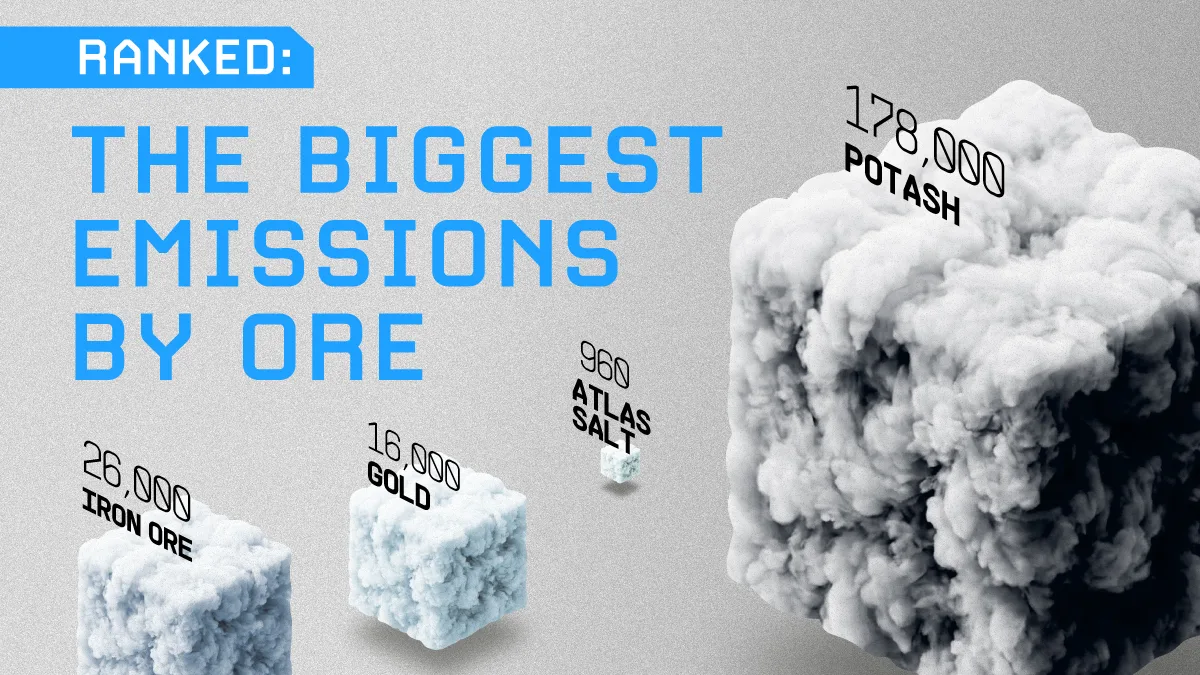
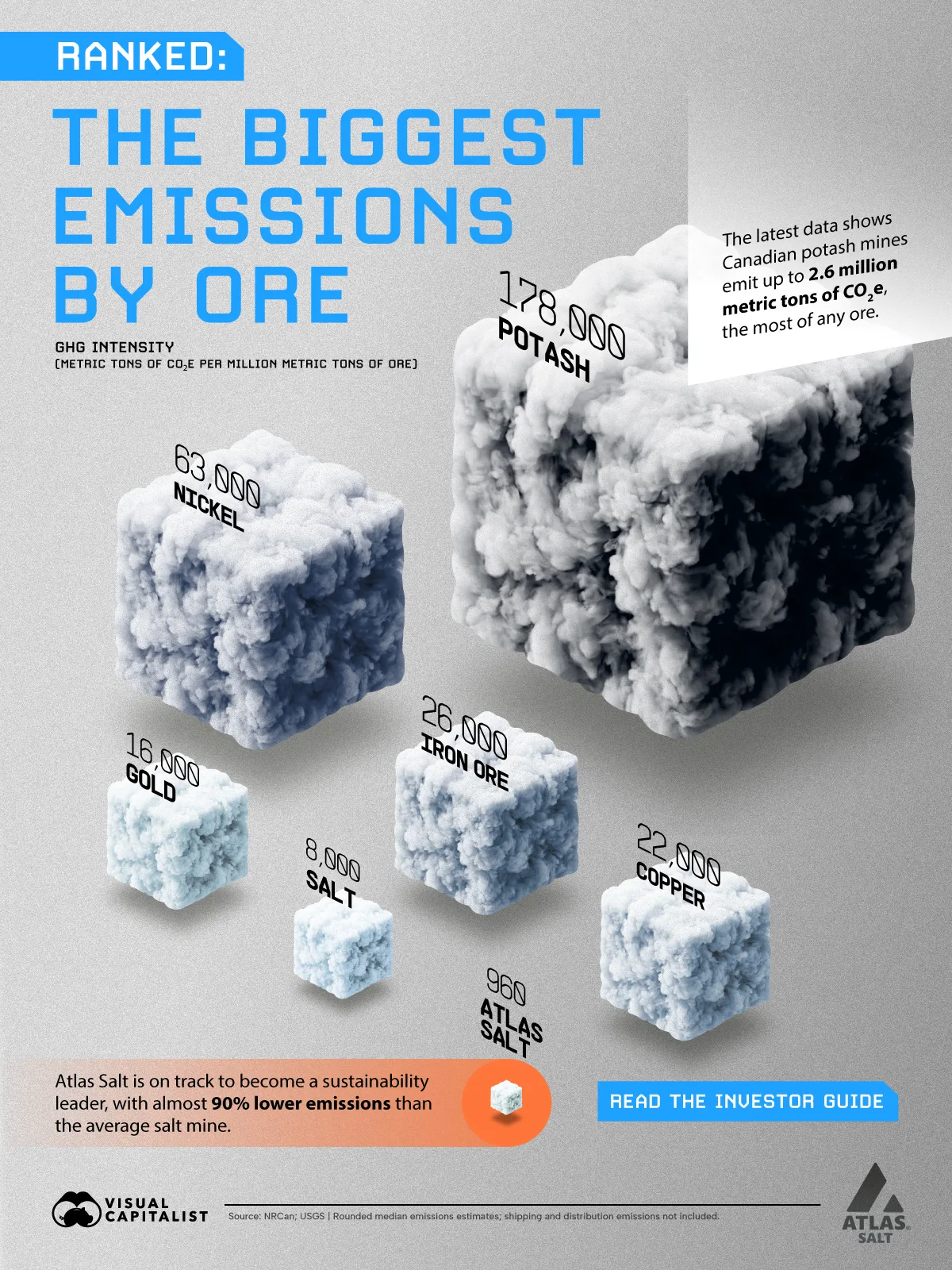
- Potash has the highest emissions intensity in the dataset at 178,000 tCO₂e per million metric tons (Mt) of ore, far above nickel, iron ore, copper, gold, and salt.
- Salt has the lowest emissions intensity of commodities in the dataset at 8,000 tCO₂e per Mt of ore.
Mining is essential for producing the raw materials used across agriculture, industry, energy, and infrastructure. But not all mined commodities carry the same emissions footprint.
This graphic, in partnership with Atlas Salt, ranks the GHG emissions intensity of major mined commodities using data from NRCan and the USGS.
Potash Has the Highest Mining Emissions
Potash is the biggest outlier in the dataset, with an emissions intensity of 178,000 tCO₂e per million metric tons (Mt) of ore. The latest data shows Canadian potash mines can emit up to 2.6 Mt of CO₂e, the most of any mine type.
| Commodity | Mining Emissions Intensity (tCO₂e/Metric ton ore) |
|---|---|
| Potash | 178,000 |
| Nickel | 63,000 |
| Iron Ore | 26,000 |
| Copper | 22,000 |
| Gold | 16,000 |
| Salt | 8,000 |
| Atlas Salt | 960 |
Source: Natural Resources Canada & USGS
Rounded median estimates of emissions from NRCan (2022) and production from USGS; ore tonnage estimated using typical Canadian ore grades to calculate tCO₂e per Mt of ore, includes only end−use energy−related GHG emissions.
Nickel ranks second at 63,000, followed by iron ore at 26,000 and copper at 22,000. These commodities are critical to global supply chains, but their extraction can come with higher emissions intensity.
Salt Sits at the Low End
On the opposite side of the chart is salt. At 8,000 tCO₂e per Mt of ore, average salt mines have one of the lowest emissions intensities among the commodities shown.
Atlas Salt’s newest project, the Great Atlantic Salt Project, is even lower. At 960 tCO₂e per Mt of ore, its estimated emissions intensity is almost 90% below the average salt mine.
This contrast matters because it shows how emissions profiles can vary widely across mining. While many commodities are tied to high-emissions extraction, few offer a lower-impact path to supplying essential materials.
Atlas Salt’s Low-Emissions Opportunity
Atlas Salt is on track to become a low-emissions leader within the salt industry with an estimated emissions intensity well below the broader salt mining average.
As the world looks for reliable sources of essential commodities with lower emissions profiles, Atlas Salt has a strong position. The Great Atlantic Salt project highlights how mine design, location, and operating model can shape the future footprint of resource development.
Read the Investor Guide to learn more about Atlas Salt’s low-emissions opportunity.
-
 Precious Metals2 weeks ago
Ranked: The World’s Largest Gold Producers (2010 vs. 2025)
Largest gold producers ranked from 2010 to 2025, revealing major shifts in global mine output and the growing share of BRICS nations.
-
 Commodities2 weeks ago
Ranked: Countries That Hold the Most Reserves in Gold
The U.S. and Germany have the highest gold shares among the selected economies, at 82% of central bank reserves.
-
 Coal4 weeks ago
Ranked: The World’s Biggest Mineral Fuel Producers
See which countries are the world’s leading mineral producers, and how much higher China’s output is than other nations.
-
 Commodities4 weeks ago
Why Tungsten Prices Soared 622% Since 2025
See which critical mineral prices surged the most in 2026, led by tungsten, tantalum, cobalt, and rare earths.
-
 Uranium1 month ago
Ranked: The World’s Biggest Mineral Producers
See which countries are the world’s leading mineral producers, and how much higher China’s output is than other nations.
-
 Silver2 months ago
The World’s Biggest Gold, Silver, and Platinum Reserves
Explore the countries with the world’s biggest precious metal reserves, including gold, silver, and platinum group metals.