

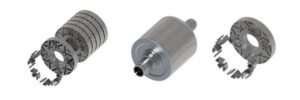
Specialists at Schaeffler's E-Mobility plant in Szombathely, Hungary have developed a process for recovering rare earth magnets from defective electric motor rotors and reusing them in new ones. Seven people in Szombathely and two in Germany worked on the project, which Schaeffler calls "Pioneering Sustainability."
The magnets are pressed out of the defective parts, then cleaned and vacuum packed. They go into new rotors under strict testing, according to the company.
In transfer molding, magnets are set into slots in a rotor's laminated core and locked in place with injected resin, so they cannot simply be lifted out of a rejected part. Schaeffler says the process can also be moved to other permanent-magnet e-motor production sites that use transfer molding.
The magnets come from parts that failed during manufacturing rather than from vehicles at the end of their lives, so the process is a factory scrap loop rather than end-of-life recycling. The technology developed at Szombathely allows the magnets to be recovered and reused safely, the company says.
Schaeffler describes the magnets as extremely expensive and says managing high-value raw materials in production is one of the industry's most pressing challenges. The process requires minimal investment and produces significant cost savings, according to the company, which also credits it with reducing scrap and transport-related CO₂ emissions compared with other processes. The announcement includes no figures for any of them.
"With this project, we not only protect our environment, but also serve the interests of our customers," said Tibor Szigeti, CEO of Schaeffler's Hungarian companies and Managing Director of Schaeffler in Szombathely.
Source: Schaeffler


