
Highly pathogenic avian influenza (H5N1) has affected birds as well as dairy cattle in some regions.
Canadian infectious disease specialist Dr. Samira Mubareka recently described what this means for people who work with animals at an international conference about avian influenza and its human-animal interface, held in partnership with the University of Guelph.
The current virus of concern, known as clade 2.3.4.4b, has caused a small number of human infections, mostly in the United States among people with close contact with poultry or dairy cattle.
WHY IT MATTERS: A major epidemiological concern in any high-path avian flu outbreak has always been the strain’s potential to cross over to people. This H5N1 strain’s leaps from wild birds to poultry, and now to dairy cattle, have ramped up that risk.
However, a few had no clear exposure source, including the only documented case in Canada in which a person was infected but survived after intensive medical care.
Other related H5N1 strains (clade 2.3.2.1c) in Cambodia, Vietnam and Laos have a fatality rate in the 40 to 50 per cent range, said Mubareka.
The Centers for Disease Control and Prevention (CDC) said H5N1 is transmitted by breathing in infected droplets or dust.
However, another route that matters just as much on a farm is through the eyes. H5N1 viruses bind to specific receptors on cells in the respiratory tract and on the surface of the eye — the mucous membrane that covers the front of the eye and lines the inside of the eyelids.
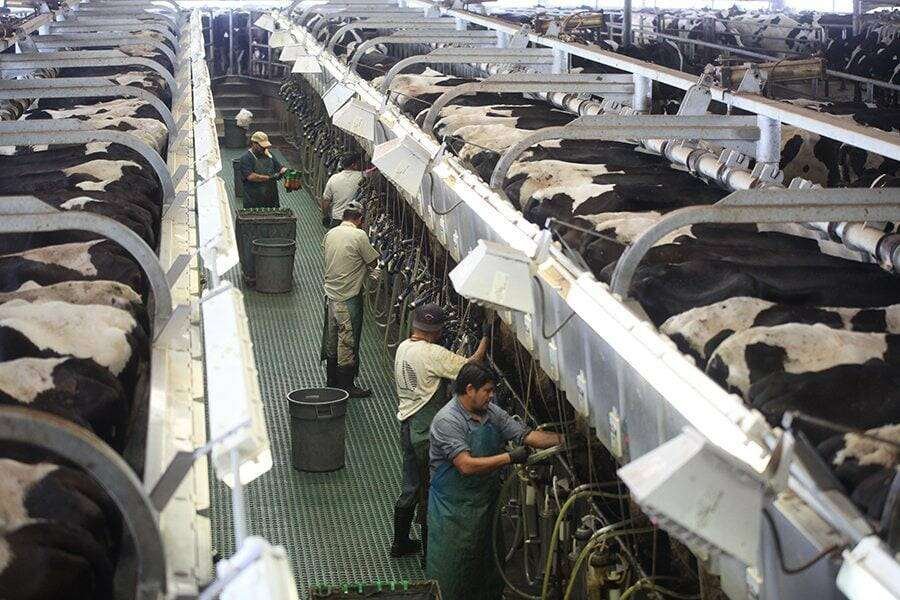
That has direct implications for barn work. Splashes from milk and manure, nasal discharge, respiratory secretions, as well as dust and aerosols that rise when handling bedding, can all reach the eyes and cause infection.
“We shouldn’t discount the importance of ocular exposure and obviously (personal protective equipment) that also mitigates infection by the ocular route,” said Mubareka.
For workers, that means wearing goggles, a well-fitting mask or face shield and coveralls as basic protective gear, especially when working with sick animals, known H5N1 herds or flocks, or undertaking high‑risk procedures such as power-washing, vaccinating, milking, or handling bedding and carcasses.
Workers should wash their hands after animal contact and before touching face or eyes, and they should not eat, drink or smoke in animal areas.
Eye infections a common symptom
A challenge with the H5N1 viruses is that many infected workers don’t appear too sick, Mubareka added. Half or fewer people exposed to infected poultry or dairy cattle had a fever, but eye infections were common.
“They do certainly present with conjunctivitis, that’s a fairly common clinical presentation, but really not necessarily seeing individuals who are developing respiratory distress and failures,” she said.
Eye infections can be easy to ignore because red, irritated or weeping eyes after a long shift in the barn might easily be blamed on allergies, dust, chemical splashes, or fatigue. In the context of H5N1 on farms, that problem could be a sign of infection.
READ MORE: What it’s like dealing with avian influenza on a dairy farm
If eye problems, fever, or breathing issues develop after working with poultry or dairy cattle, workers should quickly seek medical care. The clinic should be told that the individual works with poultry or dairy cattle and may have been exposed to H5N1, according to the CDC.
Routine diagnosis still relies on polymerase chain reaction testing of respiratory samples, similar to seasonal influenza. However, Mubareka said swabs seem to have better diagnostic results in cases where conjunctivitis predominates.
“We don’t really know what the ideal sample type is for diagnosis, and maybe it is the conjunctival swab. That’s not something that we usually do, but we should consider,” she said.
Treat suspected cases early
Treatment with oral Tamiflu works best when given as soon as infection is suspected, not after waiting days for lab results. Other drugs such as inhaled Zanamivir can be used as backup if resistance is suspected, the doctor said.
“We initiate therapy for query cases immediately, just because of the possibility if we wait for the results, you might actually lose your window of opportunity,” she said.
Mubareka said better surveillance, genetic monitoring of the virus, and a stronger One Health approach that links human, animal, and the environment are important for managing patients and staying ahead of these infections.
“We really don’t incorporate a One Health perspective in this regard. So, I think this is something that I’m hoping will change in the coming years,” she said.
The post Farms can take steps to protect people against avian flu appeared first on Farmtario.


