
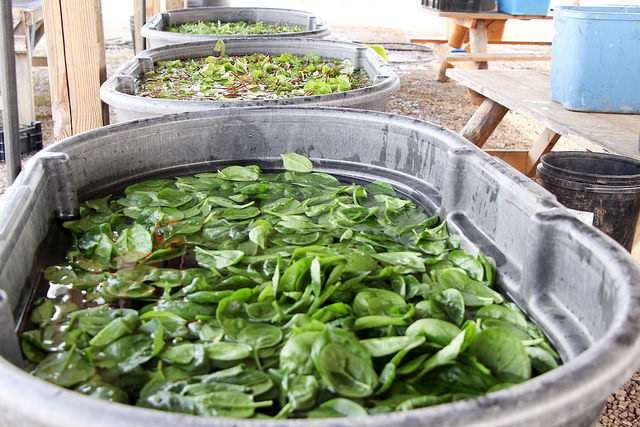
As the old saying goes, one bad apple can rot the whole bunch. In 2026, a more appropriate twist is that a bad batch of lettuce can lead to entire harvests being lost, not to mention the public health impacts. The recent Cyclospora outbreak, produced by a confluence of international and domestic policy and business decisions, has drastically impacted much of the US domestic produce market. From July 18 to August 8, US sales of iceberg lettuce fell 25.4%, and prepacked salads dipped 34.2%. Rather than impacting lettuce alone, the sales of a variety of vegetables and specialty crops have also dropped.
A driving factor in the significant drop in produce sales can be attributed to the murky nature of this specific recall. The Food and Drug Administration (FDA) – the government agency responsible for produce food safety – initially named Taylor Farms in its recall request, but then retracted this statement. This back and forth is due, in part, to the complicated nature of traceback and attribution science. Yet amidst the backdrop of significant staff shortages at FDA and the US Department of Agriculture (USDA), it is entirely fair to question the extent to which government decisions have played a role in the Cyclospora outbreak.
As consumers dart through grocery store aisles, they rarely have the time or the information needed to consider complex international food safety protocols, administrative and funding changes, changing climatic conditions, and convoluted supply chains that shape food safety.
All of these factors have led to the conditions that produced this most recent outbreak.
Thankfully, the policy solutions necessary to foster strong food safety in the US aren’t secret: we need to reinvest in the nation’s capacity to prevent and recall contaminated food in the broader food system, while also supporting a higher proportion of diversified farms that sell into local markets. All of this will systemically help reduce the spread of pathogens of human concern.
This blog post explores the root causes of the current food safety outbreak and the corrective actions that can be taken across farm scales to reduce the future likelihood of food safety outbreaks, such as Cyclospora.
Food Safety Funding Context
In the last few years, much of the already understaffed federal food safety system has been hit with further punches. These punches have impacted a produce and meat food safety apparatus that was already dangerously embattled. For years, FDA has fallen short of its goals for international food safety inspections, and it has failed to fully leverage its food safety partnership with Mexico’s regulatory authorities, leading to the increased likelihood of harmful outbreaks.
For years, domestic produce associations have often called for greater parity between international and domestic inspection. Some members of the industry have occasionally claimed that international produce growers and food manufacturers may be able to outcompete on price due to having lower regulatory need for food safety investment, and greater assistance by their governments.
In the U.S., while some local food safety funding does exist, such as the Local Food Safety Collaborative hosted at the National Farmers Union or the Food Safety Outreach Program, it is a relatively small amount and moreover has also remained flat in recent years.
Cyclospora and Climate
Amidst the backdrop of an undermined food safety apparatus, changing environmental conditions can allow new outbreaks to occur.
Cyclospora is a protozoan parasite, often spread through feces from humans. It reproduces better in hotter temperatures and in longer warm seasons. Decisions decades in the making, such as the location, or absence, of human sewage facilities, along with the effects of a warming climate, may have contributed to the conditions that facilitate the wider spread of Cyclospora.
However, there are opportunities to reduce risk at multiple scales, some of which can mitigate the effects of climate change and help address threats it poses.
Local and Diversified Food Safety – Lower Risk
A food safety hazard is any biological, chemical, or physical agent that has the potential to cause illness, injury, or adverse health effects when the food is consumed, as defined in Food Safety Modernization Act-derived policy and enforced by the FDA. Especially with biological agents that reproduce given favorable conditions, there is really no such thing as a zero-risk food safety system. Rather, there is only a system in which risks have been appropriately mitigated to feasible levels. Therefore, food safety is the reduction of hazards to the extent possible through risk assessments conducted at the farm, facility, and industry levels.
It has become accepted among scholars in the field that a zero-risk approach is not attainable. A zero-risk approach often produces undesired outcomes and can contradict other desired outcomes within a food system, such as mitigation of food waste and loss.
While the definition of risk is not based on a rule, and hence law, in the same way as hazard, it is commonly understood and applied by nonbinding guidance that FDA has produced. There, risk is described as “the combination of the probability of occurrence of harm and the severity of that harm”. So, due to the shorter, lower consumer-to-producer nature and shorter geographic distance, they have inherent traceability characteristics that reduce risk. Specifically, the shortened supply chain allows for fewer sites of contamination, and their smaller volumes reduce the latter part of the definition of risk.
The National Sustainable Agriculture Coalition (NSAC) and its many member groups have historically advocated for the food safety apparatus to reflect the safety benefits of local food systems, based on evidence to this point, even before the formation of the Food Safety Modernization Act.
Harm at Scale
Larger dynamics in the agricultural industry, including but not limited to access to crop insurance and credit, as well as automation that favor large specialty crop producers, have been contributing factors toward an industry that is highly concentrated. As an example, Taylor Farms – the business that was initially linked to the 2026 Cyclospora outbreak – supplies between 11% and 40% of various individual produce categories in the US. While there is little evidence to suggest there are major differences in the application of food safety practices across the scale of farms, this means that any hazard that makes it through different risk assessments and control point interventions reaches a much larger consumer base, and hence has a higher overall risk.
Funding and Policy Solutions
While we do not know the true source of the recent Cyclospora contamination at this moment, there are a variety of proven ways to reduce risk, including by supporting local food systems. Investing in education across scales, as well as restoring the ability to track potential spreads of pathogens, remain some of NSAC’s key priorities under this Administration.
Local Food Safety Education – Practical Produce Safety for Farmers
The key to supporting inherently lower-risk local food systems is to help ensure that the other side of the equation is addressed: the probability of occurrence of harm. Small and diversified farmers need food safety knowledge that utilizes best practices in adult education, recognizes structural differences in their farms, and showcases conservation co-management practices.
Some of these efforts can be supported through continued funding for the Food Safety Outreach Program in future appropriation cycles. This funding can also be best deployed when the program operates on a consistent basis, not under a rushed 30-day application window as happened this year. Other interventions may require funding from other sources, such as supporting a new curriculum – the Practical Produce Safety for Farmers curricula, which will be released in the coming year.
Federal and Scientific Investments
While supporting local food systems is a key component of supporting food safety in the US, restoration of previous food safety monitoring capacity is a large part of it as well. The following actions below should be taken to enhance food safety monitoring and oversight:
- Congressional oversight of the FDA to ensure it meets its international obligations
- Increased surveillance testing funding, and funding to coordinate across the 30 agencies covering food safety in the US
- Increased funding for the state FDA-State Produce Safety Implementation Cooperative Agreement Program, specifically Objective 3 Education and Assistance
- This program ensures states have the capacity to provide education to local farms as well
Moving food safety forward for consumers, farmers, and other stakeholders will require investment across scales and industries, but specifically because of capital constraints for smaller operators, it must include adequate and dedicated federal funding for smaller operators.
The post Cyclospora, Climate, and Solutions to Strengthen Food Safety appeared first on National Sustainable Agriculture Coalition.


