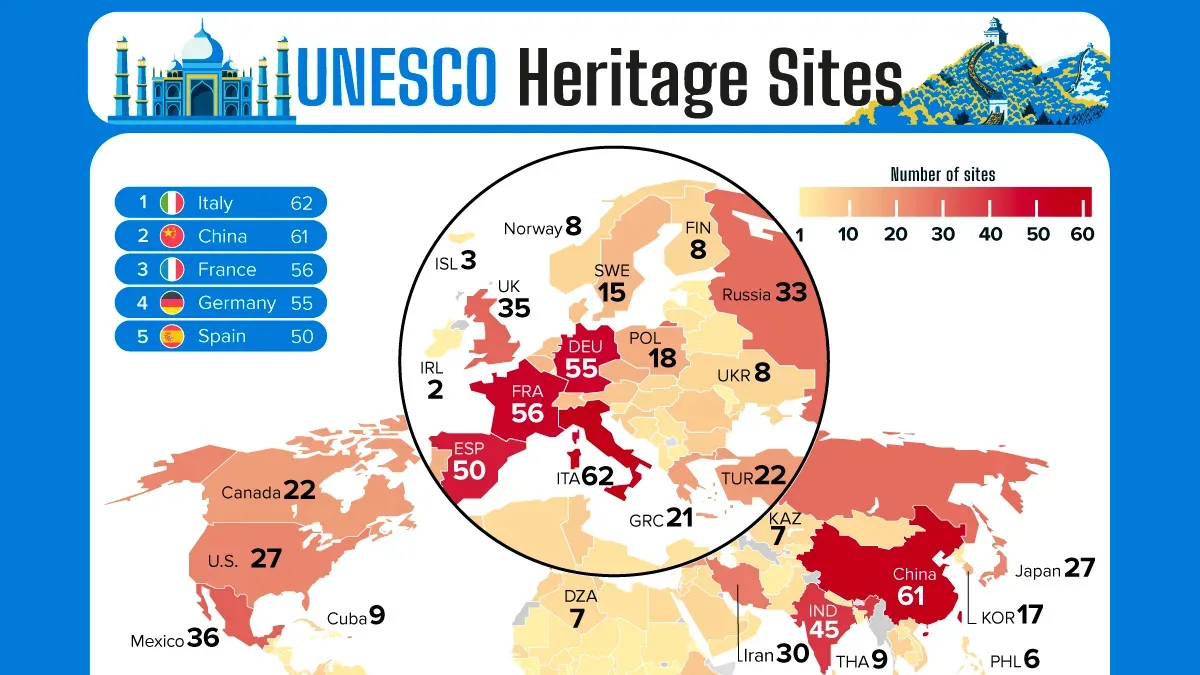
Where Are the World’s UNESCO Heritage Sites?
Key Takeaways:
- Italy leads the world with 62 UNESCO World Heritage Sites, narrowly ahead of China with 61.
- Four European countries rank among the global top five: Italy, France, Germany, and Spain.
- India ranks sixth globally with 45 UNESCO World Heritage Sites, nine more than Mexico (36), the next-highest country outside Europe and East Asia.
From ancient cities and archaeological ruins to forests, mountains, and unique ecosystems, the UNESCO World Heritage List identifies places considered to have outstanding universal value to humanity.
This visualization ranks countries by their number of UNESCO World Heritage Sites in 2026. Transboundary properties are counted for each participating country.
Number of UNESCO Heritage Sites, by Country
The following table shows the number of UNESCO World Heritage Sites by country.
| Country | Number of Heritage Sites |
|---|---|
 Italy Italy |
62 |
 China China |
61 |
 France France |
56 |
 Germany Germany |
55 |
 Spain Spain |
50 |
 India India |
45 |
 Mexico Mexico |
36 |
 United Kingdom United Kingdom |
35 |
 Russia Russia |
33 |
 Iran Iran |
30 |
 Japan Japan |
27 |
 United States United States |
27 |
 Brazil Brazil |
26 |
 Canada Canada |
22 |
 Turkey Turkey |
22 |
 Australia Australia |
21 |
 Greece Greece |
21 |
 Poland Poland |
18 |
 Czechia Czechia |
17 |
 Portugal Portugal |
17 |
 South Korea South Korea |
17 |
 Belgium Belgium |
16 |
 Sweden Sweden |
15 |
 Denmark Denmark |
13 |
 Netherlands Netherlands |
13 |
 Peru Peru |
13 |
 Switzerland Switzerland |
13 |
 Argentina Argentina |
12 |
 Austria Austria |
12 |
 Ethiopia Ethiopia |
12 |
 South Africa South Africa |
12 |
 Romania Romania |
11 |
 Bulgaria Bulgaria |
10 |
 Croatia Croatia |
10 |
 Indonesia Indonesia |
10 |
 Tunisia Tunisia |
10 |
 Colombia Colombia |
9 |
 Cuba Cuba |
9 |
 Israel Israel |
9 |
 Morocco Morocco |
9 |
 Thailand Thailand |
9 |
 Vietnam Vietnam |
9 |
 Finland Finland |
8 |
 Hungary Hungary |
8 |
 Jordan Jordan |
8 |
 Kenya Kenya |
8 |
 Norway Norway |
8 |
 Saudi Arabia Saudi Arabia |
8 |
 Slovakia Slovakia |
8 |
 Sri Lanka Sri Lanka |
8 |
 Ukraine Ukraine |
8 |
 Uzbekistan Uzbekistan |
8 |
 Algeria Algeria |
7 |
 Bolivia Bolivia |
7 |
 Chile Chile |
7 |
 Egypt Egypt |
7 |
 Kazakhstan Kazakhstan |
7 |
 Lebanon Lebanon |
7 |
 Mongolia Mongolia |
7 |
 Senegal Senegal |
7 |
 Tanzania Tanzania |
7 |
 Iraq Iraq |
6 |
 Malaysia Malaysia |
6 |
 Pakistan Pakistan |
6 |
 Palestine Palestine |
6 |
 Philippines Philippines |
6 |
 Syria Syria |
6 |
 Azerbaijan Azerbaijan |
5 |
 Bosnia and Herzegovina Bosnia and Herzegovina |
5 |
 Cambodia Cambodia |
5 |
 Cote d’Ivoire Cote d’Ivoire |
5 |
 Democratic Republic of the Congo Democratic Republic of the Congo |
5 |
 Ecuador Ecuador |
5 |
 Libya Libya |
5 |
 Lithuania Lithuania |
5 |
 Oman Oman |
5 |
 Panama Panama |
5 |
 Serbia Serbia |
5 |
 Slovenia Slovenia |
5 |
 Tajikistan Tajikistan |
5 |
 Turkmenistan Turkmenistan |
5 |
 Yemen Yemen |
5 |
 Zimbabwe Zimbabwe |
5 |
 Albania Albania |
4 |
 Belarus Belarus |
4 |
 Burkina Faso Burkina Faso |
4 |
 Costa Rica Costa Rica |
4 |
 Georgia Georgia |
4 |
 Guatemala Guatemala |
4 |
 Laos Laos |
4 |
 Mali Mali |
4 |
 Montenegro Montenegro |
4 |
 Nepal Nepal |
4 |
 Armenia Armenia |
3 |
 Bahrain Bahrain |
3 |
 Bangladesh Bangladesh |
3 |
 Benin Benin |
3 |
 Cameroon Cameroon |
3 |
 Cyprus Cyprus |
3 |
 Iceland Iceland |
3 |
 Kyrgyzstan Kyrgyzstan |
3 |
 Latvia Latvia |
3 |
 Madagascar Madagascar |
3 |
 Malawi Malawi |
3 |
 Malta Malta |
3 |
 New Zealand New Zealand |
3 |
 Niger Niger |
3 |
 North Korea North Korea |
3 |
 Sudan Sudan |
3 |
 Suriname Suriname |
3 |
 Uganda Uganda |
3 |
 United Arab Emirates United Arab Emirates |
3 |
 Uruguay Uruguay |
3 |
 Venezuela Venezuela |
3 |
 Afghanistan Afghanistan |
2 |
 Botswana Botswana |
2 |
 Central African Republic Central African Republic |
2 |
 Chad Chad |
2 |
 Estonia Estonia |
2 |
 Gabon Gabon |
2 |
 Gambia Gambia |
2 |
 Ghana Ghana |
2 |
 Honduras Honduras |
2 |
 Ireland Ireland |
2 |
 Jamaica Jamaica |
2 |
 Mauritania Mauritania |
2 |
 Mauritius Mauritius |
2 |
 Mozambique Mozambique |
2 |
 Myanmar Myanmar |
2 |
 Namibia Namibia |
2 |
 Nicaragua Nicaragua |
2 |
 Nigeria Nigeria |
2 |
 North Macedonia North Macedonia |
2 |
 Republic of the Congo Republic of the Congo |
2 |
 Rwanda Rwanda |
2 |
 Seychelles Seychelles |
2 |
 Vatican City Vatican City |
2 |
 Andorra Andorra |
1 |
 Angola Angola |
1 |
 Antigua and Barbuda Antigua and Barbuda |
1 |
 Barbados Barbados |
1 |
 Belize Belize |
1 |
 Cabo Verde Cabo Verde |
1 |
 Comoros Comoros |
1 |
 Dominica Dominica |
1 |
 Dominican Republic Dominican Republic |
1 |
 El Salvador El Salvador |
1 |
 Eritrea Eritrea |
1 |
 Fiji Fiji |
1 |
 Guinea Guinea |
1 |
 Guinea-Bissau Guinea-Bissau |
1 |
 Haiti Haiti |
1 |
 Kiribati Kiribati |
1 |
 Lesotho Lesotho |
1 |
 Luxembourg Luxembourg |
1 |
 Marshall Islands Marshall Islands |
1 |
 Micronesia Micronesia |
1 |
 Moldova Moldova |
1 |
 Palau Palau |
1 |
 Papua New Guinea Papua New Guinea |
1 |
 Paraguay Paraguay |
1 |
 Qatar Qatar |
1 |
 Saint Kitts and Nevis Saint Kitts and Nevis |
1 |
 Saint Lucia Saint Lucia |
1 |
 San Marino San Marino |
1 |
 Sao Tome and Principe Sao Tome and Principe |
1 |
 Sierra Leone Sierra Leone |
1 |
 Singapore Singapore |
1 |
 Solomon Islands Solomon Islands |
1 |
 South Sudan South Sudan |
1 |
 Togo Togo |
1 |
 Vanuatu Vanuatu |
1 |
 Zambia Zambia |
1 |
Beyond the two leaders, France (56), Germany (55), and Spain (50) round out the top five. India follows in sixth with 45 sites.
Why Do Europe and Asia Dominate the List?
Italy’s position reflects an unusually dense concentration of cultural heritage spanning Roman antiquity, medieval cities, and Renaissance art and architecture. Its list also includes natural properties and cultural landscapes, showing that UNESCO recognition extends well beyond famous monuments.
China’s 61 sites similarly span thousands of years of history alongside major natural landscapes. Along with imperial and religious heritage and archaeological sites, its properties include biodiversity hotspots, karst formations, and mountain regions.
More broadly, Europe and Asia together account for over 70% of the sites shown on the map. UNESCO requires a property to demonstrate “outstanding universal value” and satisfy at least one of 10 selection criteria, ranging from masterpieces of human creative genius to exceptional habitats for biodiversity.
What Makes a World Heritage Site?
UNESCO divides World Heritage properties into cultural, natural, and mixed sites. Cultural heritage can include monuments, archaeological sites, and landscapes shaped by people, while natural heritage encompasses exceptional geological formations, ecosystems, habitats, and areas of remarkable natural beauty.
Mixed sites qualify for both cultural and natural heritage, such as Machu Picchu. Countries nominate sites for consideration, but inscription is ultimately decided by the World Heritage Committee following evaluations by international advisory bodies.
What Happens When Heritage Is in Danger?
World Heritage status does not guarantee a site’s survival. Conflict, disasters, and development can threaten the qualities that made a property globally significant.
In 2026, UNESCO added six sites to its List of World Heritage in Danger, including three nominated through an emergency procedure. Placement on the danger list can unlock technical and financial assistance and strengthen international conservation support.
Protecting these places is about more than maintaining a tourism destination or historical landmark. Conservation helps ensure that future generations can experience physical evidence of human history and the natural systems that form part of humanity’s shared heritage.
Learn More on the Voronoi App
See The Best Countries For Culture & Heritage, As Determined by the People to explore which countries rank highest for their cultural influence and heritage.