

Britain’s butterflies enjoyed one of their strongest summers on record, but conservationists are warning that the effects of extreme heat and drought could lead to a population crash next year.
Results from Butterfly Conservation’s 2026 Big Butterfly Count show the second-best summer in the 16-year history of the survey, with 101,565 people recording almost 1.4 million butterflies and moths across the UK.
However, the charity says the figures may not tell the full story. While hot, sunny weather created ideal conditions for adult butterflies to fly, feed and breed, drought may have severely affected caterpillars and the plants they rely on for food.
The Met Office has said it is increasingly likely that 2026 will be the hottest summer on record. In August, the National Drought Group declared more than 70% of England to be officially in drought, while almost all of the UK experienced drier-than-usual conditions.
Professor Richard Fox, Head of Science at Butterfly Conservation, said: ‘This has been one of the hottest, driest summers on record, and the figures certainly suggest that was good news for many of the widespread butterfly species monitored by the Count.
‘Adult butterflies love hot, sunny weather for flying, feeding and breeding, and that’s exactly why people saw so many this summer. But a good summer for adult butterflies is not the same as a good summer for butterfly populations.
‘What matters far more is what’s happening on the ground, to the butterflies’ caterpillar offspring and the plants they depend on. The very same weather that made it a good year for butterflies – lots of sunshine and very little rain – could mean we’re actually on course for a population crash, which could take years to recover from.’
As such, Butterfly Conservation fears the effects of this year’s weather could become more apparent next summer, as plants withered or died before caterpillars had finished feeding.
Fox warned that previous extreme droughts, including those in 1976 and 1995, had severe effects on butterfly populations, with some species never fully recovering. He added that 80% of the UK’s butterflies have declined since the 1970s.
The charity is urging people to take steps to help butterflies through future dry weather: plant trees and shrubs such as holly, ivy and buckthorn; install water butts to collect rainwater; and leave areas of grass uncut.
Longer grass develops deeper roots, stays greener during drought and provides food and shelter for caterpillars and adult butterflies. Butterfly Conservation research found gardens with patches of long grass had up to 93% more butterflies and a greater variety of species.
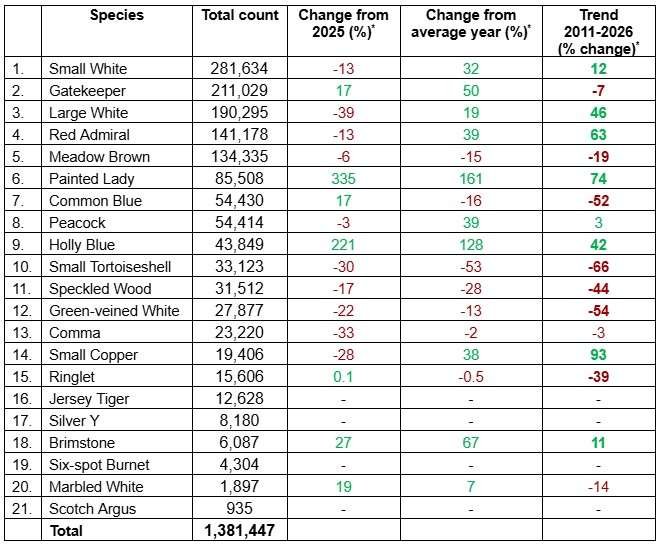
Among the winners in this year’s Big Butterfly Count were Holly Blue and Gatekeeper, which both recorded their best Big Butterfly Count results, while Small Copper had its third-best year. Painted Lady numbers were also 335% higher than in 2025, in what has been described as a ‘Painted Lady summer’.
Small White topped the national count with 281,634 sightings, followed by Gatekeeper, Large White, Red Admiral and Meadow Brown.
But other species struggled. This was the second-worst year for Small Tortoiseshell, whose abundance has fallen by 66% since the count began. Speckled Wood, Green-veined White and Ringlet, all considered sensitive to drought, were also recorded below average and have declined by 44%, 54% and 39% respectively since 2011.
The Big Butterfly Count will return in 2027, when the results could provide a clearer picture of the impact of this summer’s extreme weather.
Photo: Bob Eade, Butterfly Conservation


