

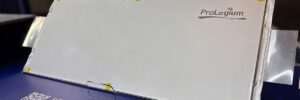
ProLogium Technology has begun mass production of its Gen 3.5 Lithium Ceramic Battery (LCB) at the company’s plant in Taiwan.
According to a recent third-party TÜV test, the 185.4 Ah large-format cell delivers 381 Wh/kg specific energy and 903 Wh/L energy density.
UL Solutions tested the cell under China’s GB/T 43568-2026 methodology. After six hours under vacuum at 120° C the cell recorded weight loss of less than 0.05%, below the 0.5% maximum the standard sets for all-solid-state classification.

The cell is built on ProLogium’s Logithium architecture, which pairs a ceramic separator with an edge-frame structure that adds a second separator around the electrode perimeter to help isolate potential burrs while providing sealing and insulation. ProLogium completed the design and patent work for the architecture in 2012 and has kept it in place through four generations of cell technology and three generations of manufacturing process.
Commercial production began in 2013 on a sheet-by-sheet line aimed at niche markets including consumer electronics, wearables, explosion-resistant applications, medical devices and semiconductor equipment. A roll-to-roll line followed in 2017, and the third-generation Giga-level platform entered operation in 2024. ProLogium says it obtained IATF 16949 automotive quality-management certification for its production line in 2022 and has passed the annual surveillance audits since.
ProLogium’s cells are supplied to a US automotive audio-system company and installed in vehicles from a Japanese automaker. ProLogium estimates deliveries to the audio-system company at more than 900,000 cells across over 175 repeat orders, and says the unmanned systems market has brought orders as well, for applications in which payload, endurance and recharge time matter.
Gen 4 LCB uses a fully inorganic superfluidized electrolyte system, a change ProLogium outlined in 2025, while keeping the same Logithium architecture and manufacturing process. About 10% of the existing Giga-level line and related equipment would need modification to build Gen 4 cells, by the company’s estimate. The generation adds an Active Safety Mechanism (ASM) designed to prevent thermal runaway by stabilizing electrode active materials at high temperature, and the company expects Gen 4 to improve low-temperature performance and reduce material and manufacturing costs. Its intended applications, according to ProLogium, are electric vehicles, maritime and aerospace.
ProLogium plans to build a global manufacturing network built in three regions: Taiwan as its technology-development and manufacturing-validation base, France for scaled production and North America for localized supply and manufacturing capacity. In the first phase of its North American plan, the company says it will evaluate partnerships under which Inlays, the single-layer unit that forms an LCB cell, would be produced at scale in France and shipped to North America, where partners would stack them into pouch cells and handle module and pack integration closer to end customers. It would consider adding Inlay production capacity in the United States at a later stage.
Source: ProLogium


