So, Where Does America Get Its Potash?
Key Takeaways
- Potash supplies potassium, an essential nutrient for growing crops.
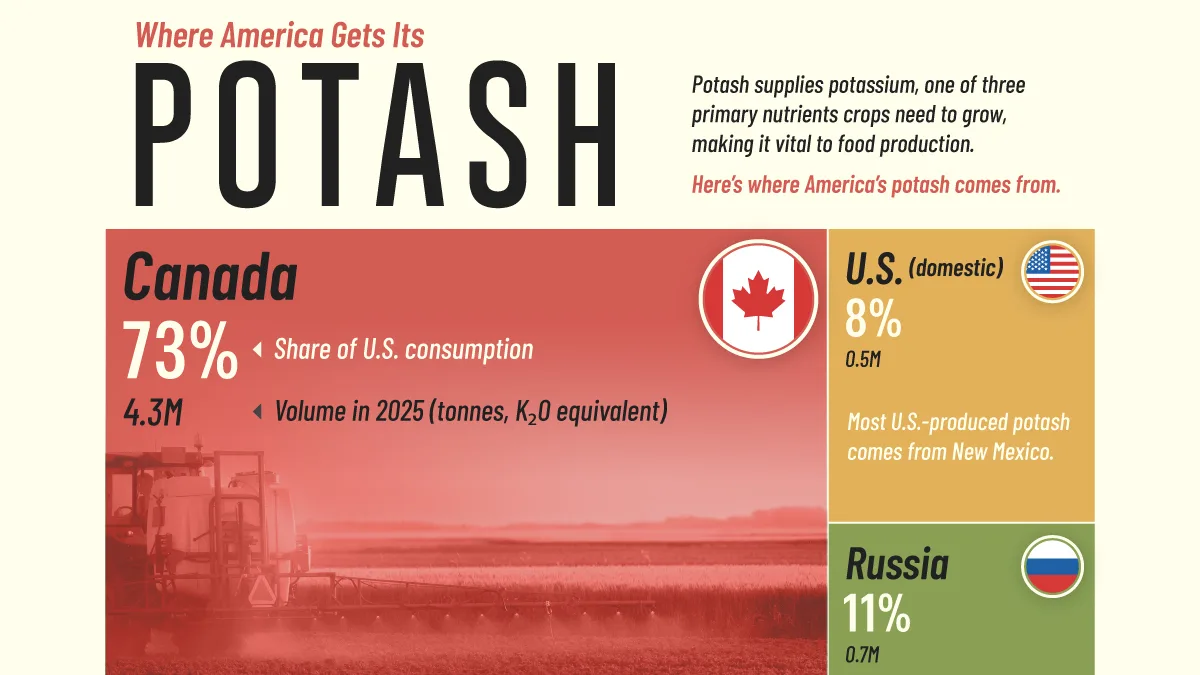
- Nearly three-quarters (73%) of U.S. potash consumption comes from Canada.
- Domestic supply, primarily from New Mexico, covers just 8% of U.S. consumption.
The United States is one of the world’s largest agricultural economies. Growing those crops requires large amounts of fertilizer, including potassium-rich potash.
This visualization shows the largest sources of U.S. potash consumption using data from the U.S. Geological Survey (USGS) Mineral Commodities Summaries 2026.
Volumes are expressed in tonnes of potassium oxide equivalent (K₂O), a standard measure that allows different potash products to be compared by their potassium content.
Canada’s Natural Advantage
Canada accounts for 73% of U.S. potash consumption, supported by abundant mineral deposits and its proximity to American farms.
Canada is the world’s largest potash-producing country, with much of its mining industry concentrated in Saskatchewan. Beneath the province lie extensive salt deposits that support a major fertilizer export industry.
The table below shows the estimated breakdown of sources for U.S. potash consumption.
| Source | U.S. potash by source (K₂O equivalent, 2025) |
Share |
|---|---|---|
 Canada Canada |
4.31 Mt | 72.9% |
 Russia Russia |
0.65 Mt | 11.0% |
 U.S. (domestic) U.S. (domestic) |
0.47 Mt | 8.0% |
 Israel Israel |
0.18 Mt | 3.0% |
| Other (foreign) | 0.30 Mt | 5.1% |
| Total | 5.91 Mt | 100.0% |
Established rail connections help move Canadian production south into the United States. Nutrien, a major Saskatchewan-based producer, ships potash across the U.S. through its North American transportation network.
That overland connection gives Canadian supply a logistical advantage over alternatives that require ocean transport.
Washington Looks to Belarus
In September 2026, U.S. President Donald Trump said Washington was working on a major agreement to purchase potash from Belarus at prices below those paid for Canadian supply. The following day, he said the U.S. would continue buying Canadian potash while also pursuing the possibility of lower-priced Belarusian supply.
Potash has been excluded from the additional Section 338 tariffs imposed on certain Canadian goods, underscoring its importance to U.S. agriculture.
However, adding Belarusian supply would involve more than finding another producer. Landlocked Belarus faces restrictions on European export routes and relies heavily on Russian transportation infrastructure. It also has existing customers, including China, Brazil, and India, limiting how much production could readily be redirected.
Transportation costs are another consideration. Unlike Canadian potash, which can move overland into the U.S., Belarusian supply would face a longer and more complex journey. That means a lower purchase price would not necessarily translate into lower delivered costs for American buyers.
What It Means for American Farmers
For farmers, the practical question is whether alternative suppliers can deliver affordable fertilizer when it is needed. Potassium helps plants regulate water use, develop roots, and withstand drought. When available potassium is insufficient, plant growth and yields can suffer.
Farmers can use soil testing to determine how much potash to apply. Nitrogen and phosphorus cannot replace potassium’s role in crop development, so cheaper supplies of other fertilizers do not remove the need for it.
Other suppliers, including Russia at 11% and Israel at 3%, already provide some diversification. Whether additional Belarusian supply ultimately lowers costs will depend on the final terms, available volumes, and transportation expenses.
Learn More on the Voronoi App
See which countries have the most arable land in this visualization on Voronoi.