

Key Takeaways
- The rules already apply to 2026 gifts. OBBBA’s new AGI floor (0.5% for itemizers), the 35% deduction cap for top-bracket donors and the 1% corporate floor are in effect this year, with no carryover if you wait until 2027.
- “Bunching” may be beneficial. Aggregating multiple years of giving into one 2026 gift helps clear the new AGI floor more efficiently than annual gifts.
- A DAF separates the tax decision from the giving decision. Contributing now locks in this year’s deduction while you decide which nonprofits to fund later.
- Appreciated assets beat cash. Donating stock, business interests and other noncash assets that have been held for more than a year can avoid capital gains tax, stacking additional savings on top of the deduction, especially valuable in a high-income year (IPO, sale, bonus, etc.).
Beginning January 1, 2026, OBBBA introduced several adjustments to how charitable contributions are treated for tax purposes. These changes are already in effect for gifts made in 2026, so they directly affect any giving you do before year-end.
What Changed in 2026
Beginning January 1, 2026, OBBBA introduced several adjustments to how charitable contributions are treated for tax purposes. These changes are already in effect for gifts made in 2026, so they directly affect any giving you do before year-end.
- For itemizers: Deductions will apply only to gifts that exceed 0.5% of adjusted gross income (AGI), creating a new “floor” before charitable deductions begin. Cash contributions to DAFs cannot be deducted for non-itemizers.
- For high-income taxpayers: Those in the 37% bracket will see their charitable deduction benefit capped at 35% of the donation’s value.
- For corporations: A new 1% floor for corporate charitable deductions will also take effect.
Given these changes, high earners may benefit from more strategic planning moving forward.
How The ImpactAssets Donor Advised Fund Can Help
A donor advised fund (DAF) lets you separate the giving decision from the tax decision. You can give now, lock in this year’s deduction, and decide which nonprofits to support later. OBBBA’s new rules make that separation more valuable than ever.
- Consider donating appreciated assets. Contributing publicly traded stock, concentrated stock positions, private business interests and real estate avoids capital gains tax and could clear the new AGI floor more easily than a cash gift.
- Bunch multiple years into one gift. Contributing several years’ worth of giving to your DAF in 2026 helps exceed the 0.5% floor now. You can recommend grants over the following years at your own pace.
- Invest donated assets for positive impact. Contributions to an ImpactAssets Donor Advised Fund can be invested in funds and companies that align with your values. Invest in sectors such as renewable energy, sustainable agriculture, affordable housing and health equity, all while you take the time to plan your long-term giving strategy.
What this Looks Like in Practice*
CASH CONTRIBUTIONS
A donor with $1M AGI giving $100,000 a year hits the 0.5% floor annually, forfeiting a small deduction each time. Contributing three years at once ($300,000) hits the floor only once — preserving roughly $10,000 more in deductible giving.
That same $300,000 gift is even more effective when funded with appreciated stock rather than cash: donating shares held for years avoids capital gains tax on the appreciation entirely, adding tens of thousands more in tax savings on top of the deduction.
APPRECIATED ASSETS
Appreciated asset gifts are especially relevant for donors with long-held, highly appreciated portfolios or individuals whose company went public recently and have a highly concentrated position in their portfolio that they want to reduce while limiting taxes. For donors thinking one year at a time, the new 0.5% floor also makes a single large gift more efficient than several smaller ones.
In 2026, donating appreciated assets held for over a year can help reduce capital gains taxes and increase the value of your gift. Consider a founder whose company recently went public. Her 2026 AGI is $15M, and her position has a very low cost basis. She donates $4M of shares with a $200,000 basis to her DAF:
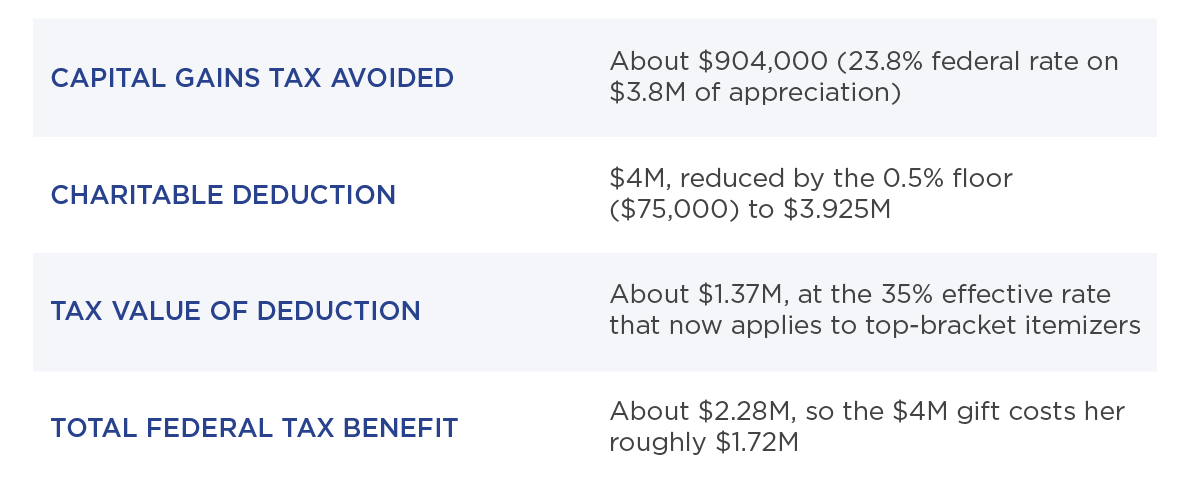
Had she sold the shares first and donated the after-tax proceeds, the charity would have received about $3.1M instead of $4M.
As these gifts become more common, ImpactAssets has the expertise to handle them, while working with your advisors or accountant. Assets we accept include:
- Private company stock
- Restricted securities
- Cryptocurrency
- Fine art and collectibles
- Real estate
Because complex and restricted assets take time to transfer, we recommend engaging with us early to ensure your gift is completed in 2026.
*These case studies are entirely hypothetical and provided for illustrative purposes only. The scenarios do not include state and local taxes in their calculations. They do not depict any actual donor. Consult your tax advisor on strategies that make sense for your unique situation.
Why Year-End Timing Matters
The new AGI floor and the cap on high-bracket deductions apply to the calendar year in which a gift is made. That means decisions made before December 31 determine what counts toward this year’s deduction.
High-income years are the highest-value giving years. Donors with a liquidity event, IPO, business sale, carried interest payout, or large bonus in 2026 have the most to gain from giving before year-end. Large gifts concentrated in high-income years are more tax-efficient under the new rules.
Take Action Before Year End
The December 31 deadline is coming up. Talk to your advisor and get a giving strategy in place that takes into account OBBBA’s new rules, especially if you are experiencing an extraordinary income year.
LEGAL AND PROGRAM DISCLAIMER: This is not a solicitation to buy or sell securities, nor a private placement offering pursuant to any private placement memorandum that must be issued to qualified investors. It is an informational description of charitably oriented, social purpose investment options that have been approved by ImpactAssets only for use in its donor advised fund asset base. It is only for use by its donors. This does not constitute tax advice. Please note there are a number of factors to consider when assessing the tax implication of gifts to charity. Individuals should consult with a tax specialist before making any charitable donations.
ImpactAssets Capital Partners PB LLC (“IA Capital”) is an investment adviser registered with the SEC. The content of this website is not a solicitation or offer to sell investment advisory services, nor is it a solicitation or offer to sell securities. All content of this website is for informational purposes only and should not be relied upon as investment advice. Information is subject to change at any time, and IA Capital is under no obligation to provide updates or amendments. Investment in securities involves the risk of loss. Past performance is no guarantee of future returns.
The post What the “One Big Beautiful Bill Act” Means for 2026 Charitable Giving first appeared on ImpactAssets.


