Ammonia is essential to modern agriculture, but making it via the traditional Haber-Bosch process is carbon-intensive and typically requires enormous industrial plants. So, what’s the alternative?
Iceland-based Atmonia has spent the past decade developing patented catalysts for a single-step electrochemical process that eliminates the need to first produce and store hydrogen.
The company is now focused on cutting energy demand and scaling its technology toward a 40-foot containerized system producing around 150 tons of ammonia a year.
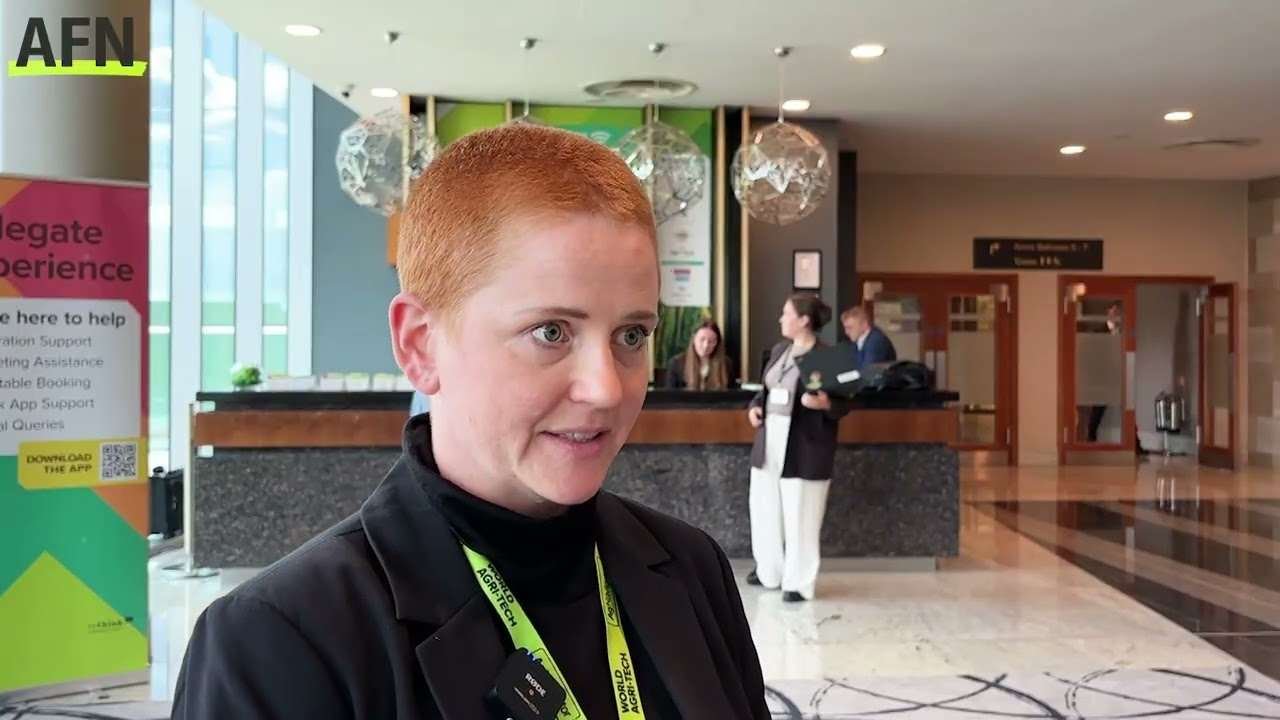
AgFunderNews (AFN) caught up with cofounder and CEO Helga Dögg Flosadóttir (HDF) at the World Agri-Tech innovation summit in London to discuss the technical hurdles to scale-up, the economics of decentralized ammonia production, and how Atmonia has funded its tech.
AFN: How is Atmonia making green ammonia
HDF: We founded Atmonia in 2016, so we’ve been around for a decade. For a great part of that time, we’ve been engineering and working on developing a catalyst that can produce ammonia in an aqueous electrochemical cell [at ambient temperature and pressure].
This is single-step ammonia production from nitrogen and water so we do not need to produce or store any hydrogen. We also do not need two different systems and have an equilibrium between them. We just have a simple system for ammonia production, rather than hydrogen first and then ammonia.
AFN: Describe the hardware involved…
HDF: This is our nitrogen electrolyzer. It’s a commercially available electrolyzer that we have amended for our purpose. It works like an AEM [anion exchange membrane] aqueous electrolyzer with a membrane electrode assembly, and this way we can bring the nitrogen gas in through a gas stream, and it will have direct access to the catalyst on gas diffusion electrode.
The nice thing about electrolyzers is that they scale up. When we scale up, we scale up in two dimensions. We don’t scale up in three dimensions. Now we’re working with an electrode that is 10 square centimeters. Then we will scale up to 400 square centimeters, but following that, we will start stacking the cells into an electrolyzer stack, similar to the AEM systems.
And this we want to do in collaboration with AEM electrolyzer manufacturers who have already optimized and perfected [producing] AEM electrolyzers at large scale.
AFN: Does this scale in a predictable way? If you know that it works at a small scale, do you know that it will work at a large scale?
HDF: To a certain degree, yes. So we can demonstrate it on a small scale. Then we can use computational fluid dynamics to simulate the way that it will react and operate on a large scale and use the optimized versions there.
There will be, of course, some unknown parameters that we will have to work with and optimize on the way. The nitrogen reduction reaction hasn’t been done on that scale yet in an AEM electrolyzer.
AFN: Why is your approach potentially more efficient than that of other companies making green ammonia
HDF: First of all, I want to say how extremely important it is, and great that we have competition. It shows how important green ammonia development is, and how we need to find solutions.
Some are going to industrial ammonia production, others are going small scale, and we will be competing in a small scale market where we’re bringing nitrogen fertilizer production directly to the farmer.
There, what we think are the most important factors are energy demand, flexibility, and size. And in all of those areas, we have an advantage over the other systems.
AFN: Tell me about your catalyst…
HDF: The catalysts have been developed using density functional theory or quantum chemical simulations. [The key is] understanding the chemical composition of the catalyst and which reaction sites can efficiently activate and attract nitrogen rather than water or hydrogen, and produce ammonia, and selectively produce ammonia rather than hydrogen.
This is extremely important because most other catalysts favor hydrogen production over nitrogen reduction and ammonia synthesis.
We will be focusing on the catalyst in our business model, on the catalyst synthesis and the electrode manufacturing, and we want to collaborate with others on the manufacturing of the hardware and the scale up. The catalysts themselves have a specific reaction site that selectively reduces nitrogen, and in addition to that, they’re also made of abundant raw materials.
AFN: What is the biggest technical bottleneck right now? Is there something particular you need to optimize to get to viable unit economics?
HDF: We’ve demonstrated the chemistry, which took us 10 years of research. And now we’re optimizing the energy demand, and we’ll do that both via optimization of the catalyst itself and an optimization of the environment around the chemical reaction inside the electrolyzer.
We have a very clear and structured approach to that, and we anticipate to reach that milestone before the end of next year.
AFN: What size plants would be needed at a commercial scale for this to be viable?
HDF: Our goal is to scale up to a 40-foot containerized production process, and this process will be producing about 150 tons of ammonia per year. This should create viable economics, even at electricity prices that we are seeing today.
AFN: What is your business model?
HDF: We aim to be a catalyst and electrode producer and partner up with hardware manufacturers closer to end user markets. Atmonia is located in Iceland, and we could saturate the market in Iceland with 80 containers, so the market in Iceland is limited.
We will go global and bring the manufacturing closer to the end user. With the business model in general, what we’re looking at is a leasing model to the farmer to remove the barrier of capex for the farmer.
AFN: How have you funded the company so far?
HDF: We’ve been extremely successful in receiving grant funding, which has provided most of the runway that the company has needed over the past decade, from Icelandic research bodies, the European Innovation Council, and Horizon Europe.
AFN: What about equity? Have you got any institutional investors, and what kind of money are you looking for going forward?
HDF: We have Icelandic venture capitalists that have joined the company throughout the past years, and Canadian agriculture angels that joined us a couple of years ago. We have just kicked off our seed investment round, where we’re looking for agritech investors, deep tech investors, and other investors that have a slightly longer horizon than conventional venture capitalists.
Our next milestone is to optimize the energy demand and then start scaling up. This funding should get us to TRL-6, so we can demonstrate a prototype operating on-farm.
Further reading:
Facet Amtech bets on multifunctional catalyst to disrupt ammonia production
🎥 Inside Faraday Earth’s bid to make cheap green ammonia without Haber-Bosch
Mafix raises $5.4m to activate silicate rock into climate-smart fertilizer
Switch Bioworks tests ‘switchable’ nitrogen-fixing microbes in corn for fertilizer
The post Atmonia scales green ammonia with single-step electrochemical process appeared first on AgFunderNews.
- Source: https://agfundernews.com/atmonia-scales-green-ammonia-with-single-step-electrochemical-process