

Europe’s battery storage market is entering a new phase as utility-scale projects become the industry’s main growth engine, creating fresh opportunities for manufacturers while reshaping competition across residential and commercial markets. According to EUPD Research’s new calculations, Europe’s (EU + UK + Switzerland + Norway + Ukraine) annual battery storage installations are projected to increase from 34 gigawatt-hours (GWh) in 2025 to 65 GWh in 2026, marking one of the region’s fastest periods of market expansion.
The shift reflects more than stronger battery demand. Higher electricity prices, tighter energy markets, expanding renewable generation and supportive policy measures are changing storage from a complementary technology into an increasingly important part of Europe’s electricity system. Rather than serving only as a backup solution for homes and businesses, batteries are becoming a critical tool for balancing power systems as solar and wind account for a larger share of electricity generation.
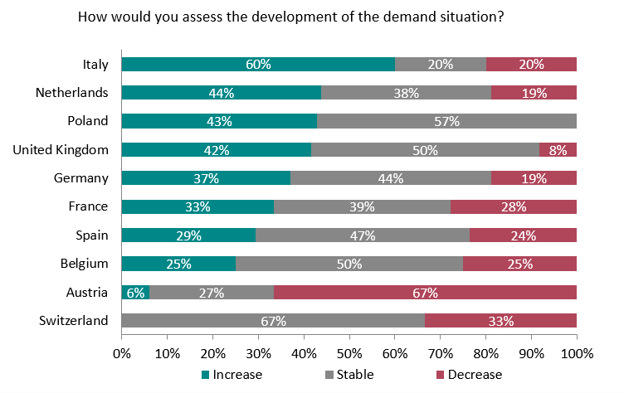
Recent findings from EUPD Research’s Business Climate Survey, indicate buoyant demand sentiment across major European markets. The survey gathered responses from a broad base of installation companies, providing a representative view of current market sentiment.
Figure 1: Solar & Storage Demand Across Major European Markets
Utility-Scale Projects Drive the Next Wave of Growth
The strongest momentum is emerging in large-scale battery projects connected directly to the grid. EUPD Research expects the utility segment alone to install a record of around 44 GWh of storage in 2026, making it the largest contributor to Europe’s overall market growth.
Countries with rapidly expanding renewable fleets are leading that transition as grid operators increasingly rely on batteries to shift electricity across different hours of the day, improve system flexibility and support network stability. While electricity prices have eased from the extraordinary peaks seen during Europe’s energy crisis, they remain high enough in many markets to strengthen the business case for storage investments.
Policy is reinforcing that trend. European electricity market reforms, funding mechanisms, permitting improvements and national storage support measures are creating a more favorable environment for deployment, particularly for larger projects that help integrate growing volumes of renewable electricity. At the same time, changing incentive structures in several countries are encouraging households and businesses to maximize self-consumption, making batteries more attractive as export payments for rooftop solar decline or net-metering schemes begin to phase out.
Bigger Projects Reshape the Competitive Landscape
The expansion of utility-scale storage is changing how manufacturers participate in Europe’s battery storage market. As projects become larger and more complex, engineering, procurement and construction (EPC) companies are becoming increasingly specialized, creating a more structured project ecosystem than the fragmented market that characterized earlier stages of deployment.
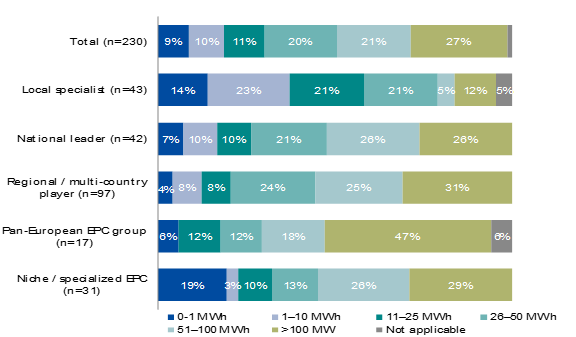
Insights from the newly released EUPD PV and Storage C&I EPCMonitor© 2026 indicate that local contractors continue serving smaller installations, while national leaders, regional players and pan-European firms are taking on progressively larger battery projects across multiple countries. That differentiation is creating multiple routes to market for manufacturers, allowing suppliers to build longer-term partnerships with contractors that specialize in infrastructure-scale delivery instead of relying primarily on equipment sales.
Project size is increasingly defining competitive positioning. Companies focused on smaller systems continue serving distributed markets, while firms capable of delivering larger projects are becoming more important as utilities, developers and industrial customers pursue higher-capacity installations. The result is a market where partnerships and delivery capabilities are becoming as important as battery technology itself.
Figure 2: Annual Installed EES Capacity | Company Type | 2025
Residential Storage Enters a More Competitive Phase
While utility-scale deployment is accelerating, distributed storage is entering a more mature stage rather than slowing. Europe’s residential market is becoming increasingly sophisticated as manufacturers expand beyond standalone batteries into broader home-energy ecosystems that combine rooftop solar, electric vehicle charging, heat pumps, energy management software and grid-flexibility services.
Several market forces continue supporting residential adoption. High retail electricity prices, declining battery costs, tax incentives, value-added tax (VAT) exemptions and growing interest in energy independence remain important drivers across Europe. However, the market also faces persistent challenges, including uneven smart-meter deployment, financing constraints, labor shortages and the gradual reduction of some subsidy programs in certain countries.
Despite those headwinds, EUPD Research expects Europe to install roughly 15 GWh of new residential battery capacity during 2026, with Germany, Italy, the Netherlands, Austria and the United Kingdom remaining among the strongest-performing markets.
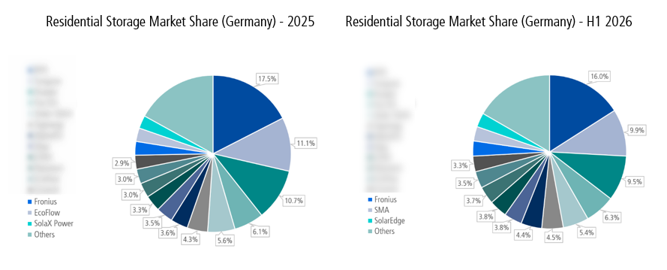
According to EUPD Research’s latest EES Report Europe© H1 2026, the competitive landscape is evolving just as quickly as deployment. Residential supplier rankings have already shifted between 2025 and the first half of 2026, illustrating how rapidly manufacturers are competing for market share as customer preferences change. Germany’s residential storage market is becoming increasingly fragmented, as share gradually shifts away from the leading suppliers. The top suppliers’ combined share declined between 2025 and H1 2026, while mid-sized brands and smaller brands expanded their presence. These trends point to a market where competition is intensifying and leadership positions are becoming less secure.
Figure 3: Germany’s Residential Storage Supplier Landscape: 2025 Vs H1 2026
Instead of competing only on battery hardware, manufacturers are increasingly differentiating themselves through integrated energy solutions, software capabilities and broader customer offerings that create additional value after installation.
Storage Becomes Core Energy Infrastructure
Europe’s battery market is increasingly developing along two complementary paths rather than replacing one segment with another. Utility-scale batteries are becoming essential infrastructure for balancing renewable electricity and supporting grid operations, while distributed storage is expanding its role within homes and businesses through integrated energy-management systems.
For manufacturers, this creates a dual opportunity. Larger grid-connected projects provide access to infrastructure-scale investment, while distributed markets offer opportunities to deepen customer relationships through broader energy solutions and connected technologies. As Europe moves toward a projected 65 GWh storage market in 2026, batteries are becoming less of a standalone clean-energy product and more of a core component of the region’s evolving electricity system.
The next phase of this market will be shaped not only by how many batteries are installed, but also by how effectively storage becomes embedded across both the power grid and the wider energy ecosystem. Partnerships and delivery capabilities will become increasingly important, particularly in the commercial and industrial segment, where solar, storage and energy management are converging into a single business case.
This is where industry collaboration becomes critical. European Sustainability Week 2026, taking place from 23 to 25 November at the historic Petersberg near Bonn, brings together manufacturers, EPCs, utilities, investors and industrial energy buyers to explore these developments. As Europe’s C&I event for sustainable industries, with a clear focus on renewable energy, solar and storage, it provides a platform for the exchange of market insights and practical solutions. At the Environmental Forum on 24 November, EUPD Research will share the latest market insights, while industry leaders will discuss how storage can become core infrastructure for European businesses.
Last year, more than 600 decision-makers from over 23 countries took part. Registration is open at european-sustainability-week.com.
Authors: Daniel Fuchs and Ali Arfa
Daniel Fuchs is the Chief Customer Officer of EUPD Group. He has extensive international experience in sales, marketing, customer engagement, and strategic event management within the renewable energy and cleantech industries. His work focuses on building customer-centric growth strategies, strengthening global partnerships, and supporting market development across the solar, energy storage, and sustainability sectors. He can be reached atd.fuchs@eupd-research.com.
Ali Arfa is the Head of Data Management at EUPD Research. He is a graduate of the University of Bonn and with a background in European and North American politics. His expertise encompasses market research, policy development, and stakeholder analysis. His particular focus is on solar energy, energy storage, and strategic consultation. He can be reached at a.arfa@eupd-research.com.
The post What’s driving Europe’s battery boom? Insights from EUPD Research’s Business Climate Survey and Storage Report appeared first on pv magazine Global.


