
Choosing between hinged vs two-piece containers is not simply a matter of deciding whether an attached lid is more convenient than a separate one. The better format depends on the menu, packing speed, transport conditions, presentation, storage, and how the customer will use the meal.
For some operations, a hinged container can simplify a fast-moving takeout line. For others, a two-piece bowl or entrée container may offer better visibility, portion flexibility, or handling for prepared meals.
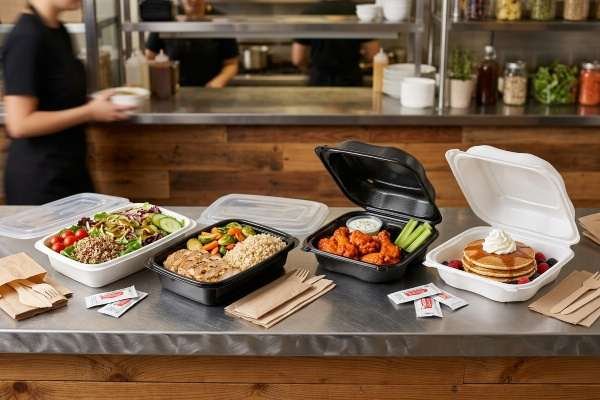
The best takeout container for restaurants is the one that fits both the food and the workflow.
Hinged vs. Two-Piece Containers at a Glance
| Factor | Hinged Container | Two-Piece Container |
|---|---|---|
| Construction | Base and lid connected | Separate base and lid |
| Packing | One-piece handling | Two components |
| Common uses | Sandwiches, entrées, fried foods, combo meals | Bowls, salads, sauced meals, meal prep |
| Presentation | Depends on lid design | Clear lids are common |
| Inventory | No lid matching | Bases and lids must remain compatible |
| Reheating | Depends on material | Depends on material |
The format alone does not determine venting, leak resistance, temperature range, or microwave suitability. Those depend on the specific container design and material.
What Makes Hinged Containers Useful?
A hinged container combines the base and lid into one unit. That can be valuable in busy kitchens because staff do not need to locate and match a separate lid.
Hinged formats are often a good fit for:
- Burgers and sandwiches
- Fried foods
- Hot or cold entrées
- Combination meals
- High-volume takeout
Different hinged takeout containers may also include clear lids, compartments, or venting depending on the application.
The main advantage is workflow simplicity. During a lunch rush, removing even one packaging step can make the line easier to manage.
Where Two-Piece Containers Fit Better
Two-piece containers use a separate base and lid. That creates an extra handling step, but it also gives restaurants more flexibility in certain applications.
They are especially useful for:
- Grain and protein bowls
- Pasta and sauced entrées
- Salads
- Meal prep
- Catering
- Prepared-food displays
Formats such as Smart2Go and Grab-A-Bowl show how a separate base and lid can support deeper portions, clear presentation, and stackable meal formats.
For bowl-based meals or food that customers may refrigerate or reheat later, that flexibility can be more important than one-piece handling.
Which Format Is Faster in the Kitchen?
Hinged containers usually have the advantage when speed is the priority. Since the lid is attached, staff can fill, close, and move the order without searching for a matching top.
That can matter in a quick-service environment packing large numbers of sandwiches, fried entrées, or combo meals.
Two-piece containers can still work efficiently when bases and lids are clearly organized at the station, especially when meals are prepared in batches rather than packed one at a time.
The real question is whether the packaging matches the way the kitchen works.
A burger line and a catering station may have very different needs even if both are packing hot food.
Which Is Better for Presentation?
Two-piece formats often use clear lids, making the food easier to identify during staging, pickup, catering, or grab-and-go display.
That can help with:
- Order verification
- Ingredient visibility
- Prepared-food presentation
- Meal-prep identification
But visibility is not exclusive to two-piece packaging. Hinged containers such as Genpak’s ProView™ can also use clear lids.
Presentation therefore depends more on the specific package than on whether the lid is attached.
Which Handles Takeout and Delivery Better?
Neither format automatically performs better during transport.
A hinged container can still leak or deform if it is overfilled, too shallow, or poorly matched to the food. A two-piece package can also fail if the lid fit is weak or the portion is too heavy for the base.
Transport performance depends on:
- Closure design
- Container depth
- Portion weight
- Headspace
- Structural strength
- Venting
- Stackability
- Material
For hot foods that release steam, a vented Clover™ hinged container may be worth considering. A deep two-piece bowl may make more sense for pasta, curry, or another heavy sauced entrée.
The food should determine the format.
Match the Format to the Menu
| Menu or Application | Often Worth Considering | Why |
|---|---|---|
| Burgers and sandwiches | Hinged | Fast packing |
| Fried entrées | Vented hinged | Moisture release |
| Combination meals | Compartmented hinged | Keeps components organized |
| Grain or protein bowls | Two-piece | Bowl shape and visibility |
| Pasta and sauced meals | Two-piece | Depth and containment |
| Meal prep | Two-piece | Stackability and clear presentation |
| Catering | Either | Depends on portion and service style |
These are starting points, not fixed rules. A container should be evaluated with the actual portion and normal transport conditions before it becomes the standard format.
Do Not Ignore Storage and Inventory
Packaging affects the back of the house as much as the customer experience.
With hinged containers, the lid and base are one unit, so there is no separate lid to organize or match.
Two-piece systems require bases and lids to stay properly paired, but they can still be efficient when the operation uses a limited number of compatible formats.
When comparing hinged vs two-piece containers, consider:
- Number of packaging SKUs
- Lid compatibility
- Shelf space
- Stacking
- Batch packing
- Order staging
A container that performs well with the food but creates unnecessary complexity in the kitchen may not be the best operational choice.
Material Still Matters
Hinged and two-piece describe the construction of the package, not its full performance.
Restaurants still need to consider:
- Hot or cold use
- Microwave reheating
- Refrigeration or freezing
- Greasy or wet food
- Holding time
- Portion weight
Recommended application ranges for common materials are available in our material temperature guide, but material, food, holding time, and customer use should be considered together.
So, What Is the Best Takeout Container for Restaurants?
The best takeout container for restaurants is the one that creates the fewest compromises between food quality and kitchen workflow.
Hinged containers are often a strong fit when packing speed, simple handling, and attached lids matter most.
Two-piece containers may be better when the menu relies on bowls, prepared meals, clear presentation, or batch packing.
Many restaurants do not need to choose only one. Different menu categories may perform better in different formats.
Choose the Format Around the Food
The decision between hinged vs two-piece containers should begin with the meal and the operation.
Consider how the food is packed, how it travels, whether visibility matters, how containers are stored and stacked, and what the customer will do with the meal after purchase.
For help comparing hinged and two-piece formats for specific menu items or foodservice applications, contact our team.
The post Hinged vs. Two-Piece Containers: Which Is Better for Foodservice? appeared first on Genpak.


