
Alto says it has not begun moving ahead with land purchases for a proposed high-speed rail line between Toronto and Quebec City.
In September, the company acquired a property in an undisclosed location that was already on the market.
The privately operated rail line, owned by the federal Crown corporation Alto, would connect the two provinces, cutting through more than 1,000 km of rural communities and farmland.
“To date, Alto has acquired a single property. It’s important to note that the property was already on the market and presented a potential strategic opportunity in support of the project’s ongoing planning and studies,” said Marlee Socket, senior adviser, media relations and spokesperson. “As with any acquisition decision, Alto acted where there was a sufficient level of certainty that the property could be required to support the project.”
In a statement to Farmtario, the company said it was not yet ready to confirm any additional properties that may be considered for acquisition. According to the statement, the project remains in the planning phase, with land requirements becoming clearer as route planning and design work advance.
Josh Suppan, president of the National Farmers Union–Ontario (NFU-O) and NFU Region 3 co-ordinator, said farmers feel they haven’t received enough communication from Alto. He added that the NFU-O’s position remains firmly opposed to the development.
“There has not been enough consultation with farmers or the general public. The NFU-O’S position has not changed. They (Alto) need to pause this project and do real, meaningful consultation,” he said.
Socket said that as planning progresses, Alto will engage directly with potentially affected landowners, including farmers, and provide information as it becomes available.
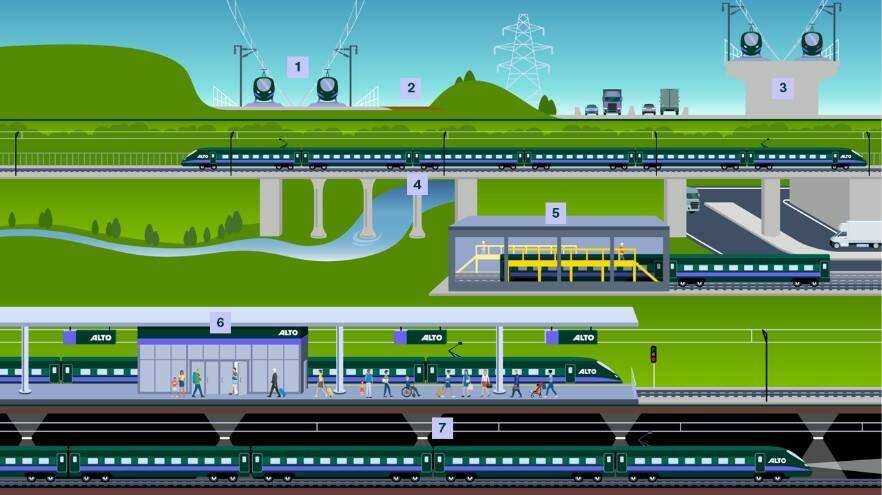
“Earlier this year, Alto presented five engagements focused on rural and agricultural communities,” she said. “And a new round of consultation this fall will provide further opportunities for communities and property owners to learn more about the project, ask questions and share feedback as we work toward presenting a narrow corridor between Ottawa and Montréal.”
According to Alto, any decision to acquire property would be made on a case-by-case basis and informed by ongoing planning, engineering and environmental studies. The company will consider acquisitions only where there is a sufficient level of certainty that a property may be required to support the project.
“While it is too early to comment on future acquisitions, Alto remains committed to prioritizing negotiated agreements, offering fair compensation and minimizing impacts,” she said.
The company said as planning progresses, property owners will receive project updates and have opportunities to ask questions, review available information, seek independent professional advice and discuss their specific circumstances with Alto representatives.
Suppan questioned whether farmers would receive fair value for their property, adding that calculating future lost income would be difficult.
“But perhaps even more important is determining the intangible value of a farm to that farm family, multi-generation or not. Nothing Alto has shown thus far indicates they’ve put thought into that,” he said.
Beyond determining the value of a property to farmers and landowners, he said there must be an assessment of the value of land used to grow food and greater prioritization of feeding communities.


