Support CleanTechnica’s work through a Substack subscription, on Patreon, or on Stripe. Help us produce all of the high-quality, original content we publish week after week despite the challenges of content-scraping AI, antisocial media, inflation, and other hurdles.
There are Department of Energy programs in the Trump administration’s FY2027 budget request that I would cut too. Hydrogen for buses, trucks, building heat and routine electricity storage has consumed years of public funding and attention without overcoming the basic efficiency and cost advantages of using electricity directly. Ending more attempts to force those applications into existence would be progress. The problem is that the administration has wrapped those defensible cuts into a much broader retreat from batteries, electric vehicles, buildings, solar, wind and public energy research while treating several much weaker technological bets far more gently.
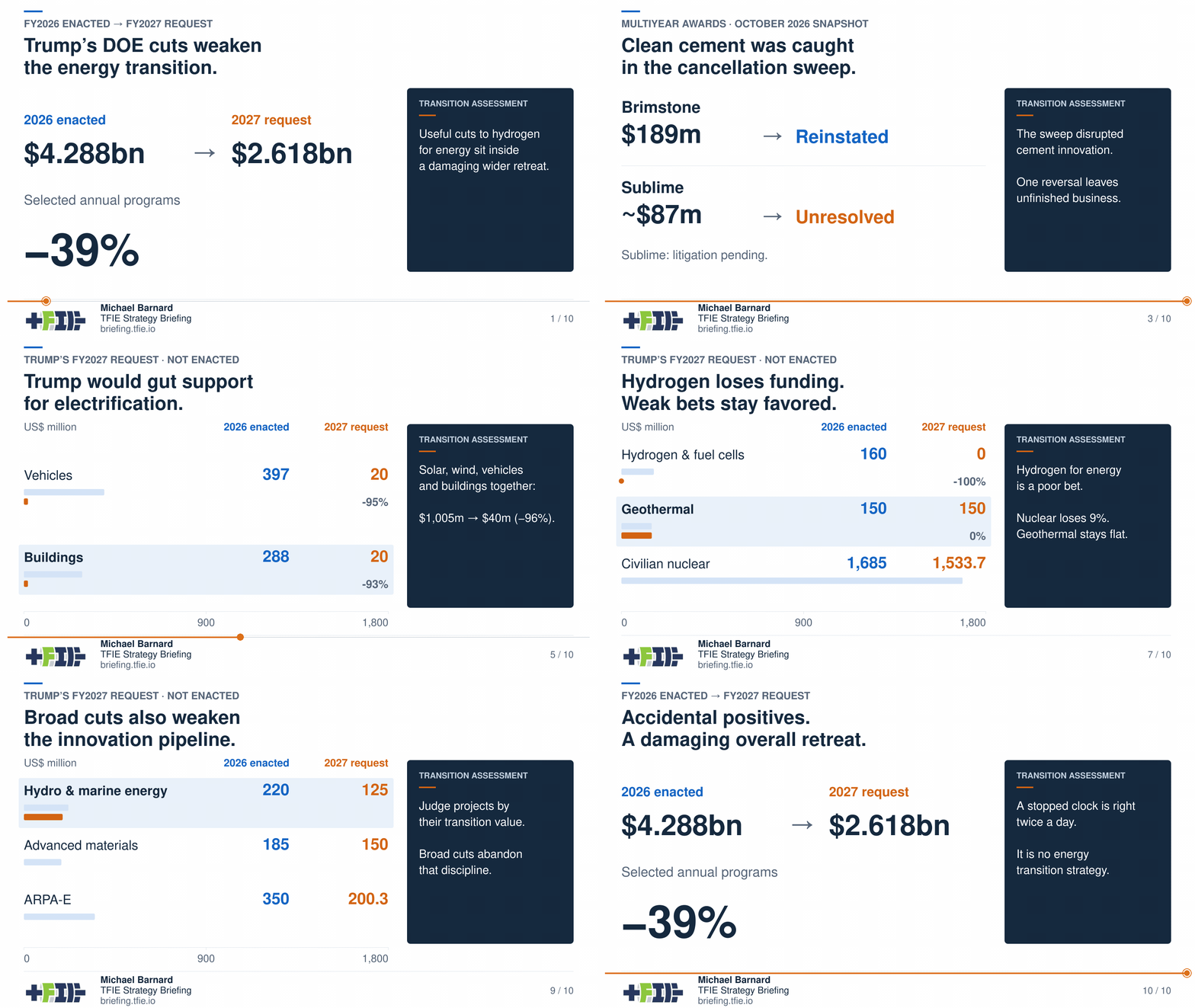
Across thirteen selected DOE technology program lines, FY2026 enacted funding totals about $4.288 billion. Trump’s FY2027 request reduces that to $2.618 billion, a decline of roughly 39%. The distribution matters much more than the aggregate. Solar, wind, vehicles and buildings together fall from $1.005 billion to only $40 million, about a 96% reduction. These are selected annual DOE programs, not the entire department or every federal dollar that supports the technologies, and the FY2027 figures are a presidential request rather than enacted appropriations. But budget requests tell Congress what an administration thinks deserves public support, and the pattern is difficult to mistake.
The useful way to judge these programs is not to divide technologies into politically favored and politically disfavored camps. Research, demonstrations and deployment support should face different tests. Early-stage research should answer a credible question that is worth answering. A demonstration should resolve specific technical, operating or commercial uncertainties. Deployment funding should accelerate something with a plausible path to delivering useful services competitively. A technology can justify a bounded experiment while being a terrible candidate for a billion-dollar rollout, and commercial success in a sector does not mean there are no remaining public-interest research questions.
Solar and wind illustrate the latter point. Their DOE program lines go from $220 million and $100 million respectively to zero in the FY2027 request. Neither technology requires the federal government to prove that it can generate electricity at commercial scale. That argument was settled years ago. The remaining public questions concern durability, manufacturing, recycling, materials, grid integration and operating electricity systems with very large shares of variable generation. Firms should fund ordinary product competition, but shared knowledge and system-level research often produce benefits that no single company can capture.
Vehicles fall from $397 million to $20 million, while buildings fall from $288 million to $20 million. That is especially difficult to square with the actual transition. Battery-electric vehicles have already won substantial passenger-vehicle markets and are spreading rapidly into commercial-duty niches where economics align. Heat pumps are a mature technology whose remaining problems increasingly concern installation quality, controls, building integration, flexible demand and how to electrify existing buildings without making unnecessary renovation a prerequisite. Those are exactly the kinds of practical problems that public research can help solve across an industry.
Hydrogen is a different case. The annual hydrogen and fuel-cell line falls from $160 million to zero, and much of its energy mission deserves to disappear. Producing hydrogen, conditioning it, moving it and converting it back into useful work generally adds energy losses, equipment and cost compared with direct electrification. Necessary industrial hydrogen is different because ammonia, methanol and other chemical processes require the molecule itself. A sensible federal portfolio would focus its hydrogen expertise on reducing emissions from hydrogen that industry actually needs while ending serial attempts to create a giant new hydrogen market for applications where electricity already has the advantage.
That does not mean the much larger regional hydrogen hubs have simply been cancelled. The hubs are multiyear awards funded separately from the annual technology-program comparison, and five remained nominally retained after the administration’s review. Retention, however, is not the same thing as a functioning project. Reporting from Pennsylvania continues to describe uncertainty, cautious partners and little evidence of meaningful momentum, while the FY2027 request proposes clawing back unobligated clean-hydrogen funding. The result is less a coherent technology decision than a prolonged “will they or won’t they?” process that makes planning harder for good projects and bad projects alike.
The mixed treatment of other technologies reinforces the point. Critical-minerals funding rises sharply, from $83 million to $364 million, and some of that can be useful if it builds processing, refining and qualified industrial output rather than merely subsidizing extraction. Geothermal remains at $150 million, including substantial support for enhanced-geothermal work whose eventual electricity economics remain uncertain. Civilian nuclear falls only about 9%, from $1.685 billion to $1.534 billion. Existing-fleet work and bounded research can have value without accepting the proposition that new nuclear or SMRs are likely to become the fast, inexpensive backbone of the transition.
The cement awards show why program management matters as much as headline appropriations. Brimstone’s large demonstration award was reinstated while Sublime’s remained unresolved in the October award snapshot. Neither administrative status tells us whether the underlying technology will succeed. Brimstone still has to prove the economics of a rock refinery whose business case depends on several saleable outputs, while Sublime has its own feedstock, energy, qualification and cost questions to answer. A demonstration should purchase evidence about those uncertainties. Reinstatement is not commercial validation, and cancellation is not scientific falsification.
ARPA-E makes the institutional problem clearest. Its total allocation falls from $350 million to $200.3 million, while project funding drops from $310 million to $160.3 million. The purpose of an organization like ARPA-E is not to select a portfolio in which every experiment becomes a company. Some experiments should fail. Some should reveal that an attractive concept does not scale. Some should create knowledge that private firms subsequently exploit. The public value comes from asking useful questions at stages where private capital cannot capture enough of the upside to justify carrying all of the uncertainty.
That requires competent people inside government who can distinguish research from demonstration, negotiate milestones, inspect projects, interpret evidence and stop work that is no longer justified. Hollowing out that capability while cancelling and reinstating awards through broad political sweeps weakens both sides of the process. It becomes harder to kill bad projects intelligently and harder to protect good experiments from indiscriminate cuts.
I would keep the cuts to weak hydrogen-for-energy applications, narrow several other portfolios whose commercial claims have outrun their evidence, and impose much harder tests on new nuclear and speculative geothermal electricity ambitions. I would restore serious capacity around electrification, buildings, industrial conversion, batteries, renewable generation and useful shared research, while supporting mineral processing where it removes real industrial bottlenecks. That is not a defense of every clean-energy grant. It is an argument for judging technologies by the useful work they can perform and judging public programs by the evidence they buy.
A stopped clock can cancel something that deserved to go. It still cannot decide what the United States should build next.
The full TFIE Strategy Briefing assessment goes program by program through the funding changes, the hydrogen hubs, cement awards, ARPA-E and the distinction between research, demonstration and deployment.
Sign up for CleanTechnica’s Weekly Substack for Zach and Scott’s in-depth analyses and high level summaries, sign up for our daily newsletter, and follow us on Google News!
Advertisement
Have a tip for CleanTechnica? Want to advertise? Want to suggest a guest for our CleanTech Talk podcast? Contact us here.
Sign up for our daily newsletter for 10–15 new cleantech stories a day. Or sign up for our weekly one on top stories of the week if daily is too frequent.

CleanTechnica uses affiliate links. See our policy here.
CleanTechnica’s Comment Policy