
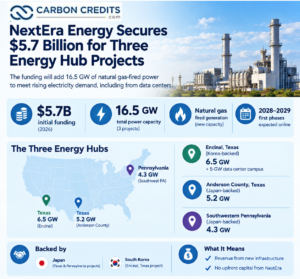
NextEra Energy has secured $5.7 billion in initial funding for three federally backed energy hub projects in Texas and Pennsylvania. The projects will add large amounts of natural gas-fired power to meet rising electricity demand, including demand from data centers.
The company announced the funding during its third-quarter 2026 earnings call on October 21. The three projects are expected to provide about 16.5 gigawatts (GW) of power capacity, according to NextEra. The company has signed definitive agreements to develop, build, and operate the hubs, with the first phases expected to begin serving customers as early as 2028 and 2029.
The deals also offer NextEra a way to earn revenue from new power infrastructure without investing its own capital in the projects. But they raise wider questions about how the United States will meet fast-growing electricity demand while managing emissions from fossil fuels.
Three Energy Hubs Will Add New Natural Gas Capacity
Two of the projects are planned for Texas and Pennsylvania. They are backed by the Government of Japan and the U.S. Department of Commerce as part of a wider U.S.-Japan investment effort.
The U.S. government announced the two natural gas projects in March 2026. Its fact sheet put their estimated costs at up to $16 billion for the Texas project and $17 billion for the Pennsylvania project. NextEra Energy Resources is the operator for both facilities.
The Texas project is planned for Anderson County and could provide up to 5.2 GW of natural gas-fired generation. The Pennsylvania project, planned for the southwestern part of the state, is expected to provide 4.3 GW. Both projects are designed to serve large electricity users, including data centers.
The third hub is backed by the Republic of Korea and the U.S. Department of Commerce. It is planned for Encinal, Texas, and will include about 6.5 GW of natural gas generation to serve a planned 5-GW data center campus. The first phase could begin operating in 2029.
NextEra said the three hubs have secured $5.7 billion in initial funding so far in 2026. An initial $3.3 billion funding release in August will support the purchase of turbines and other equipment that can take years to deliver.
The funding supports early project development and equipment procurement. It should not be confused with the full construction costs of all three hubs.
NextEra Will Earn Project Fees Without Investing Its Own Capital
The projects use a different business model from power plants that NextEra owns and operates with its own money. Under the agreements, NextEra Energy Resources will develop, build, and operate the hubs for fees. The company expects to receive fees during development and construction, as well as during the first 20 years of operations.
NextEra says it will not need to invest its own capital in these three projects. Even so, the hubs are expected to provide about 50% of the adjusted earnings per share that the company would expect if it owned the power assets itself.
This approach could allow NextEra to earn long-term income while limiting the amount of its own money tied up in construction. It also gives the company a role in building new power capacity as electricity demand grows.
The model does not remove all project risks. The hubs still need to move through construction, secure required permits and approvals, and bring their power supply online on schedule. NextEra is also working on power purchase arrangements for the projects while construction planning moves forward.
The company expects electricity supply to increase in stages. It aims to serve some demand as early as 2028 and 2029, then expand supply to meet the full needs of the campuses between 2030 and 2032.
AI Data Centers Drive Demand for New Electricity Supply
The projects reflect a wider change in the U.S. electricity market. Data centers, especially those used for artificial intelligence (AI), need large amounts of power to run computing equipment and cooling systems. Their demand can also grow quickly as companies expand their digital services.
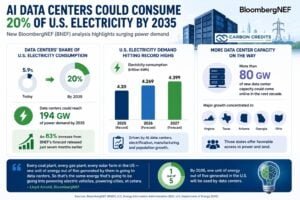
Building new power generation close to large electricity users can help developers bring supply online faster. The approach may also reduce pressure on existing grids if the projects provide dedicated generation and infrastructure for new customers.
NextEra says the hubs are designed to match new electricity demand with new power generation. Its view is that data centers should pay for the generation and infrastructure they require, rather than shifting those costs to existing utility customers.
However, the impact on other electricity users will depend on how each project is financed, connected to the grid, and operated. New power plants alone do not guarantee lower bills. Fuel prices, construction costs, transmission limits, and the rules for sharing grid costs will also matter.
- INTERESTING READ: AI’s Environmental Cost: Data Centers Now Rival Entire Nations in Energy, Water, and Land Use
The projects are part of NextEra’s wider effort to serve large electricity users. During the third quarter, NextEra Energy Resources added 3.7 GW to its development backlog, including 2.4 GW of battery storage. Its total backlog reached about 36.7 GW.
The company is also discussing a pipeline of 30 to 40 potential energy hub projects. That is a development pipeline, not a set of approved projects or a guarantee that all will be built.
Natural Gas Adds Power But Raises Climate and Emissions Questions
Natural gas can provide electricity when customers need it, including during periods when wind and solar output is low. That flexibility can help data centers and other large users that need a steady power supply.
However, gas-fired power plants also produce carbon dioxide when they burn fuel. Natural gas supply chains can release methane, a powerful greenhouse gas, during production and transport. The total climate impact depends on plant efficiency, how often the plants operate, and methane leakage across the supply chain.
The three hubs are designed mainly around natural gas generation, rather than renewable energy. Their planned capacity could help meet new electricity demand, but it could also add to long-term fossil fuel use if the plants operate for decades.
The company has pointed to the potential to add battery storage alongside the hubs. Batteries can store electricity and release it when needed, helping balance supply and demand. However, storage does not generate electricity on its own. Its climate benefits depend in part on the source of the power used to charge it.
The projects therefore highlight a key challenge for the U.S. power sector: meeting the rapid growth in electricity demand while keeping emissions in check. The result will depend on how much the gas plants operate, whether additional clean energy is built, and how the wider electricity system changes over time.
Federal Energy Hubs Reflect a Wider Push to Meet AI Power Demand
The three projects are part of a broader effort to build energy infrastructure around large industrial and technology users. The U.S. government has promoted energy hubs as a way to expand domestic power supply, support economic activity, and meet demand from data centers.
NextEra is also involved in a separate project in western Kentucky. There, the company is part of a coalition planning a data center campus with up to 2 GW of natural gas generation and up to 2.6 GW of battery storage. That project is distinct from the three hubs tied to the $5.7 billion in initial funding.
For NextEra, the new agreements create a path to earn fees from large power projects without providing the construction capital itself. For the U.S. energy market, they show how quickly data center demand is shaping investment decisions
- READ MORE: NextEra Energy Secures $1.9 Billion DOE Loan to Restart Duane Arnold Nuclear Plant in Iowa
The post NextEra Energy Secures $5.7B for Federal Gas Hubs Serving AI Demand appeared first on Carbon Credits.


