
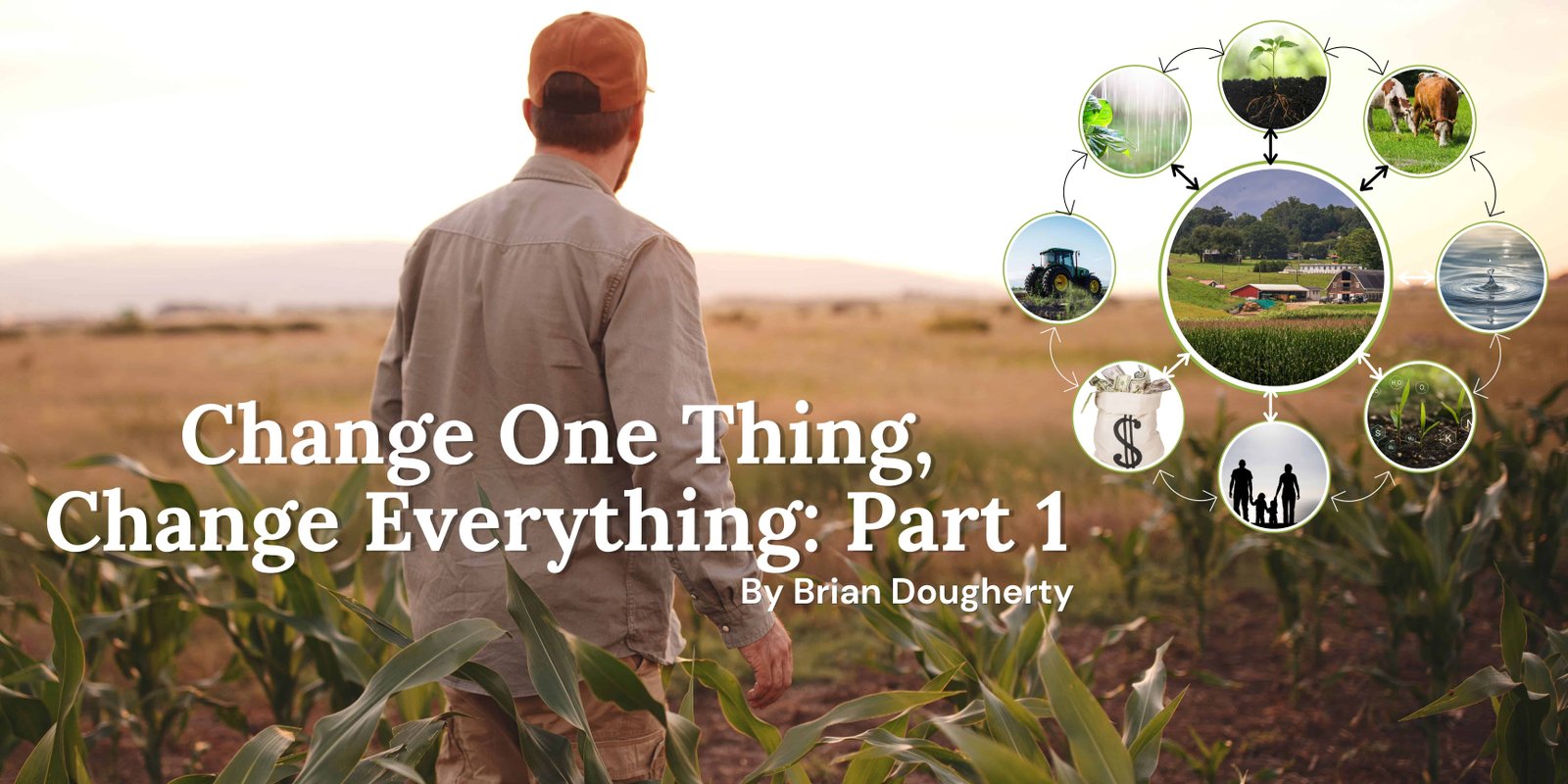
Change One Thing, Change Everything
Why Systems Thinking Is the Key to Farm and Ranch Survival
By Brian Dougherty
Farm and ranch profitability depends on more than crop yields, livestock performance, or input costs. These factors are connected through a larger system, and decisions that improve one area can create costly problems elsewhere. Systems thinking in agriculture helps farmers and ranchers understand these connections, recognize the root causes of recurring problems, and make management decisions that improve soil health, reduce input dependence, and build long-term profitability and resilience.
In this 3 part series we will explore why looking at individual parts of a farming system without considering the whole can lead to unintended consequences. From declining soil health and disrupted water cycles to rising production costs, the effects of narrow decision-making can undermine the very goals farmers and ranchers are working to achieve. By learning to see how agricultural systems function as a whole, producers can make better decisions for their land, their bottom line, and the future of their operations.
Part 1: The Hidden Costs of Narrow Boundary Thinking in Agriculture
I recently read an article on the Regenetarianism blog that put a name to something I have been wrestling with for many years. The author contrasts two ways of thinking about methane. The first is reductive reasoning: trace a gas back to a single source, multiply it by a fixed number, and assign blame. Under that logic a grazing cow is no different than a tailpipe. The second is intellectual ambidexterity, the ability to see and understand the details and the whole system at the same time.
Agriculture is full of examples where reductive reasoning drives management decisions. We measure and manage for one or two things and then are surprised when everything else starts to unravel. In this article series I will make the case that intellectual ambidexterity, which most of us would call systems thinking, is absolutely critical for both the short and long-term survival of every farm and ranch. We simply cannot separate one action or one outcome from all of the other things it is connected to.
Two Views, Not One: Understanding Farm Systems as a Whole
Being a systems thinker does not mean throwing out reductionist science. Taking a system apart and studying the pieces taught us how legumes fix nitrogen, how mycorrhizal fungi trade phosphorus for sugar, and how plants farm microbes in their roots. Donella Meadows’ book Thinking in Systems makes the same point: studying the parts is valuable, as long as we don’t lose sight of the relationships that tie those parts together. Meadows wasn’t writing about farming, but almost every page of the book reads like it was written with agriculture in mind. I encourage everyone to read this book if you want to become a better systems thinker.
The problem isn’t reductionism. The problem is when the narrow view becomes the only view. That’s when we start making decisions that are perfectly logical inside a narrow boundary and disastrous outside of it. A good manager uses both views: a narrow boundary view to examine the moving parts, and a wide boundary view to keep an eye on the whole.
The Hidden Costs of Farm Management Decisions
You have probably heard about externalities, which are unintended costs imposed on someone else or the environment, where that effect is not reflected in market prices. But there are also “internalities”, or costs that you impose on yourself that do show up on your bottom line over time.
Internal Costs: How Poor Management Decisions Affect Farm Profitability
Internalities are the bills that we pay the price for. Some of the costs of narrow boundary thinking show up directly on the farm, just not typically on this year’s balance sheet. Many farms have lost 40–70% of their original soil carbon, which means they have lost a big share of their water and nutrient holding capacity. That shows up as compaction, a broken water cycle, more pest and disease pressure, and increased input costs. Every one of these problems is real and they are all paid for by the farm or ranch. The problem is they often show up later, so we rarely connect them to the decisions that caused them.
External Costs: How Farming Decisions Affect the Environment and Communities
Externalities are the bills that we send to everyone else. In other words, they are costs that leave the farm entirely. High nitrate levels in drinking water. Sediment in our rivers and a dead zone in the Gulf. Taxpayer dollars spent on crop insurance premium subsidies and on edge-of-field engineering fixes that treat the symptom instead of the cause. Even food itself. An analysis of USDA food composition data found declines in several minerals and vitamins in garden crops between 1950 and 1999. One likely explanation is that decades of breeding for yield diluted the nutrient content of what we grow. We got exactly what we selected for.
Ecologist Garrett Hardin has a great line on this: “There are no side effects, just effects.” A “side effect” is just an effect we didn’t foresee or didn’t want to think about. And as Meadows points out, the long term increasingly becomes the short term. The nitrate leaving a field can become somebody’s contaminated drinking water soon after.
Meadows also warns against confusing effort with result. Agriculture does this constantly. We count acres enrolled in a program, practices installed, gallons applied, and bushels harvested. Those are measures of effort. The result most of us actually want is a profitable farm with functioning soil that produces healthy food and clean water. If we only measure effort, we will get a system that is very good at producing effort, not results.
Systems Thinking: Aligning Farm Management With Long-Term Goals
What is your farm or ranch designed to do? Meadows describes every system as having three parts: elements, interconnections, and a purpose. On a farm or ranch the elements are easy to list: soil, plants, livestock, microbes, water, equipment, people, and money. The interconnections are harder to see. They are the flows of energy, water, and minerals, and the feedback loops that tie them together. At Understanding Ag, we refer to these as ecosystem processes. The purpose is the most important part, and the most overlooked and misunderstood.
Meadows says that purposes are deduced from behavior, not from rhetoric or stated goals. Ask most farmers what their goal is and you’ll likely hear something about profit, family, and leaving the land better than they found it. Contrast that with how decisions are made. Are animals overstocked and pastures overgrazed? Are nitrogen rates set to chase the last bushel? The coffee shop conversation is about bushels per acre and weaning weights, and the plaques on the office wall are from yield contests. The behavior says the purpose of the system is yield or rate of gain, not profit or resilience or passing on the land in better condition. Here is the uncomfortable part: your farm or ranch is designed to produce the results it is producing right now, not necessarily the results you say you want.
Meadows offers a simple test for spotting systems at work. If A causes B, ask whether B might also cause A. Compaction restricts root growth. But restricted root growth also means fewer roots and less root exudate to build the aggregates that resist compaction. Low soil organic matter makes a crop more dependent on purchased fertility. Purchased fertility, in turn, reduces the plant’s need to feed the microbes that build organic matter. Once you start looking for these loops, you see them everywhere. A system causes its own behavior.
In part 2 of this series, we will investigate some of the common traps that prevent you from seeing the big picture and becoming a better systems thinker.
Ready to Make Your Farm or Ranch More Profitable and Resilient?
The challenges you face on your farm or ranch rarely exist in isolation. Understanding how soil health, water movement, plant diversity, livestock, and other ecosystem processes work together can help you address the root causes of problems rather than continually paying to manage the symptoms.
An Understanding Ag consultant can help you evaluate your operation as a whole, identify opportunities for improvement, and develop a practical plan tailored to your land, goals, and financial needs.
Reach out to an Understanding Ag consultant to learn more about managing systems profitably on your farm or ranch.

The post Change One Thing, Change Everything, Part 1 appeared first on Understanding Ag.


