

Food safety has been in the news a lot this year, from produce to poultry. Amid these outbreaks, the National Sustainable Agriculture Coalition (NSAC) has consistently reported dwindling staffing levels at nearly all federal agencies that oversee food safety. In late 2026, the staffing situation continues to deteriorate.
The US Department of Agriculture (USDA) faces an unprecedented staffing crisis, having lost approximately 20,000 employees since January 2025. Meanwhile, USDA remains in the throes of a major reorganization, caught in court, that will likely drive even more employees out of the Department. The Food Safety and Inspection Service (FSIS), the USDA agency responsible for ensuring that meat, poultry, and eggs sold in the United States are safe, has experienced relatively small staff losses compared to other agencies. However, the loss of food safety inspectors – the professionals on the front lines of protecting US food safety – has been staggering, resulting in a more than 50% reduction in some classes of inspectors. At the federal or state levels, these inspectors are not being replaced. Without a decline in the number of inspected plants, the remaining inspectors are required to sufficiently inspect a greater number of plants in the same amount of time.
This loss of inspectors also potentially threatens the impact of previous investments in meat processing and efforts made by the Trump Administration. This blog post examines the continued loss of food inspectors and its potential impacts on farmers, processors, and consumers.
Types of Inspectors
FSIS is responsible for meat, poultry, and egg safety and labeling, while the Food and Drug Administration (FDA) is responsible for the food safety of fresh fruits and vegetables.
FSIS employs three different types of inspectors:
- Food Inspectors (occupational code 1863) include both slaughter inspectors and processed products inspectors. Slaughter inspection involves the ante-mortem and post-mortem inspection of meat, poultry, and fish. Processed products inspection includes the inspection of all processed foods containing those animals, such as lunch meat or ground beef.
- Consumer Safety Inspectors (occupational code 1862) work in meat, poultry, and egg processing plants to ensure that the plants’ Hazard Analysis and Critical Control Point (HACCP) and Sanitation Standard Operating Procedures (SSOP) plans are adequate and conduct regulatory oversight in the plants to ensure compliance with consumer protection regulations such as labeling requirements.
- Compliance Investigators (occupational code 1801) investigate alleged violations of food safety laws and regulations, sample products for pathogens, educate businesses and officials about food safety, and serve as a liaison to other agencies and law enforcement.
In addition to these inspectors, FSIS also employs Public Health Veterinarians (occupational code 0701). Public Health Veterinarians are responsible for conducting animal disease surveillance, conducting ante-mortem and post-mortem inspection of meat and poultry products that require specific veterinary expertise, supervising food inspectors to ensure compliance, and enforcing federal meat and poultry inspection procedures, including animal welfare laws.
Collectively, these inspectors are frontline professionals who inspect and regulate the meat processing industry for our collective safety. Their expertise takes years to build, including how to work proactively with plants in a way that protects consumers and processors.
FSIS Staffing Losses
Every category of FSIS inspectors and public health veterinarians has lost a significant staff between January 2025 and June 2026, but the most dramatic losses were amongst Food Inspectors. Since January 2025, FSIS has lost 56% of its Food Safety Inspectors (463 employees), the frontline inspectors in meat, poultry, and egg processing facilities. This is followed by the loss of 28% of Compliance Investigators (40 employees), 27% of Public Health Veterinarians (177 employees), and just 2% of Consumer Safety Inspectors (106 employees).
Figure 1: Percentage decline in FSIS positions

Cumulatively, FSIS lost 786 employees (11%) in positions responsible for ensuring the safety of meat and animal products.
Losses by State
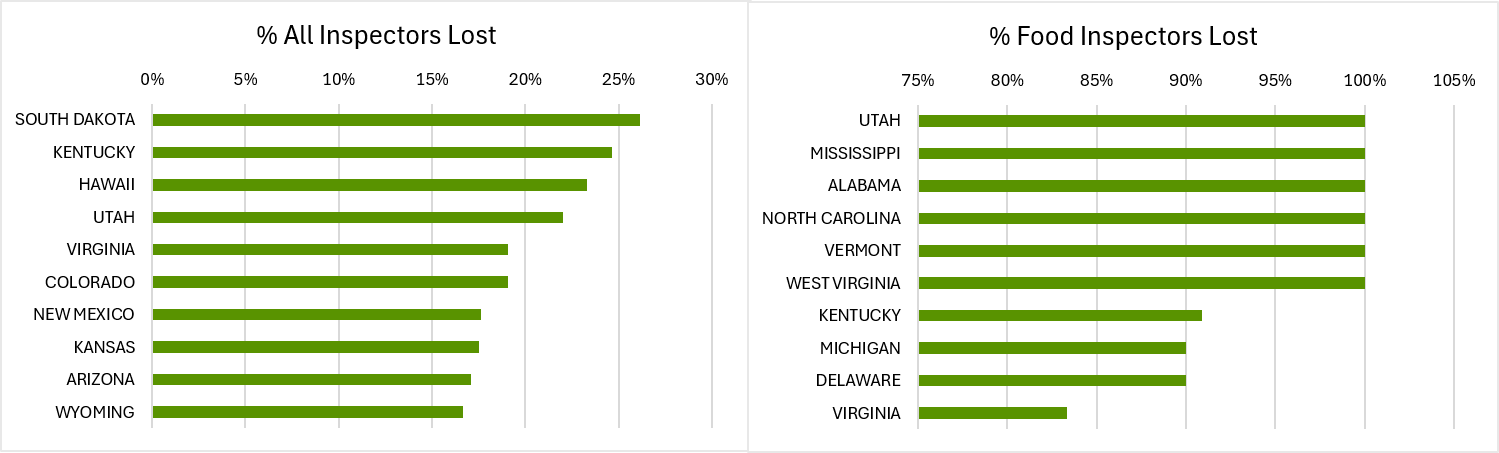
This loss has not been felt uniformly across the US, but has been geographically concentrated, both in percentage and absolute numbers of inspectors.
Many states have lost a significant amount of their inspectors, with many of the greatest absolute losses in southern states. This is true both across all classes of inspectors and specifically food safety inspectors (1863s).
Figure 2: Top Ten States With FSIS Inspectors Lost
Figure 3: Top Ten States With Percentage of FSIS Inspectors Lost
State Meat Inspection
Federal inspectors are not the only professionals that inspect plants across the US. In fact, there are many state inspectors across the country that are partially funded by the federal government.
However, there is no evidence that the ranks of state inspectors are expanding to take up the slack due to the decline of federal inspectors, in part because processing plants do not erratically shift from state to federal inspection requirements. Even if that were the case, it is unlikely that there would be adequate funding for new state inspectors. In recent years, there have only been small increases in the FSIS cost share with states in the State-Federal Cooperative Inspection Program (SFCIP), in response to state Meat and Poultry Inspection (MPI) agencies’ input.
Impact on meat processing expansion
The cumulative loss of food safety inspectors comes at a time of significant expansion in the number of smaller processors in the US. Since 2021, hundreds of millions of dollars from USDA have been spent to expand existing plants and increase the overall number of plants. Several states, including Oregon and Minnesota, have also made significant investments towards this goal. This has increased the number of small and very small plants under both federal and state inspection, and those that need approval to join those ranks.
Anecdotally, many plants across the US have experienced slower-than-normal approval of inspections as a result of staffing losses, which would largely be done by the 1862 and 0701 inspectors. The broader dwindling of food safety inspectors, and of public trust in our food safety system, threatens the expansion of the small and very small meat and poultry processing system.
Without adequate hiring of new staff, or expansion of plants in state inspection and the Cooperative Interstate Shipment (CIS) program, these plants may not be able to receive the mandated continued inspection, or receive grants of inspection to start processing that they need. Delayed grants of inspection, or rescheduled inspection days, have a much greater impact on these smaller processors, as they have fewer financial resources to sustain themselves compared to multi-plant companies that may be able to shift output from one plant to another.
Potential solutions
With the current Administration’s focus on supporting ranchers and farmers by supporting slaughterers and processors, such as through the Rancher First initiative, it makes sense that they would also want to support continued market access through federal or state inspection for those enrolled in CIS.
Significant rehiring of federal food safety inspectors is needed, along with continued investment in programs like the Start Up program to draw more states into MPI, and consequently, more hiring of state inspectors.
This rehiring or state expansion would create an opportunity to ensure that the newly hired inspectors are also following many of the recommendations outlined in the 2020 Small Plant Report. This would fall in line with Administrator Ransom’s recent commitment to the expansion and protection of small processing plants.
The post FSIS Staffing Losses Put Small Meat Processing at Risk appeared first on National Sustainable Agriculture Coalition.


