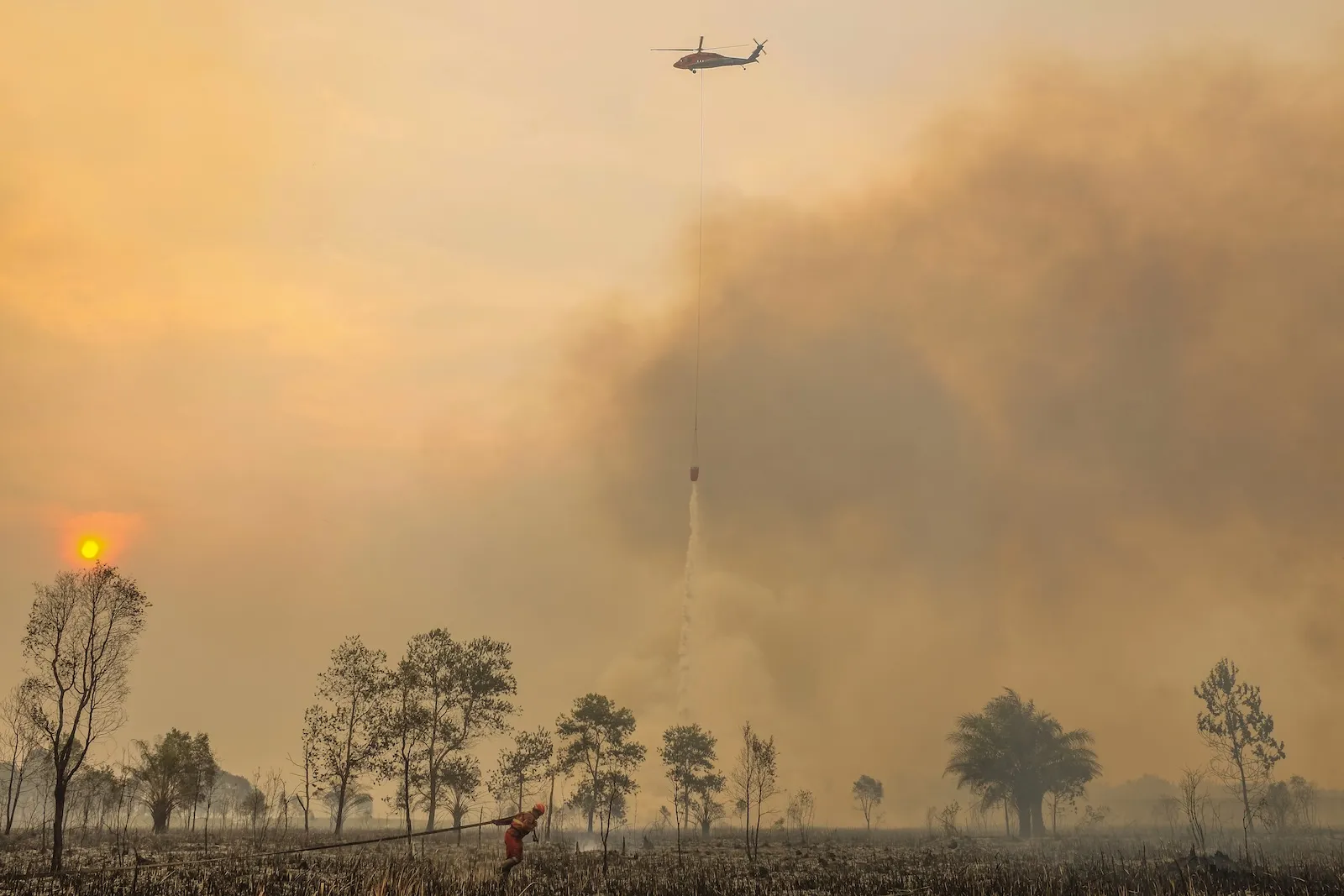
A government bus outfitted with oxygen tanks. Fire fighters collapsing to the ground in relief at the first sign of rain. Dozens of orangutans rescued. And hundreds of Indonesian students marching through the haze, some wearing gas masks, others carrying signs that read, “If we burn, you burn with us.”
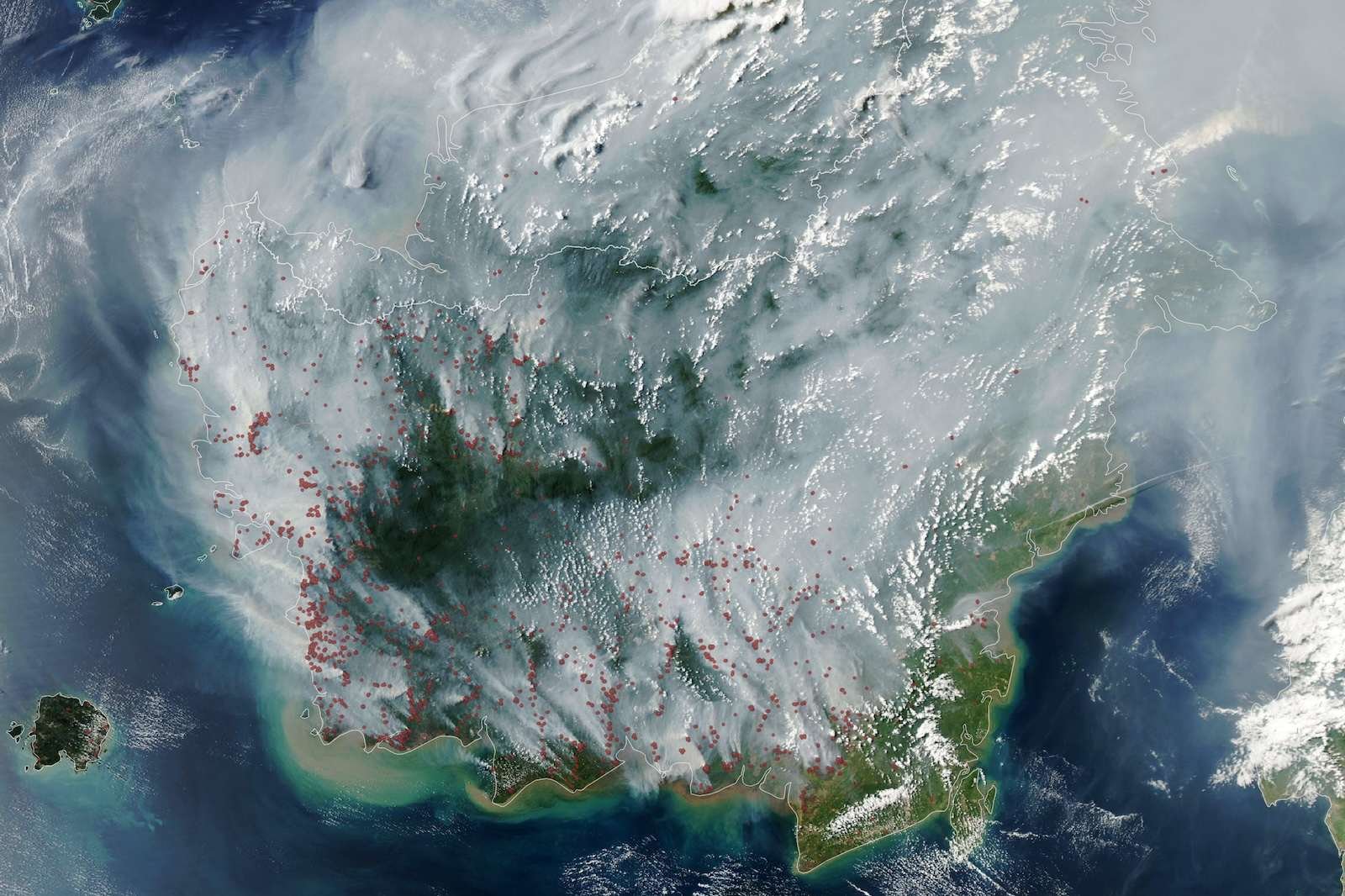
These are recent scenes from Indonesia’s worst wildfire season in a decade. More than 4.6 million acres have burned across the country since August, blanketing its large island regions, like Kalimantan and Sumatra, in a thick smoke that has spread to neighboring countries. Millions are breathing in this toxic haze, and the government’s data shows that more than 300,000 Indonesians have sought treatment for acute respiratory problems.
On some days, the air quality conditions are more than thirteen times worse than the threshold considered unhealthy. And like in many tropical countries, buildings in Indonesia are often built to maximize air flow — rather than filter it or keep it out. “This is a public health catastrophe,” said Robert Field, a fire researcher at Columbia University. Although there are other pressing consequences of the fires, such as carbon emissions and the harm to wildlife and forest habitats, “it’s hard to think much past the air quality issues,” he said.
NASA
The fires are the latest environmental crisis inundating Indonesia. The country is not only one of the world’s most populated, but also one of its most disaster-prone. Just last year, 1,200 residents of Sumatra died during catastrophic cyclone-induced flooding and landslides. And the country’s capital city of Jakarta, which already partially sits below sea level, is sinking. As a warming climate pushes sea levels higher, the country is racing to build a new capital on higher ground.
These disasters are all wrought from the dangerous combination of human sprawl and climate change. But it’s not yet clear how much hotter temperatures influenced the ongoing disaster. By contrast, wildfires in parts of the world that are warming faster than Indonesia – like the recent devastating outbreaks in Canada and Europe – are clearly attributable to climate change, scientists say.
The primary culprits of Indonesia’s fires, however, are no mystery. A super-strong El Niño has sent Indonesia into a severe drought, drying out the peatlands found across the country. And peat, a kind of soil packed with partially-decayed plant matter, is highly flammable, especially so when dried out. But when farmers or agriculture companies light fires to quickly and cheaply clear away vegetation and debris, a common practice in Indonesia, peat fires can quickly get out of control — smoldering underground for months.
“This is a crime against humanity because what they have done endangers the health of millions of our people,” said Prabowo Subianto, the president of Indonesia, during a cabinet meeting last week, according to a government press release. Seemingly in an effort to address the public’s outrage, he vowed to investigate who was responsible for lighting the fires, and called these actions a kind of environmental terrorism. Frustration over the fires, high living costs, and government spending has sparked numerous large protests across the country in recent weeks.
Bagus Kurniawan/NurPhoto via Getty Images
The government has also been preparing for the year’s fires for months, ever since scientists first began forecasting this year’s El Niño. “This year, we must be much more careful,” Raja Juli Antoni, Indonesia’s minister of forestry, told the United Nations in May. “The potential for a longer dry season due to El Niño demands heightened vigilance from all of us.”
Unfortunately, the fires were lit anyway. According to Field, who worked with the Indonesian government to create fire prevention strategies in the 2000s, many of the fires appear to be on unmanaged lands next to working plantations, which often grow oil palm, and are the primary driver of Indonesia’s high rates of deforestation and biodiversity loss. That means the fires were likely being used to clear the overgrowth to make room for more crops, he said.
Indonesia has faced terrible peat fire outbreaks since the 1990s, but began making strides to address the problem in the last decade. In 2014, it banned drainage canals used to dry out peatlands and make them more suitable for crops. And a couple years later, after a particularly bad wildfire season, the government sharply curbed deforestation and began restoring large areas of already-degraded land. The rate of deforestation continued to fall for five more years and, although it began creeping back up in 2022, remains far below what it once was.
“I was optimistic that the drought was inevitable but the fire was not,” said Field, adding that Indonesia was much more prepared for this year’s fires than in the past. “I don’t think there was a lack of sincerity from officials not wanting this to happen, and the fact that it did just points to how hard it is to manage fire in such a large and complicated country.”
Peat fires are an especially challenging form of wildfire for many reasons, said Israr Albar, Indonesia’s former deputy director of forest fire management, in an emailed statement. The dense build up of organic material allows fires to burn underground for months, making them difficult to detect by satellite even as they release large amounts of carbon and smoke. (The smoke can become dense enough to obscure satellites from seeing fire on the surface, too.) “Just because we cannot see a fire does not mean it is not there,” Albar said.
This dynamic makes the flames hard to locate and put out, and even fires that seem extinguished will often reignite without notice. And it’s not always possible to find the large amounts of water necessary to put a peat fire out during the water-stressed conditions of the dry season. The country recently saw some rain, but “that doesn’t mean the danger has passed,” Albar said. “Even when the rainy season begins, fires may continue underground.”
This story was originally published by Grist with the headline What’s fueling Indonesia’s worst wildfire season in a decade? on Oct 30, 2026.