Which Countries Have the Most Debt Per Person?
Key Takeaways:
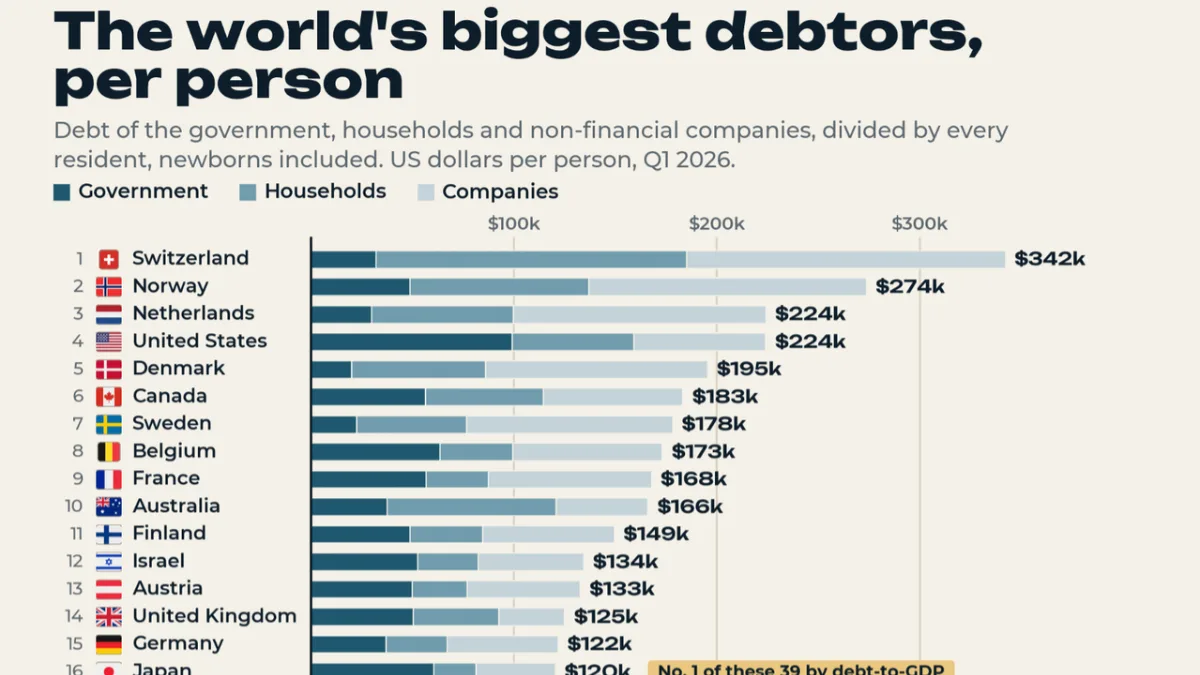
- Switzerland leads 39 economies with $342,000 in combined government, household, and corporate debt per resident.
- Norway ranks second at $274,000, while the Netherlands narrowly edges out the United States at $224,000.
- Household and corporate borrowing account for more than 90% of Switzerland’s total, highlighting how debt composition varies across countries.
Global borrowing extends far beyond government budgets. Mortgages, business loans, and corporate bonds all contribute to the trillions of dollars owed across the world’s economies.
This visualization by Valerii Emelianov ranks 39 economies by debt per resident, combining borrowing by governments, households, and non-financial companies.
The figures use Q1 2026 data from the Bank for International Settlements’ Credit to the Non-Financial Sector, divided by population estimates from the UN World Population Prospects 2024.
Which Countries Have the Most Debt Per Person?
The following table uses Q1 2026 data:
| Rank | Country | Debt Per Person ($) | |||
|---|---|---|---|---|---|
| Household | Government | Corporate (Non-Financial) |
Total Debt | ||
| 1 |  Switzerland |
153,138 | 31,994 | 157,108 | 342,240 |
| 2 |  Norway |
88,108 | 48,775 | 136,973 | 273,856 |
| 3 |  Netherlands |
69,724 | 29,973 | 124,460 | 224,157 |
| 4 |  United States |
60,103 | 99,103 | 64,826 | 224,032 |
| 5 |  Denmark |
65,957 | 20,070 | 109,337 | 195,365 |
| 6 |  Canada |
58,021 | 56,323 | 68,910 | 183,254 |
| 7 |  Sweden |
54,142 | 22,484 | 101,633 | 178,259 |
| 8 |  Belgium |
35,895 | 63,541 | 73,687 | 173,123 |
| 9 |  France |
30,627 | 56,669 | 80,440 | 167,736 |
| 10 |  Australia |
83,473 | 37,381 | 45,140 | 165,995 |
| 11 |  Finland |
35,894 | 48,682 | 64,903 | 149,479 |
| 12 |  Israel |
29,932 | 52,473 | 52,051 | 134,456 |
| 13 |  Austria |
27,036 | 49,837 | 55,722 | 132,595 |
| 14 |  United Kingdom |
42,202 | 50,267 | 32,455 | 124,923 |
| 15 |  Germany |
30,146 | 36,936 | 54,660 | 121,741 |
| 16 |  Japan |
20,947 | 60,496 | 38,896 | 120,339 |
| 17 |  New Zealand |
44,463 | 26,154 | 33,968 | 104,585 |
| 18 |  Italy |
15,932 | 60,895 | 25,877 | 102,704 |
| 19 |  Spain |
17,492 | 40,542 | 31,632 | 89,667 |
| 20 |  South Korea |
30,173 | 15,910 | 37,697 | 83,781 |
| 21 |  Portugal |
18,684 | 30,596 | 25,618 | 74,898 |
| 22 |  Greece |
10,930 | 41,923 | 17,252 | 70,105 |
| 23 |  Czechia |
12,232 | 16,331 | 21,136 | 49,699 |
| 24 |  Hungary |
5,173 | 20,619 | 19,633 | 45,424 |
| 25 |  China |
8,367 | 14,700 | 21,316 | 44,384 |
| 26 |  Saudi Arabia |
11,636 | 11,805 | 17,118 | 40,558 |
| 27 |  Poland |
6,208 | 16,939 | 9,838 | 32,984 |
| 28 |  Chile |
8,114 | 7,677 | 16,254 | 32,045 |
| 29 |  Malaysia |
9,693 | 9,105 | 12,462 | 31,261 |
| 30 |  Russia |
3,897 | 3,571 | 15,494 | 22,962 |
| 31 |  Brazil |
4,414 | 10,668 | 6,341 | 21,423 |
| 32 |  Thailand |
7,065 | 4,893 | 5,642 | 17,599 |
| 33 |  Argentina |
798 | 10,800 | 3,021 | 14,619 |
| 34 |  Mexico |
2,584 | 7,447 | 3,151 | 13,182 |
| 35 |  Türkiye |
1,748 | 3,939 | 6,736 | 12,423 |
| 36 |  Colombia |
2,445 | 6,285 | 2,776 | 11,506 |
| 37 |  South Africa |
2,353 | 5,506 | 2,344 | 10,204 |
| 38 |  India |
1,226 | 2,085 | 1,398 | 4,708 |
| 39 |  Indonesia |
760 | 2,027 | 1,225 | 4,012 |
Switzerland’s $342,000 per-person total is roughly 25% higher than Norway’s $274,000, the second-highest figure. The Netherlands narrowly outranks the United States, with just $125 separating their per-resident totals.
The gap between the top and bottom of the ranking is enormous. India’s $4,700 and Indonesia’s $4,000 per resident are less than 2% of Switzerland’s figure.
Why Do Wealthy Countries Have More Debt?
Advanced economies dominate the upper rankings, reflecting deeper credit markets, higher property values, and greater access to financing.
Switzerland’s position is particularly striking because government borrowing represents less than 10% of its total. Non-financial corporate debt accounts for roughly $157,000 per resident, while household debt contributes another $153,000.
The United States has a different profile. Government debt accounts for approximately 44% of its $224,000 per-person total, compared with just 9% in Switzerland. This illustrates how countries can have very different borrowing patterns.
Does Higher Debt Mean Greater Financial Risk?
Higher debt does not necessarily translate to greater financial risk. Debt per resident measures the size of outstanding obligations, not whether borrowers can repay them.
Japan, for example, ranks 16th by debt per person at $120,000 but first among these 39 economies by debt relative to GDP. China ranks 25th per person at $44,000, yet fourth by debt-to-GDP.
Borrowing costs also matter. Countries paying more interest on government debt may face greater fiscal pressure even with lower debt balances.
Why Debt Per Person Doesn’t Tell the Whole Story
Debt per person offers a useful snapshot of borrowing across economies, but it doesn’t account for differences in income, assets, or repayment capacity.
A country with high household borrowing may also have expensive housing and substantial household wealth. Similarly, large corporate debt balances can reflect extensive business investment and access to deep financial markets.
For a fuller picture, debt-to-GDP ratios, borrowing costs, and balance-sheet assets all matter. The OECD’s household debt indicator and IMF debt statistics provide additional context for comparing financial conditions across countries.
Learn More on the Voronoi App
For a closer look at public borrowing specifically, explore Ranked: Countries With the Most Government Debt Per Person on Voronoi.