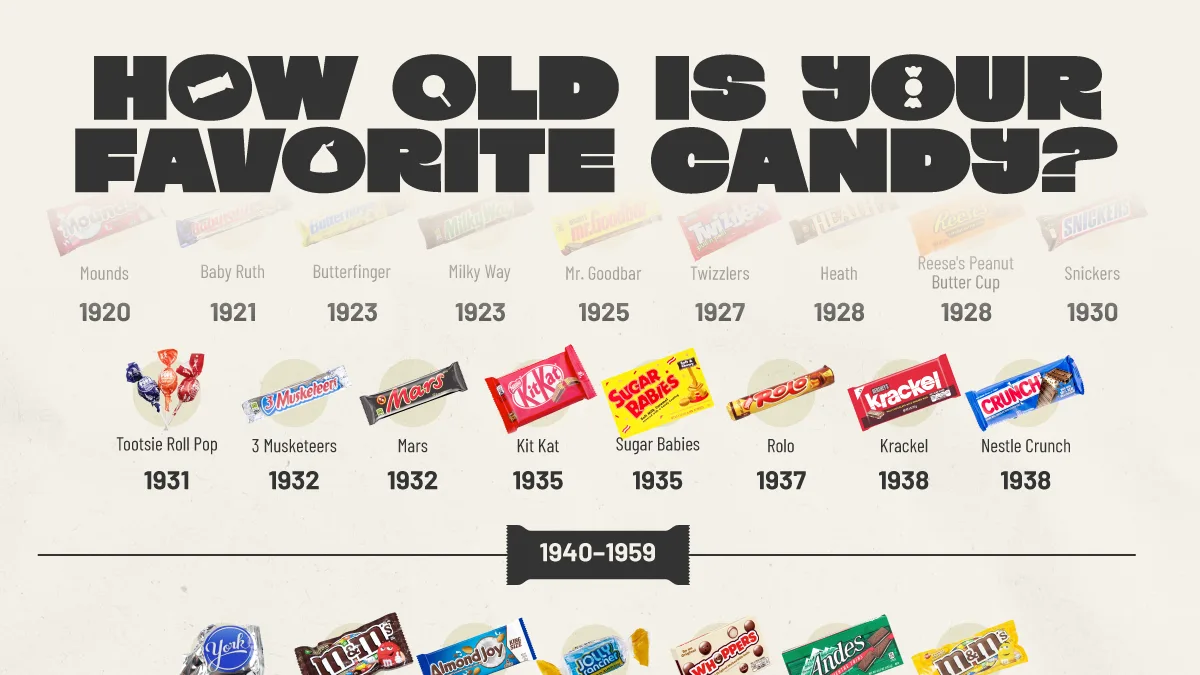
How Old Are America’s Favorite Candies?
Key Takeaways
- More than half of the 40 candies were introduced before 1940, including familiar favorites like Reese’s Peanut Butter Cups, Snickers, and KitKat.
- The 1920s and 1930s produced 17 of the 40 candies, making them the most represented decades in the selection.
- Tootsie Roll is the oldest candy at 130 years, while M&M’s, introduced 45 years later, topped YouGov’s 2021 popularity survey.
Every Halloween, familiar candy brands fill store shelves and trick-or-treat bags. Some of these treats have been around for generations, while others are relatively recent additions.
But when did America’s favorite candies first appear?
This visualization traces the origins of 40 popular candies selected from a 2021 YouGov survey of 1,188 U.S. adults.
Respondents chose their preferred treats in head-to-head matchups, with candies ranked by the percentage of matchups they won. The visualization features the 40 highest-ranking eligible branded candies and chocolates. Launch years were compiled from manufacturer histories and other sources, with ages calculated as of 2026.
The Oldest Candies in America’s Favorite 40
The candies are arranged by their original introduction dates, from the late 1800s through the 1990s. The table below shows when each product first appeared.
| Candy | Launch year |
|---|---|
| Tootsie Roll | 1896 |
| Hershey’s milk chocolate bar | 1900 |
| Hershey’s Kisses | 1907 |
| Toblerone bar | 1908 |
| Mounds bar | 1920 |
| Baby Ruth bar | 1921 |
| Butterfinger | 1923 |
| Milky Way bar | 1923 |
| Mr. Goodbar | 1925 |
| Twizzlers | 1927 |
| Heath Bar | 1928 |
| Reese’s Peanut Butter Cup | 1928 |
| Snickers bar | 1930 |
| Tootsie Roll Pop | 1931 |
| 3 Musketeers | 1932 |
| Mars bar | 1932 |
| KitKat | 1935 |
| Sugar Babies candy | 1935 |
| Rolo candy | 1937 |
| Hershey’s Krackel bar | 1938 |
| Nestle Crunch bar | 1938 |
| York Peppermint Pattie | 1940 |
| M&Ms (Original) | 1941 |
| Almond Joy | 1946 |
| Jolly Ranchers | 1949 |
| Whoppers | 1949 |
| Andes Chocolate Mints | 1950 |
| Peanut M&Ms | 1954 |
| Starbursts | 1960 |
| Sweet Tarts | 1963 |
| 100 Grand bar | 1964 |
| Twix bar | 1967 |
| Charms Blow Pops | 1971 |
| Hershey’s Special Dark | 1971 |
| Skittles (Original) | 1974 |
| Reese’s Pieces | 1978 |
| Whatchamacallit bar | 1978 |
| Sour Patch Kids | 1985 |
| Dove Dark Chocolate bar | 1991 |
| Dove Milk Chocolate bar | 1991 |
Tootsie Roll takes the top spot as the oldest candy in the selection. First introduced in 1896, it reaches 130 years in 2026, according to the manufacturer’s history.
Hershey’s milk chocolate bar follows at 126 years old, having debuted in 1900. Hershey’s Kisses arrived in 1907, while Toblerone was introduced in Switzerland in 1908.
These four products are the only candies in the selection that date back to before 1920.
How the 1920s and 1930s Shaped America’s Candy Aisle
Some of today’s most recognizable candy bars emerged during a remarkable two-decade stretch. Many have changed surprisingly little in their basic form, even as their packaging and marketing have evolved.
When Snickers debuted in Chicago in 1930, it cost just five cents. The bar was named after a horse owned by the Mars family, and it was sold in the United Kingdom under the name Marathon until 1990.
KitKat has a similarly unexpected history. First launched in Britain in 1935 as Rowntree’s Chocolate Crisp, it adopted the KitKat name in 1937. During World War II, ingredient shortages led the company to switch to dark chocolate and blue packaging, replacing the familiar red wrapper.
The staying power of these products reflects how candy brands developed generations ago have remained recognizable despite changes in ownership, branding, and consumer tastes.
From Wartime Candy to Hollywood Fame
M&M’s, introduced in 1941, was originally produced for the U.S. military during World War II. Its hard candy shell helped protect the chocolate from melting, making it practical for soldiers carrying rations. The candy became available to the wider public in 1945 and remains a favorite today.
The brand continued to expand after the war. Peanut M&M’s arrived in 1954, the same year the company introduced its now-famous slogan, “Melts in your mouth, not in your hand.”
Reese’s Pieces, introduced in 1978, found a different route to fame when it appeared in Steven Spielberg’s 1982 film E.T. the Extra-Terrestrial. The candy became closely associated with the movie, showing how pop culture could introduce a relatively new product to a wider audience.
Other additions came later, including Sour Patch Kids in 1985 and the Dove chocolate bars dated to 1991 in the supplied dataset. Even the 1991 entries are now 35 years old, showing how long it has been since some of the younger candies in the selection first appeared.
How Were the 40 Candies Selected?
The selection comes from a YouGov survey conducted on October 5–6, 2021, among 1,188 U.S. adults.
Participants chose between pairs of treats, and each candy received a score based on the percentage of its head-to-head matchups that it won. M&M’s led with a 76.1% win rate, followed by Reese’s Peanut Butter Cups at 74.4% and Kit Kat at 72.8%.
The visualization includes the 40 highest-scoring eligible branded candy and chocolate products from the 76 treats tested. Generic categories and non-candy foods were excluded, while separately tested product variants were retained.
The ages reflect the first commercial introduction year of each selected product, calculated as 2026 minus that year. They are calendar-year ages rather than exact anniversary ages, and some products were originally sold under different names.
Because the selection is based on a 2021 survey, it does not represent a new ranking of America’s favorite candies in 2026.
Learn More on the Voronoi App
If you enjoyed this visualization, check out The $128 Trillion Global Economy: Every Country’s GDP Ranked on the Voronoi app.