

Organizations connected to a shadowy network of pro-oil groups conducted a covert influence operation targeting Millennials and Gen Z in British Columbia. Groups partnered with an advertising company managing popular TikTok and Instagram accounts to subtly promote pro-oil industry narratives and reshape public perception of fossil fuels. Materials found in a previous Greenpeace investigation showed details of the partnership and promoted content.
Greenpeace previously found Energy in Action (EIA), a platform with possible connections to the Canadian Association of Petroleum Producers (CAPP) and created to coordinate pro-oil organizations and groups supported by the Canadian Energy Prosperity (CEP) group of funders. The platform showed network members, including those who spread climate disinformation, and hosted various network materials, some of which detailed operational tactics and targeting.
The narrative battleground
Avatar Innovations, which describes itself as a venture platform for the energy industry, developing programs to support industry professionals, technologies, and startups, appears to be at the centre of this operation. The company’s financing and industry ties are closely linked to the oil industry. Its venture fund received investments from Cenovus Energy, while program partners included the Oil Sands Alliance, an industry association representing five of Canada’s largest oil sands producers which includes Cenovus, and other major oil companies such as Chevron and Enbridge.
A presentation file on Avatar Innovations’ page on EIA named “Avatar Innovation KPI’s” listed a few of the organization’s achievements and program metrics. The opening slide, titled “Our Wins in 2025” also mentioned government lobbying, advocacy in traditional media, delivering major policy recommendations, and starting the organization’s “Gen-Z new-media strategy.” This strategy, according to the presentation, was launched to promote pro oil industry “storytellers” specifically on TikTok, Instagram, and podcasts to “reshape public perception and elevate the narrative around Canada’s resource strengths.”
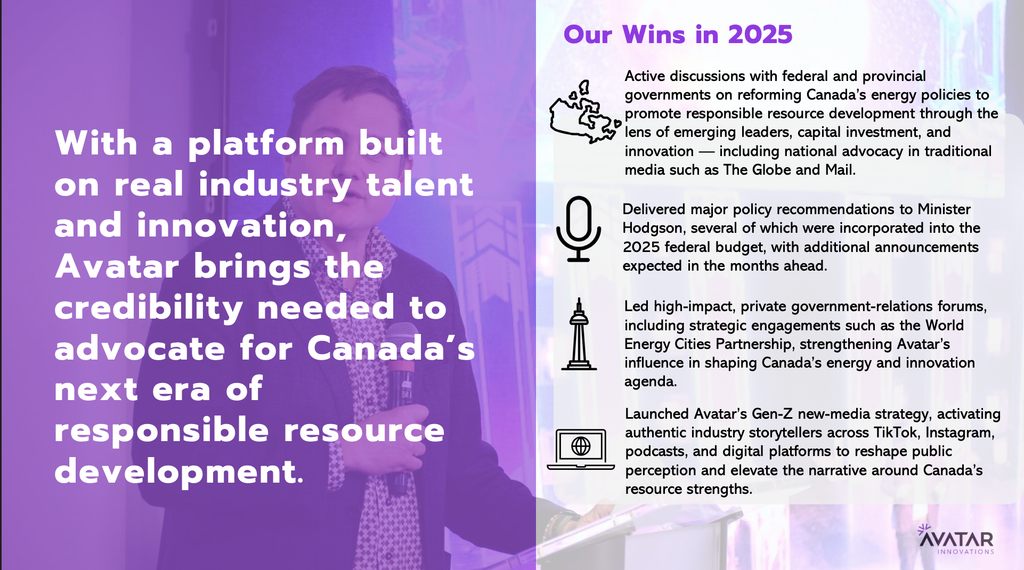
In the presentation, which called B.C. “one of the most important narrative battlegrounds in Canada’s resource debate,” Avatar highlighted the importance of targeting younger demographics and explained its strategy to “get young BCers engaged in energy.” To do so, Avatar partnered with a company called Salient Media, which described itself as “B.C.’s third largest media network,” to deliver “real energy stories” targeting “Gen-Z and Millennials.”
PR for a (pro oil) cause: Salient Media
On its website, Salient Media showcases several social media accounts, some with large followings, that brands can partner with to reach specific demographics. Among these accounts are @facesofvancouver, @venturedca, @keepitunfiltered, and @britishcolumbiathings where Greenpeace found several pieces of Avatar’s content featured without disclosing this relationship.
While Salient Media claims to be one of the top three media companies in B.C., the company’s website offers limited information about its operations, staff, or work, focusing mainly on the social media accounts it manages.
Reviewing Whois data for salientmedia.ca showed that the domain was registered on May 16, 2025. An analysis of the website’s source code revealed multiple placeholders and the use of stock media, suggesting that the site is either incomplete or created from a generic template.
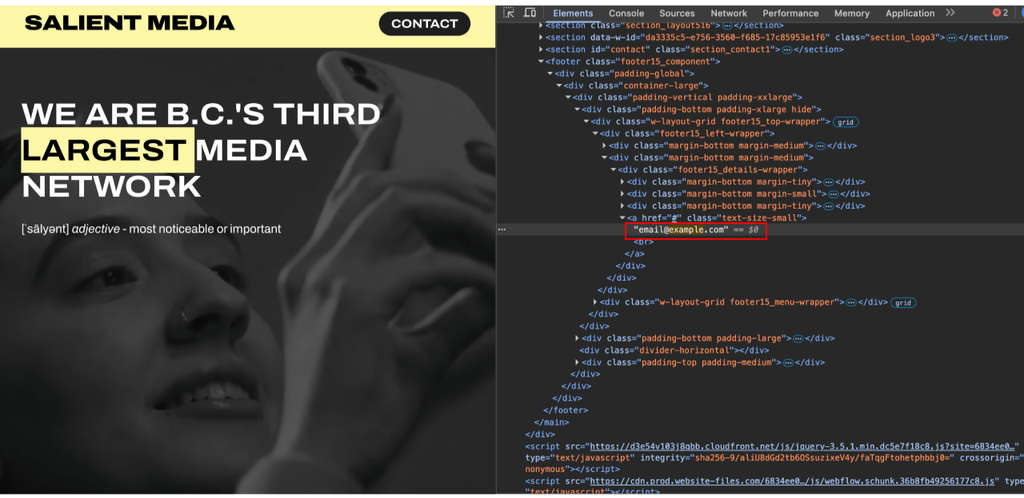
Although the domain is recent, the social media accounts Salient Media manages are much older. The Facebook and Instagram accounts for a page called Unfiltered, for example, advertised on the company’s website as a news account that can reach over 160,000 followers, were created in February 2013 under different names. Reviewing historical records for Unfiltered’s YouTube channel by searching its ID, which cannot be changed, revealed that it was previously named David from Vancouver, a channel dedicated to personal vlogs about the city. A similar pattern was identified across other accounts managed by the company.

Changes to several account names and data suggest they were acquired and then repurposed by an entity like Salient Media for commercial campaigns.
Pro oil narratives posing as authentic content
In its presentation, Avatar noted that four “content pieces on Avatar participants and companies” were featured. Some of this content appeared on Avatar’s EIA page and in a video recap prepared for the CEP group of funders on another EIA page. This partnership likely continued following this presentation as Greenpeace Canada discovered more than four Avatar-linked posts.
Much of this content was published on the TikTok and Instagram accounts for @facesofvancouver. The account, which has more than 11,000 followers on TikTok and 65,000 on Instagram, posts short video interviews with Vancouver residents answering different questions about social, cultural, and political topics.
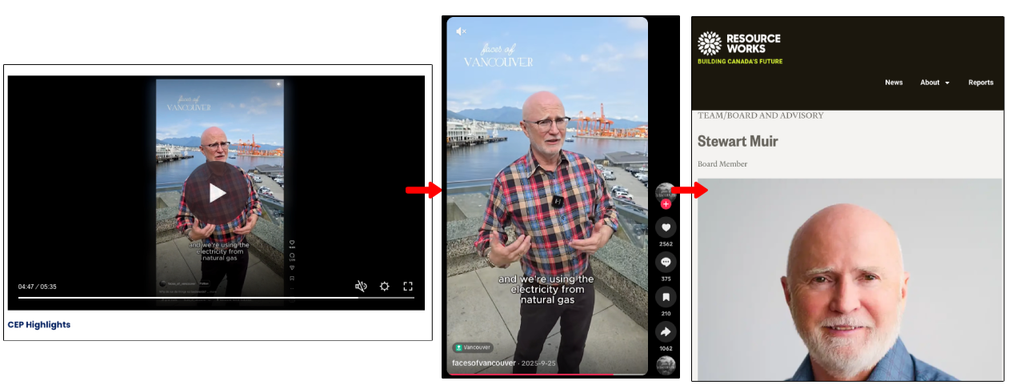
Greenpeace identified nine @facesofvancouver posts that connected to Avatar and the EIA network. These included three pro fossil fuel videos featuring Stewart Muir, President and CEO of Resource Works, an EIA member. Although some of these videos were presented to CEP funders in a recap video, the @facesofvancouver accounts fail to disclose any commercial relationship with Avatar or Resource Works.
The tanker ban
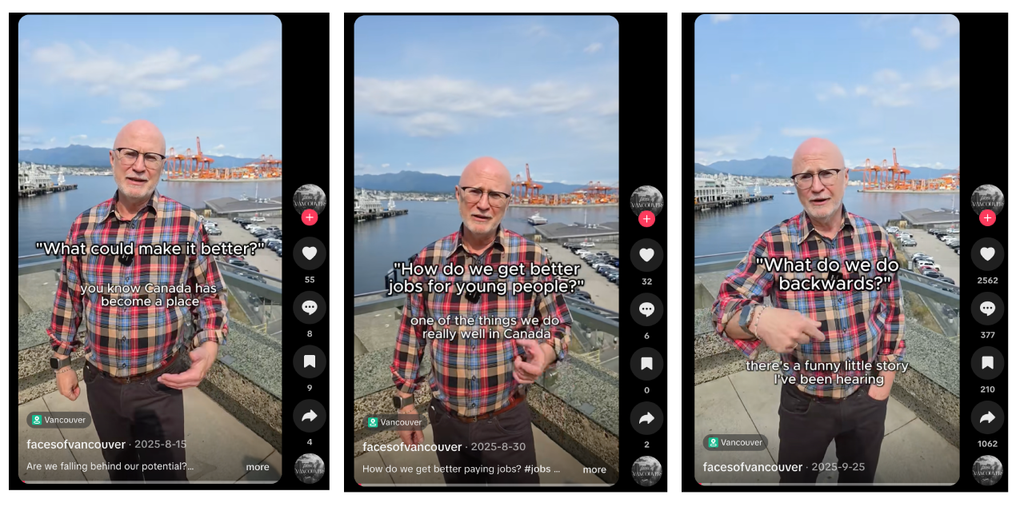
With the Port of Vancouver in the background, Muir describes Canada’s unique natural wealth and resources in the first video, arguing that the country fails to take advantage of the fuel and energy resources it has that the rest of the world needs. In the second video, addressing the question “How do we get better jobs for young people?”, Muir discussed raw materials that could be developed in B.C. into higher-value products. In the final video, which received most engagements and views answering the question “What do we do backwards?” he referred to issues with the West Coast tanker ban. He argues that the province’s energy policies ban turning natural gas into electricity locally, forcing B.C. gas to be sent to the U.S. to be converted into electricity and sold back to the province.
Entrepreneurship
Three other videos were featured on facesofvancouver and linked to Avatar featured a founder of Avatar-funded startup CO2Brew, a company specializing in on-site carbon dioxide recovery and recycling systems for breweries. In these videos, the founder discusses their interest in entrepreneurship, how it might differ city to city, and highlights their company’s work and positive experience with Avatar’s program.
Women in the trades
Three other videos linked to Avatar showed a person discussing employment, highlighting the benefits of skilled trades and opportunities for women in the sector. The speaker also talks about differences between being in B.C. and Alberta, addressing “sensitivities to the oil and gas industry” in B.C. and the presence of common industry misconceptions. The video encourages residents to better understand the oil and gas industry’s economic value and to benefit from its opportunities, aligning directly with Avatar’s CEP presentation goal to engage young audiences across the province.
More social media accounts
On other TikTok accounts managed by Salient Media such as @keepitunfiltered and @venturedca, Greenpeace Canada found additional content in different formats promoting Avatar Innovations and pro-oil industry messages.
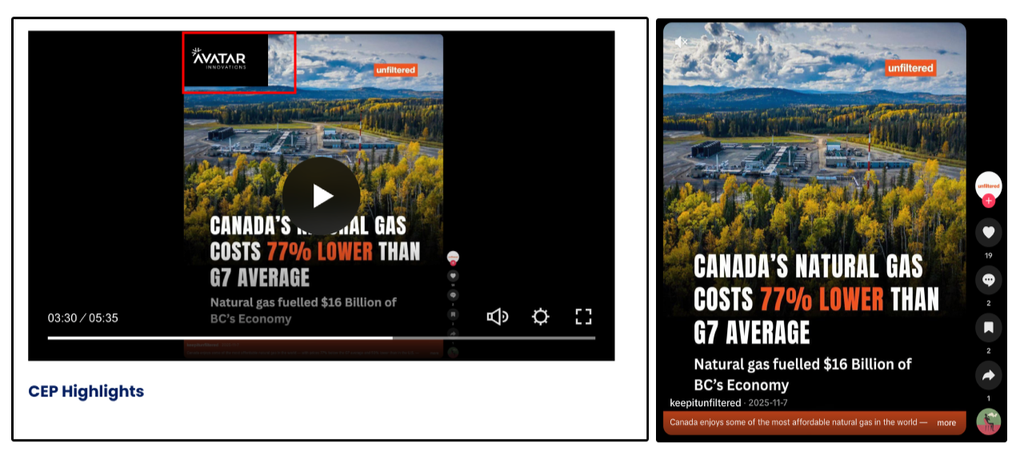
A TikTok post on @keepitunfiltered, citing Resource Works, promoted Canada’s natural gas stating that it “fuelled $16 billion of B.C.’s economy” This post also appeared in a video recap on an EIA page showing “CEP Highlights” for funders in January 2026 at the Calgary Petroleum Club. The video included Avatar Innovations’ logo, which was not used in the original TikTok post offering additional evidence of an undisclosed partnership. The post was also cross-posted on the @britishcolumbiathings Instagram account, another Salient Media account.
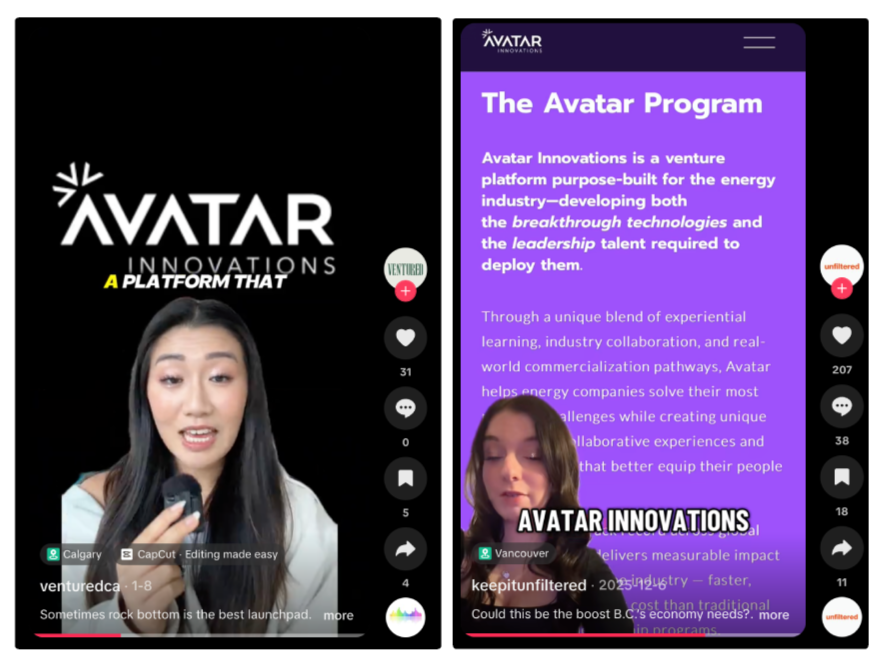
A video on @keepitunfiltered opens by highlighting economic challenges in B.C., arguing for taking advantage of the province’s natural gas resources and promoting “cleaner pipelines powered by hydro.” Before the end of the video, the narrator promotes Avatar saying that the company pairs the industry with “Indigenous communities and academia, with a touch of AI-enablement.” Another video on @ventured was more direct, profiling Avatar Innovations CEO Kevin Krausert, highlighting his career and how he founded the company, in addition to describing the company’s programs.
Energy Futures Institute
Moreover, Avatar’s page on EIA showed an Instagram post by Salient Media page @britishcolumbiathings, which has over 27,000 followers, labeled as a “media appearance.” Published on April 22, 2026, the post featured a visual stating, “B.C. facing energy deficit by 2029, says B.C. Hydro,” followed by a subheadline citing Energy Futures Institute (EFI) saying, “B.C. should boost renewable gas supply not ration power.”
Energy Futures Institute (EFI) is a program by Resource Works. While EFI does not have a dedicated page on EIA similar to pages found for around 30 organizations and groups, it appears in an agenda for a funder event for CEP at the Petroleum Club on July 2, 2025. There, EFI is listed next to the name Barry Penner, a former B.C. cabinet minister and chair of EFI. According to the agenda of the event, Penner co-presented alongside Muir during a slot dedicated to Resource Works.
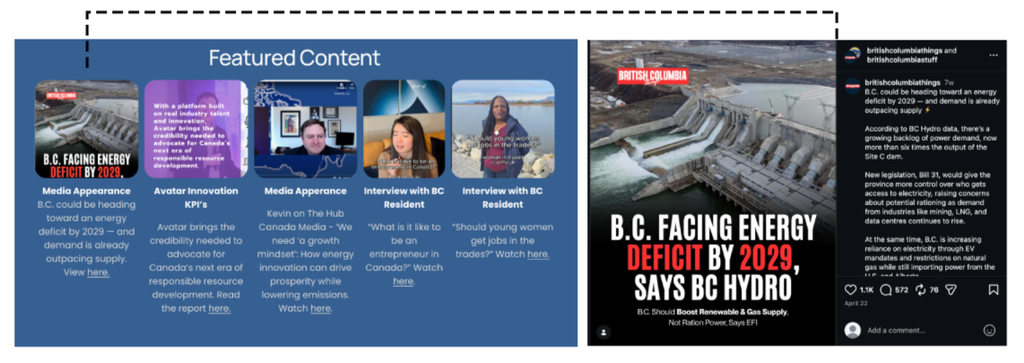
The post’s caption warned of an imminent energy deficit in B.C. driven by surging power demand, citing “BC Hydro data.” It argued that the province’s Bill 31 could lead to electricity rationing by expanding government authority to prioritize power allocation for industrial sectors like “mining, LNG, and data centres.” Moreover, the post criticized B.C.’s “increasing reliance on electricity through EV mandates and restrictions on natural gas while still importing power from the U.S. and Alberta.” It concluded by highlighting EFI’s recommendations to expand both renewable and natural gas supplies rather than limiting access.
Notably, the post mentioned only EFI rather than Avatar Innovations. However, Avatar listed the post on its EIA page, suggesting a connection between the two organizations.
Sponsored content via social media influencers is not uncommon. However, companies funded by or linked to the fossil fuel industry cross a line when they disguise paid messaging as organic content through third-party accounts. Unlabeled partnerships turn promotion into covert influence operations that spread climate disinformation and undermine information integrity in Canada. This is particularly concerning given internal documents reveal an explicit intent to change public opinion.
Greenpeace Canada urges both campaign sponsors like Avatar Innovations and digital agencies like Salient Media to clearly disclose partnerships and label promoted content, ensuring Canadians know who is behind the information they consume.


