
A new drone entered the game at Canada’s Outdoor Farm Show 2026, and it may have thrown a curveball into spray drone options for farmers.
Forward Robotics of Cambridge, Ont., has entered the market with a fixed-wing spray drone called the U9.
One thing’s for sure: change happens fast in the drone industry.
WHY IT MATTERS: The boom design of a winged drone has the potential to cover more acres per pass than a traditional quadcopter.
Only one year ago, a 50-litre spray drone was surpassed by a 100-litre capacity DJI Agras quadcopter. At the time, it was the new benchmark for agricultural spray drones.
As a fixed-wing drone, the U9 doesn’t rely on the downward rush of air of a quadcopter to deliver product to the plant canopy, said Dwayne Henderson, marketing manager with Forward Robotics, at the show.
“It takes that theory of wing and the high pressure under the wing,” said Henderson, “laying out a spray pattern nice and evenly, and the efficacy that goes along with that.”
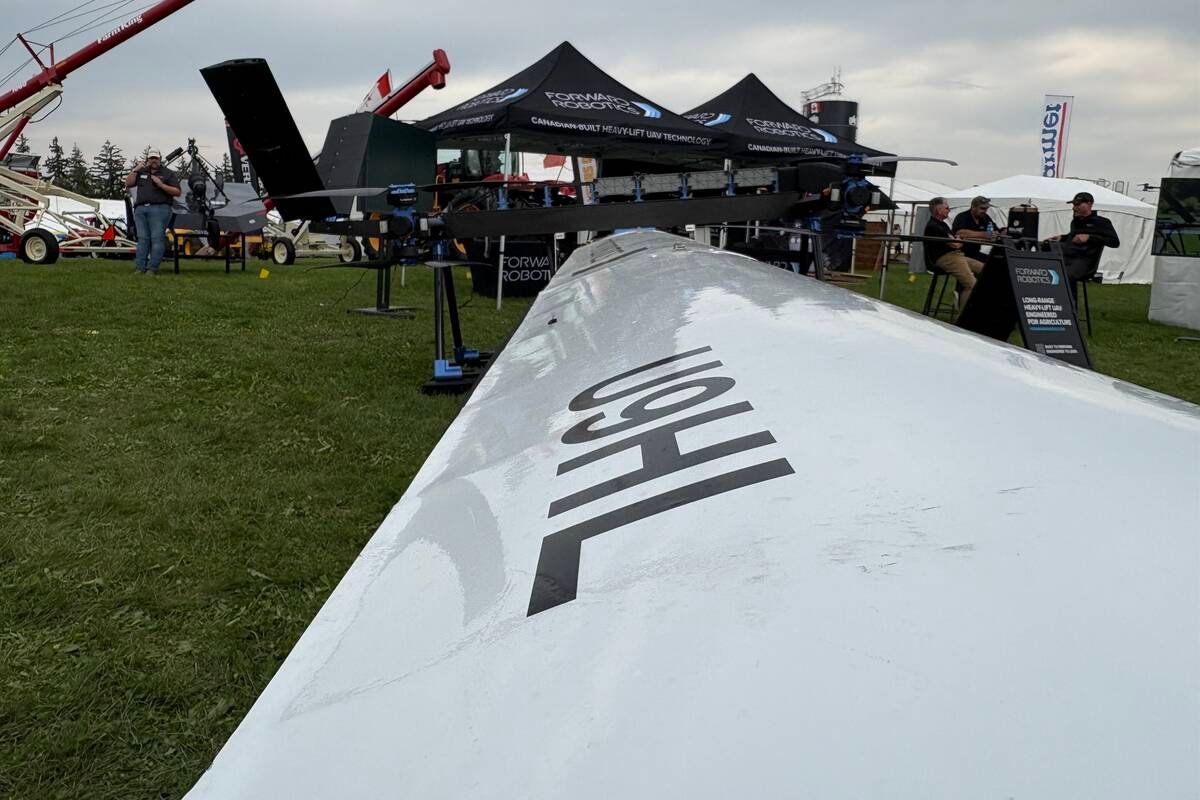
That efficacy comes with a nine-metre wingspan on the U9 that can cover a 12-metre swath, putting productivity at about 135 acres an hour.
The U9 demonstration model at Canada’s Outdoor Farm Show used traditional spray nozzles – eight nozzles per wing for a total of 16 – that are easily interchanged depending on what an operator wants to achieve in the field.
Up, up and away
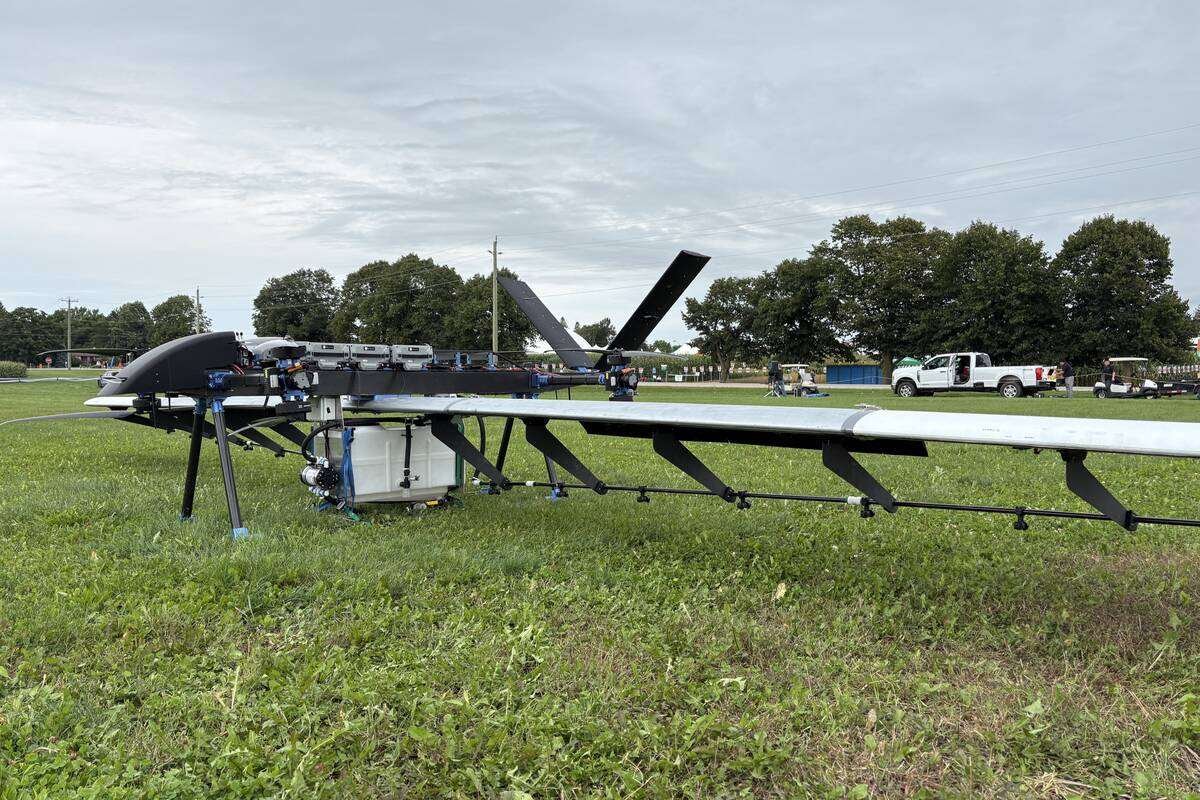
While the U9 looks like an airplane with its fixed-wing design, it takes off from the ground like a traditional drone.
But that’s where the similarities end.
Eight individual electric motors propel the U9’s four rotors into the air.
Once airborne, the rotors on the U9 transition to a forward tilt using artificial intelligence to essentially turn it into an airplane.
“That’s where we get the efficiency out of it and longer time flying,” added Henderson, “carrying a little more product, more acres per hour.”
More product comes in the form of a 100-litre tank on the underside of the U9.
Henderson said average flight time with a full payload is about 15 to 20 minutes.
Battery capacity
While the demonstration model at the show had four rechargeable batteries on board, the U9 can carry up to six batteries for larger jobs if needed.
Overheated batteries can be an issue with a traditional quadcopter, but Henderson said the U9 doesn’t suffer from that problem.
Forward flight on the U9 uses only about a third of the battery power to stay in the air.
This means the batteries only need about seven minutes to recharge after returning from a flight.
“Once those wings kick in,” said Henderson, “this system completely changes its configuration of what it needs to stay in the air and do the mission.”
The U9 spray drone stays on “mission” via a Starlink internet connection.
If a farm operator chooses to fly multiple drones in the field, Forward Robotics offers a U9 link setup to control all the aerial units at once.
“Through AI and the nine cameras on board, 360 lidar, and machine learning, these can go out into a field in a swarm and do the job on their own.”
Recognition
For its efforts, Forward Robotics was awarded a Silver Innovation Award at the farm show.
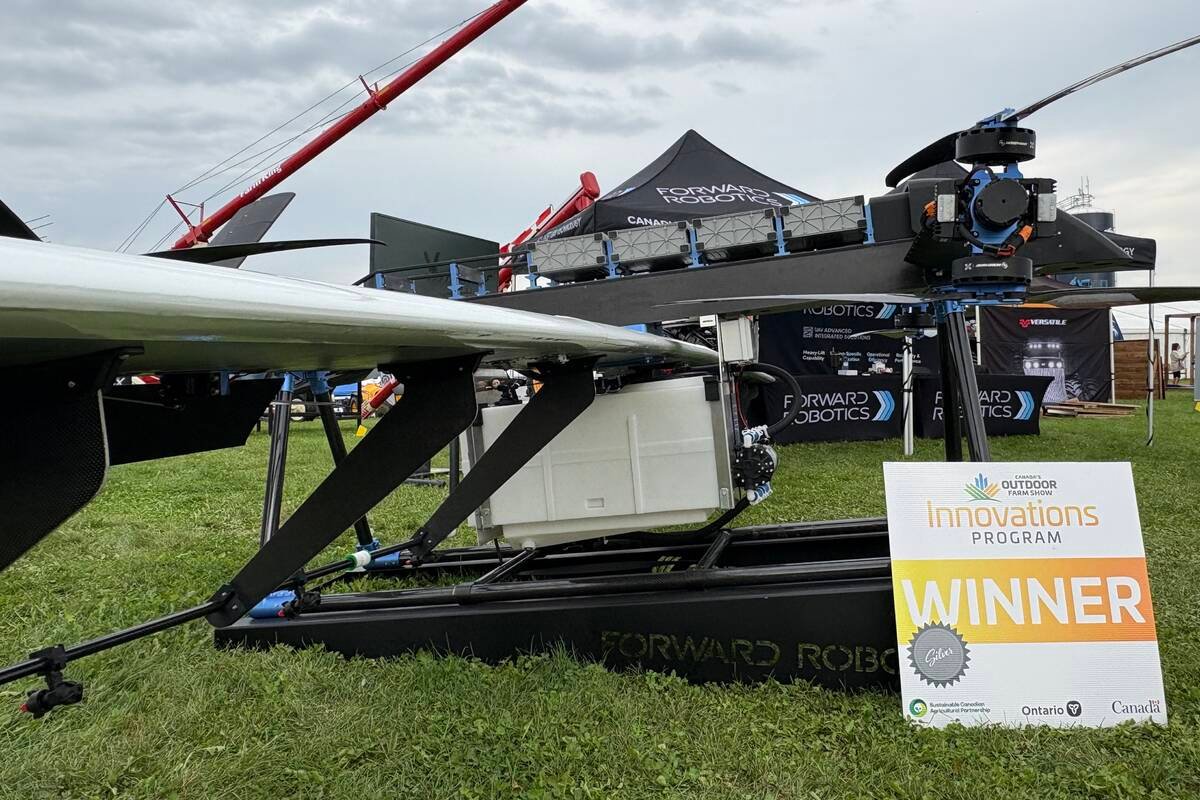
Much of the U9 is made in Canada, said Henderson.
“All of the software, all the proprietary patented control systems, everything’s all Canadian,” said Henderson.
At the show, he said that the company was moving to a new location at the end of September with a plan to start full production of the U9.
To build on its made-in-Canada approach, the company plans to start winding its own electric motors — currently one of the main outsourced components — and locally sourcing carbon fibre rotor blades and higher-end 3-D printing.
Henderson said that a lot of “brain power” went into this project from its engineering team and credited the owners of Great Lakes Helicopter with getting the project off the ground.
“I started my career off in helicopters and as a spray pilot,” said Henderson, “it’s time to retire because I think the drones are going to take over this industry. They’re leading the way.”
U9 specs
Width: 9 metres
Tank capacity: 100 litres
Top speed: 100 km/h
Spray width: 12 metres
Propulsion: four rotors powered by eight electric motors


