
Chris McLaren attributes ongoing genetic improvement, steady routine and cow comfort to a rapid return to high daily production of close to 50 kg of milk per cow, after converting to robotic milking.
The Drumbo-area dairy farmer said the Larenwood Farms herd’s average production dipped to between 40 and 43 litres per day after renovations began in 2025 inside the existing 120-cow sand-bedded free-stall barn.
Within what McLaren calls his “modified guided flow” robotic setup, the tracking parameters indicate the cows visit the milking robot between 3.1 and 3.2 times per day on average and complete a feeding, walking and resting loop 15 times per day.
Larenwood’s cows produce 47 to 49 litres and sometimes hit 50 litres.
“I never imagined we’d be pushing 50-litre averages every day,” he said in a Facebook post.

“The cows have really adapted to guided flow with no pellets,” he continued, referring to no feed being offered in the robot. “Only the cows that need to be milked are waiting in the holding area (and) they’re not there to try and steal the feed left over from the last cow who didn’t finish.”
In early October, McLaren told Farmtario the motivation behind the transition was to increase family time flexibility, address labour challenges and move to or beyond a three-times-per-day milking schedule.
Cow comfort
In 2012, when the herd moved to the free-stall barn, McLaren attempted to meet a three-times-a-day milking schedule but abandoned it due to labour issues. He said the experiment resulted in higher feed intake and production, which he hoped would be achieved with the robotic system.
He’s seen an approximately 10 per cent increase in feed intake with the three milking robots compared to the milking parlour configuration.
A huge part of achieving good results, McLaren believes, “is having a barn that’s calm and relaxed … Cows love to be bored and have a routine. Robotics are an extension of that.”

“In robotic systems, you don’t want to disturb the cows. Just let them do what they naturally want to do,” he said.
The McLarens decided not to modify the 2012 barn’s footprint for the robotic transition because it was built with a strong focus on cow comfort.
“It worked really well for us,” he noted. “The cows did really well there.”
Barn configuration
However, three-quarters of the interior space was renovated to create housing for three groups within the milking herd: a fresh, a mature and a young group.
- READ MORE: Managing through a dairy barn retrofit
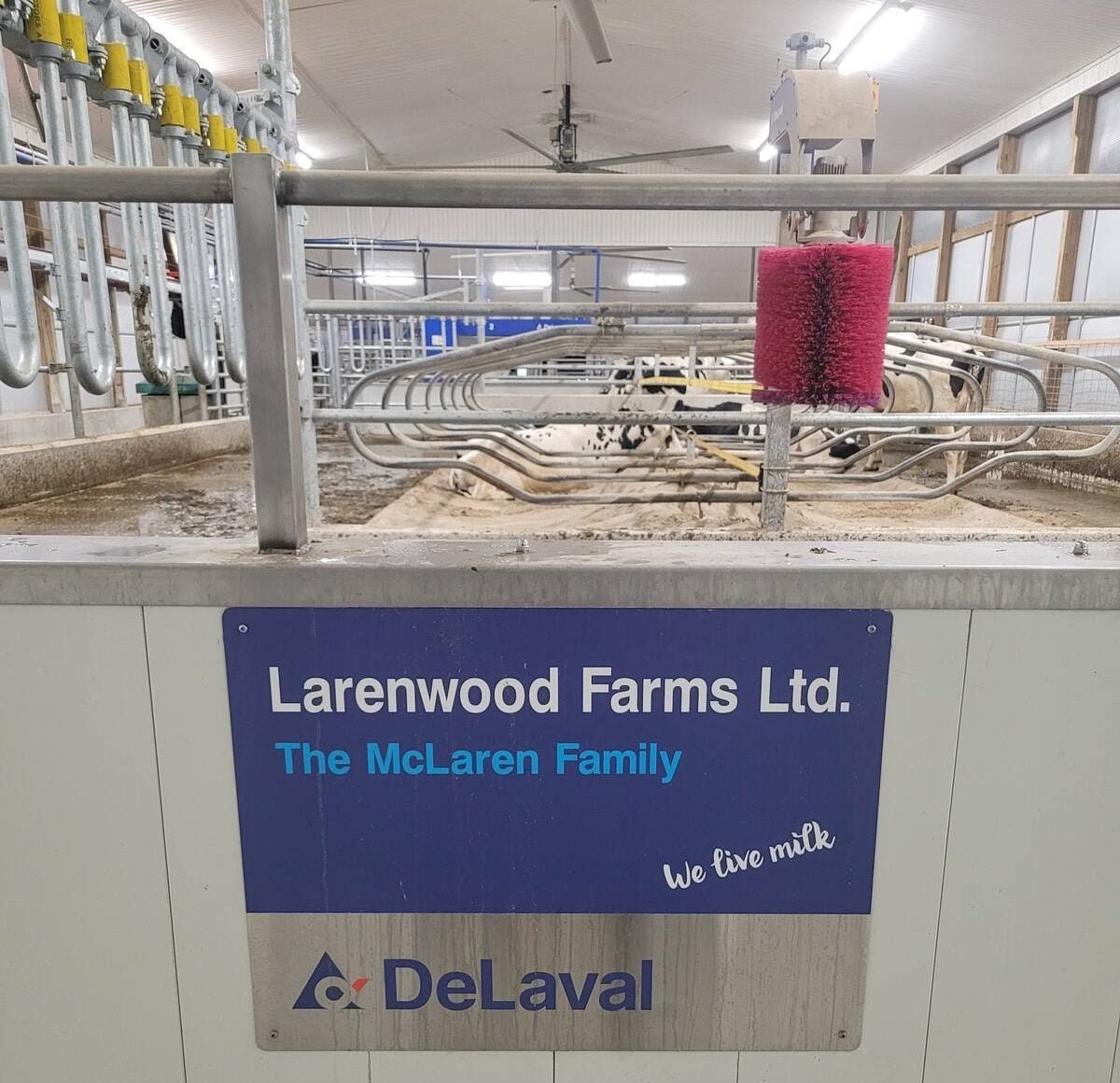
Phase one of the renovations involved installing two robotic units within the old free stall space. The former milking parlour building was gutted and converted into fresh cow housing, with a third robot installed to be shared between the fresh cow and older cow groups.
Each robot exit includes a sort gate to separate cattle needing special attention or breeding.
“I was already breeding for robotics 10 years ago without even knowing it.”
That’s because he strove for high capacity, moderate stature and good feet and legs in his cows’ offspring – “not too tall and frail but not too short and small.”
Genetics
Larenwood has been a closed herd for decades. McLaren doesn’t believe outside genetics on the female side is necessary to induce significant improvements in herd production, fertility, longevity or other factors.
“If you use a balanced lineup (of sires) and don’t put all your focus on one trait as opposed to other qualities, you constantly will be moving that herd ahead.”
Robot milking has led to increased breeding focus for teat placement, with McLaren appreciating Semex’s Robot+ branded strategy to address this as well as other genetic traits.
However, he questions milking systems and dairy genetic companies’ strategy touting the benefits of moving cows quickly through the robots. For him, milking speed isn’t necessarily the most important factor. A longer-milking cow that doesn’t create hold-ups in other ways, he argues, can be just as valuable as a quick-milking cow.
“What we like to see is a cow that wants to go to the robot, stands and doesn’t kick the milker off, and moves around the barn in a routine.”
If she likes to eat and readily converts that feed into milk, all the better – no matter how long each robot visit takes.
“There are a lot more other traits to a good robotics cow than how fast she milks,” he concluded.


