

As solar-plus-storage deployments accelerate, a fundamental design question continues to surface: whether the battery energy storage system (BESS) on a greenfield site should be coupled on the alternating current (AC) side, or the direct current (DC) side.
At first glance, DC often looks like the more attractive option. DC coupling reduces conversion losses and enables the battery to capture more clipped solar energy. Logic suggests that fewer conversion stages would lead to higher efficiency and more usable energy.
But real project behavior is different. Higher energy capture does not automatically translate into better economic performance. The interaction between PV production, grid constraints, battery dispatch, degradation, and system cost introduces complexities that cannot be captured through simplified assumptions about efficiency alone. A fair comparison between AC- and DC-coupled systems requires realistic modeling and system-level analysis under actual operating conditions.
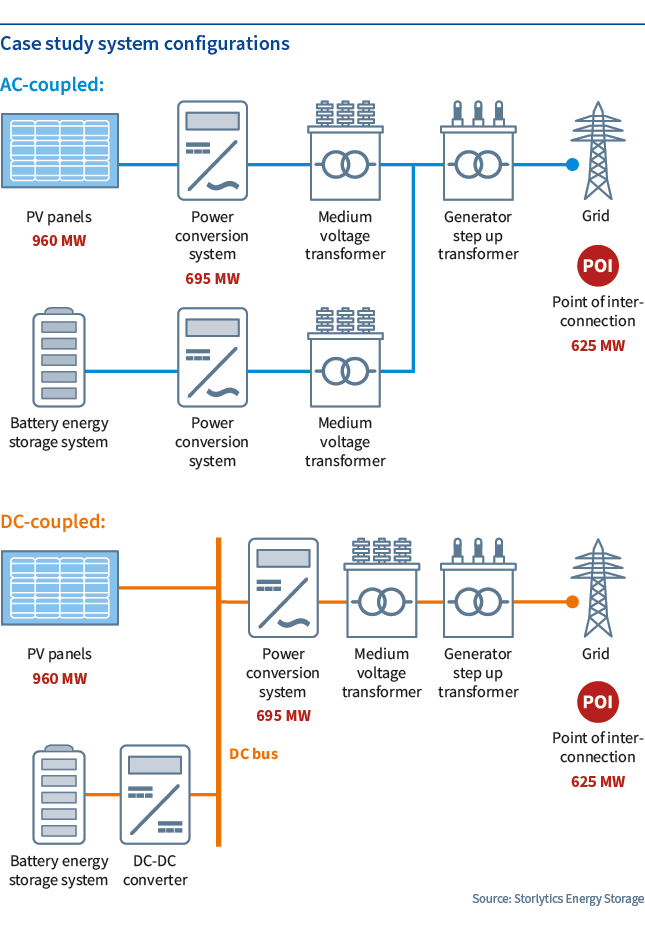
To explore this question, a detailed engineering study was conducted on a greenfield solar-plus-storage project in Nevada, in the United States. The objective was to design and evaluate the solar-plus-storage system using AC coupling and DC coupling approaches under a clearly defined use case to make a fair comparison between the two architectures. The configuration of the system in those two cases are shown in the chart to the left.
The PV system is to be integrated with battery storage to capture excess solar generation and shift it to evening demand periods. This should maximize the amount of usable energy delivered at the point of interconnection.
Key differences
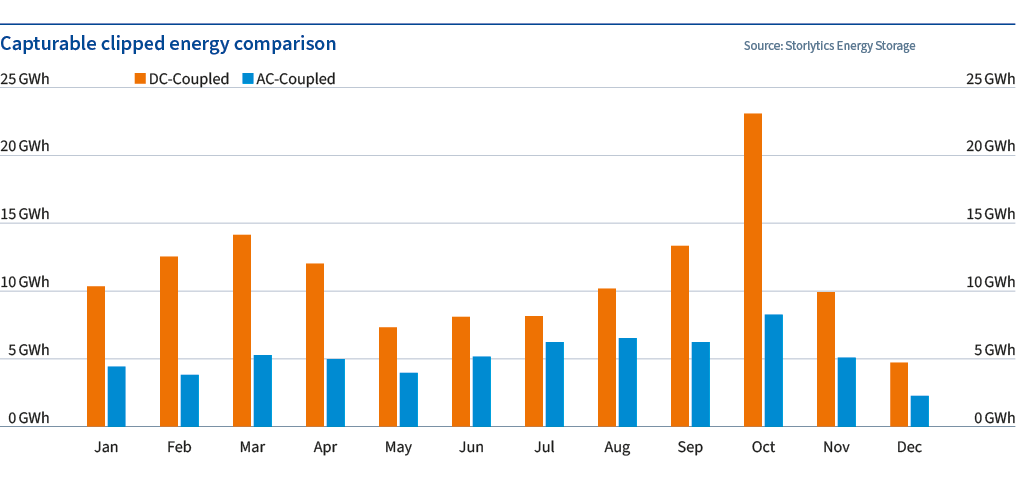
The two architectures behave differently from the very beginning of the energy flow. In DC-coupled systems, there is excess solar generation resulting from a commonly overbuilt solar-to-inverter capacity (1.38 in this case). This excess solar generation would be clipped or curtailed unless a DC coupled battery is there to capture it via a DC-DC converter. This allows the DC-coupled system to have an increased amount of capturable energy compared to the AC-coupled system, which can only capture energy that would be clipped due to inverter capacity and interconnection limit differences. In our case, the inverter capacity to interconnection limit is 1.11.
This difference can clearly be seen in the capturable clipped energy comparison (see chart on p.67), which shows higher available charging energy per month in the DC-coupled configuration and directly influences BESS sizing at the connection point.
The DC-coupled configuration captures significantly more clipped energy and therefore requires a larger battery system. In that case, the required BESS usable capacity to capture all clipped energy reaches 300 MW/1,245 MWh for DC coupling, compared to 70 MW/340 MWh for AC coupling. The DC-coupled system also achieves higher round-trip efficiency and greater annual energy throughput. From a purely technical perspective, DC coupling appears to be the stronger performer. Yet the economic outcome tells a different story.
Storlytics’ Battery System Modeler captures the battery utilization and cycling for both configurations. The DC-coupled configuration cycles more, leading to higher degradation and requiring greater upfront BESS overbuild. This leads to a much higher increase in system cost relative to the value of increase in overall energy production (from the additional energy stored in the BESS that would otherwise be clipped). As a result, when coupled with a four-hour BESS, the AC-coupled configuration achieves a lower levelized cost of energy (LCOE) of $42.57/MWh, compared to the DC-coupled system of $54.65 /MWh in the evaluated scenario.
For further validation, an extended LCOE sensitivity analysis was conducted across BESS durations of two, four, and six hours. This showed that as storage duration increases, the DC-coupled configuration experiences a faster rise in LCOE due to the higher battery capacity required upfront, driven by the high cycling and degradation of the BESS, while the AC-coupled configuration keeps a lower cost due to the lower usage of the BESS despite its limited additional energy generation.
Higher additional energy generation from coupling BESS to solar systems does not necessarily result in lower cost of energy. DC coupling is not universally better, and AC coupling is not universally cheaper. Each architecture performs differently depending on project objectives, grid constraints, and the battery dispatch. The appropriate solution can only be identified through a realistic system evaluation aligned with the intended use case.
About the authors

Jakir Hossain is the co-founder and chief technology officer at Storlytics Energy Storage. He is an engineering and business leader specializing in all aspects of energy storage development, including project origination, interconnection agreement support, EPC contracts, and technology selection. His background is in solid electric power systems, power electronics, and renewable energy resources. He has held lead engineering positions at Duke Energy Corp.

Mujtaba Abdelwahab, a renewable energy engineer and technical team lead at Storlytics, specializes in the modeling, design, and optimization of utility-scale battery energy storage systems (BESS) across a wide range of applications and markets.
The whitepaper containing full details of this case study and comparison is available at www.storlytics.net
The post AC-Coupled vs. DC-Coupled appeared first on pv magazine Global.


