
By Tracy Snider, ASA Executive Director of Industry & State Relations
As with any new technology, the bright shiny object tends to get the most attention.
Artificial intelligence, or AI, is becoming a bigger part of agriculture. From seed development to sprayers in the field, companies are using AI tools to help farmers make decisions, improve efficiency, and manage risk. While AI gets a lot of attention, it is important to understand that not all AI is the same – and not every tool fits every farm.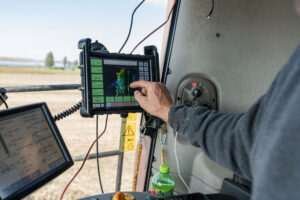
Most people know AI through programs like OpenAI’s ChatGPT or Google Gemini. These tools are called “large language models,” or LLMs. They are designed to answer questions and generate human-like text. But in agriculture, AI goes far beyond chatbots.
Today, AI is being used in seed genetics, crop protection, machinery, weather forecasting, and data analysis. Many ag companies believe AI can help farmers use inputs more precisely, reduce waste, and improve productivity. At the same time, AI tools are only as good as the data behind them. Poor data can lead to poor recommendations.
“Everybody’s excited about AI in agriculture, but nobody wants to talk about what we’re feeding it,” said Kyle Courtney, co-founder of AgriData Co-op. “An algorithm doesn’t know good data from bad — it just trusts what it’s given. If the numbers coming off our planters and combines are sloppy or incomplete, the AI will hand us confident, well-formatted nonsense. On my own operation, I’ve learned the hard way that clean data going in is the whole game. Quality at the source isn’t a technical detail. It’s the foundation everything else stands on.”
Eric Muckenhirn, co-founder of AgriData Co-op, added that the unglamorous prerequisite to “AI on the farm” is good data hygiene. “Mislabeled field boundaries, uncalibrated yield monitors, inconsistent variety records – decisions hinge on small margins, and a model trained on sloppy records will produce confident, wrong answers,” he said.
One of the biggest uses of AI is in seed breeding and genetics. Companies can now study huge amounts of plant data faster than ever before. Instead of waiting years to see how certain traits perform in the field, researchers can use machine learning models to predict which plant combinations may perform best under certain conditions.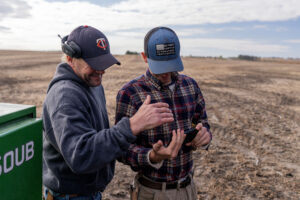
For example, AI can help scientists identify soybean traits linked to drought tolerance, disease resistance, or yield potential. Researchers can then focus on the most promising genetic combinations before they even plant a trial plot.
Companies like Corteva Agriscience and Bayer are investing heavily in AI-driven breeding systems. AI models can analyze field results, weather patterns, soil conditions, and genetics at the same time. The goal is to shorten the time needed to develop new seed products and improve how crops perform in different environments.
AI is also helping advance gene-editing tools such as CRISPR (Clustered Regularly Interspaced Short Palindromic Repeats). Scientists use computer models to predict where gene edits may succeed while reducing unintended changes. Some startups, including Inari Agriculture, are using AI to improve existing plant genetics without adding foreign DNA. Their systems look for ways to increase yield while using less water and fertilizer.
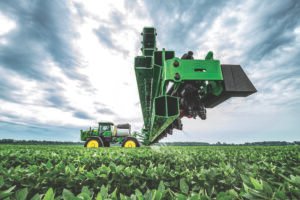
John Deere’s See & Spray technology scans fields in real time to identify weeds from crops using computer vision. Photo courtesy of John Deere.
AI is also changing farm equipment. John Deere has invested heavily in AI-powered machinery and robotics. One example is its See & Spray technology. Cameras mounted on sprayers scan fields in real time and identify weeds from crops using computer vision. The system then sprays herbicide only where weeds are present instead of treating the entire field.
This type of precision technology may help reduce chemical use, lower costs, and reduce environmental impact. It also shows how AI is moving farming from field-level decisions toward plant-by-plant management.
Modern planters and combines also collect massive amounts of information. Sensors track planting depth, soil moisture, population spacing, and yield data. That information can be combined with weather and satellite imagery to help improve future management decisions.
Still, AI is not magic.
AI systems learn from data. If the data is incomplete, biased, or inaccurate, the recommendations may also be flawed. Some AI systems can even produce incorrect answers, sometimes called “hallucinations.” That is why farmers should continue using experience, agronomic advice, and trusted local knowledge alongside technology tools.
“The failure mode I can see coming is farmers treating an AI model output (planting date, variable-rate seeding application, decision to spray or not to spray) as an oracle and switching off the intuition built over decades of knowledge of their fields. The right mentality: AI is a second opinion that’s only trustworthy once it’s been checked against what you already know works on your ground,” Muckenhirn said. “A yield model that’s never been corrected against your actual combine data is a confident guess at best. Your job shifts from ‘decide everything’ to ‘audit the machine’s reasoning against your historical knowledge and context.’”
Another challenge is ownership and privacy of farm data. As more equipment and software collect information from the field, farmers will likely continue asking questions about who owns the data, how it is stored, and who can access it.
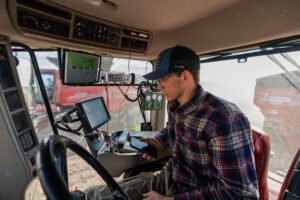
For soybean farmers, AI will probably continue showing up in small ways before big ones. It may appear through seed recommendations, more precise spraying, automated scouting, or better weather forecasting. As with all technology, early adopters take on the most risk.
The key is education.
Farmers do not need to become computer programmers to understand AI. But understanding the basic terms and capabilities can help producers ask better questions and make informed decisions. Like past technologies in agriculture, such as GPS guidance and precision planting, the use of AI will likely continue evolving over time.
The future of AI in agriculture is still being written. Some promises may deliver real value. Others may fall short. For now, AI should be viewed as another tool in the toolbox: useful in some situations, limited in others, and most effective when paired with sound management and farmer experience.
TOP AI TERMS TO KNOW
- ARTIFICIAL INTELLIGENCE (AI): Computer systems designed to perform tasks that normally require human thinking.
- MACHINE LEARNING (ML): AI systems that learn patterns from data and improve over time.
- GENERATIVE AI: AI that creates new content such as text, images, or code.
- LARGE LANGUAGE MODEL (LLM): AI trained on large amounts of text to answer questions or write content.
- PREDICTIVE ANALYTICS: Using data and models to forecast future outcomes.
- DEEP LEARNING: Advanced AI systems that recognize complex patterns in massive datasets.
- NATURAL LANGUAGE PROCESSING (NLP): AI that helps computers understand human language.
- PROMPT: The question or instruction given to an AI system.
- BIAS: Errors caused by incomplete or unbalanced data.
- HALLUCINATION: When AI generates incorrect or misleading information.
The post AI on the Farm: What Soybean Farmers Need to Know appeared first on American Soybean Association.


