
In 2017, after about 10 years of discussions, then-superintendent Amy Shane finally got to see a much needed expansion at the O’Neill Public School District’s aging junior-senior high school get approved. Expanded classrooms, state-of-the-art science labs, a new gym. The difference-maker that helped push the $13.2 million project from proposal to reality: taxes on renewable energy developments. Over nine years, the school district has taken in about $7.6 million, which Shane said helped offset the expansion cost.
“We could get something good for our students without putting a huge burden on our taxpayers,” Shane said.
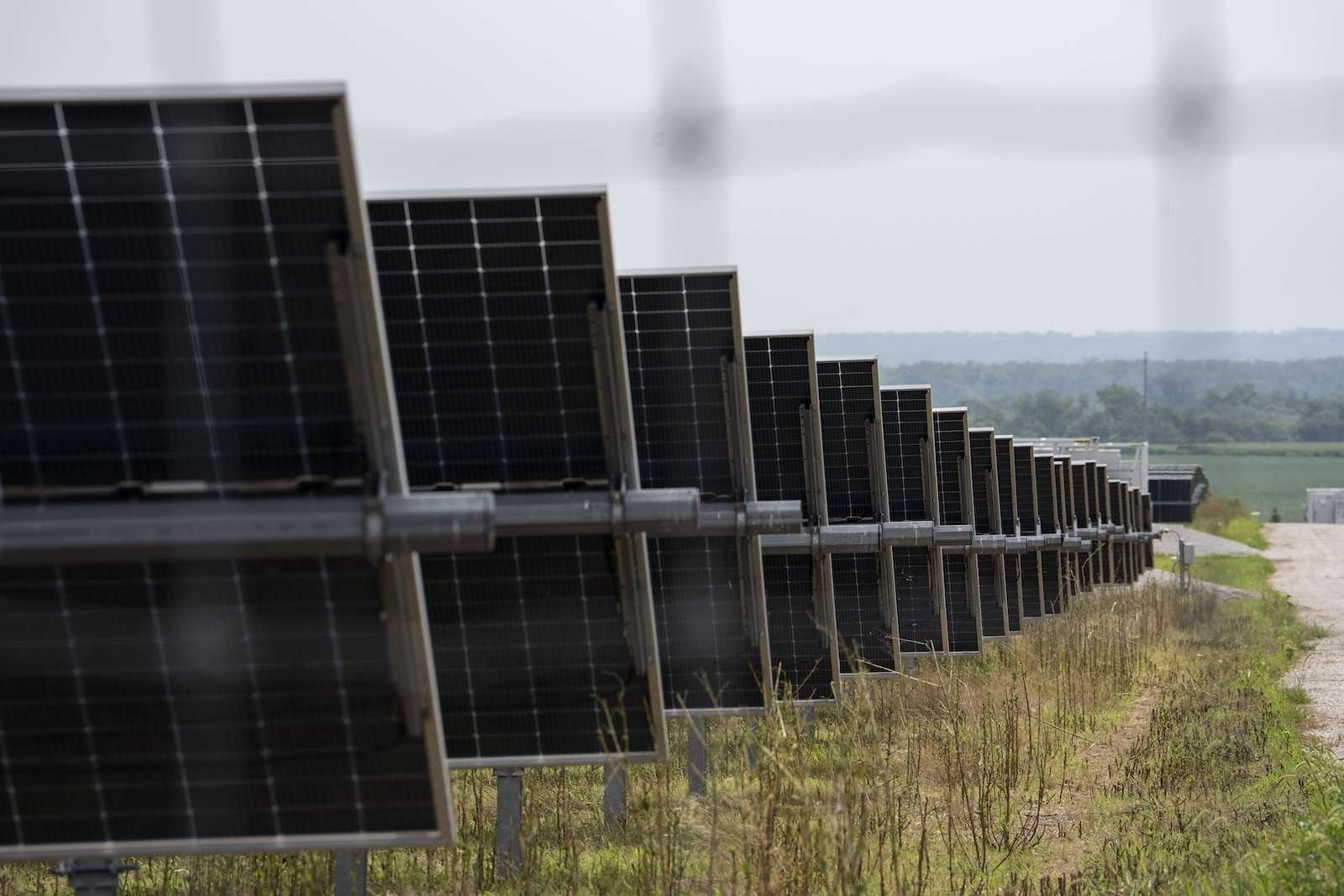
The project is an example of what economic development and renewable energy proponents have long argued: Renewable energy projects can help communities diversify their revenue streams and offset property tax burdens. The Nebraska excise tax, known as the nameplate capacity tax, requires qualifying renewable energy developments to annually pay $3,518 per megawatt of power that the facility can generate. The money flows to counties whose treasurers allocate it amongst local jurisdictions, including the county governments, community colleges, and school and natural resource districts.
But in recent years, a number of Nebraska counties have enacted strict regulations on renewable developments, as opponents have raised concerns about property values, noise, health, safety, and fire risks.
About 15 years after the tax was implemented, it’s worth looking at where the money has actually gone. Revenue distributed from the tax and the number of counties receiving it has risen over the years. In 2015, just nine counties received nameplate capacity tax revenue, which totaled $2.03 million, including penalties and interest, according to data from the Department of Revenue. In 2025, communities received over $13.6 million. But there’s an imbalance. More than 88 percent of that money went to just 10 of Nebraska’s 93 counties.
Lawmakers created the nameplate capacity tax in 2010 to replace personal property tax for renewable developments. This allows local taxing authorities to continue to receive a steady amount of tax revenue, said Jon Cannon, executive director of the Nebraska Association of County Officials. The landowner still pays property taxes.
“In county budgets, nameplate capacity tax revenue functions like other general fund revenue,” said Candace Meredith, deputy director of the Nebraska Association of County Officials, in a statement. “It helps offset the amount that would otherwise need to come from property taxes, allowing counties to keep up with state mandated essential services and inflationary costs.”
On average, counties get about 23 percent of the nameplate tax revenue, Cannon and Meredith said.
Recently, lawmakers have discussed increasing the rate. A 2025 proposal would have raised it from $3,518 per megawatt to $6,560. But the bill, part of a larger tax package, ultimately died. However, lawmakers did pass a bill this year that expands the tax to include qualifying battery energy storage developments.
According to the state, 1 in 4 jobs in Nebraska are tied to agriculture. The state’s top commodities include cattle and calves, corn, soybeans, and hogs. So it may be no surprise that Nebraskans have raised concerns that renewable energy projects, specifically solar, will reduce farmland. However, there are areas of the state where the land isn’t productive and landowners could benefit from the added revenue. John Hansen, president of the Nebraska Farmers Union, said urban sprawl and acreage housing developments are leading threats to farmland in Nebraska.
“The one thing that we know in the ag sector is that we continue to be extremely dependent on off-farm jobs to subsidize our farming operations that are not working, and so every wind turbine is like an off-farm, part-time job, except that the farmer or rancher doesn’t have to leave their farm or ranch to get paid for it,” said Hansen, who chairs the Nebraska Wind and Solar Conference.
Some Nebraska counties have gone so far as to adopt moratoriums or strict zoning regulations that have effectively banned renewable energy developments or made them more difficult to site.
But with rising power demand, advocates and experts see renewables as a contributor to future economic development in Nebraska. Pushback against renewables comes as utilities in Nebraska and across the country wrestle with an energy crunch caused by skyrocketing demand from electrification, manufacturing, and data centers.
Lily Smith / Flatwater Free Press
The Omaha Public Power District, which serves a large swath of eastern Nebraska, is taking an all-of-the-above approach, where coal remains on the grid, natural gas assets are expanding, and the utility plans to have more power purchase agreements with renewable energy developments.
Renewables can help the utility manage energy costs and address peak demand when the grid is stretched thin, said Dustin Marvel, manager of government and community relations at OPPD.
Right now, renewables are affordable compared to other energy sources and can be built quickly, said Kenneth Gillingham, a professor of environmental and energy economics at Yale University. This is especially important for utilities since new nuclear plants can take time to build and the natural gas generator supply chain remains tight.
For Nebraska, adding more power to the grid now isn’t just about serving existing customers, it could also spur more economic growth from other industries, said Hunter Traynor, an executive vice president at Nebraska Chamber of Commerce and Industry. A recent report commissioned by the Nebraska Chamber Foundation recommended the state take a more active role in promoting energy development.
“We have a lot of stated economic goals in Nebraska, and energy and public support for energy infrastructure, in particular, is a bedrock necessity right now to keep our economies all across the state flourishing and growing,” Traynor said.
Nevertheless, these projects face a few challenges. Currently, the infrastructure that transmits energy across the state is limited, which restricts where new energy generation can be located. It also takes time for new projects to connect to the grid. And then there’s community opposition.
“We do see oftentimes where a developer has an opportunity, maybe the project is advantageously located. However, due to community opposition or feedback, maybe that project loses steam or loses the ability to actually come to market,” Marvel said.
Cannon, with the Nebraska Association of County Officials, said that in order for renewable developers to actually make headway with communities that are skeptical, they need to be transparent about their intentions and address concerns early on.
Traynor said that these projects involve layers of regulatory approvals that can allow communities to assess if they are suitable. However, some projects get stopped by local resistance before they go through the regulatory process. He is concerned these experiences could cause a chilling effect on companies that are considering moving to Nebraska.
This story was originally published by Grist with the headline Some Nebraska communities are cashing in on renewables. Others are being left behind. on Aug 12, 2026.


