

China-based Beijing Relu Robotics Co., Ltd. has announced that its Bison Series robot is being used in the construction of an unspecified large-scale solar power plant in Algeria.
“In demanding outdoor operating conditions, robots must cope with a wide range of uncertainties, including intense sunlight, wind and sand, rain and snow, uneven terrain, high-altitude environments, and other unpredictable factors. Maintaining stable, efficient, and precise operation under these conditions presents a significant engineering challenge,” the company said in a statement. “Relu Robotics addresses this challenge through a combination of high-precision 3D perception, intelligent decision-making, and adaptive motion control.”
The Bison Series is designed for ground-mounted PV construction and features a 9-ton platform for enhanced stability in outdoor environments. Its robotic arm can reportedly handle payloads of up to 50 kg and has an effective working range exceeding 5 meters. According to Relu Robotics, the system’s proprietary 3D perception technology and adaptive motion-control algorithms enable less than 3 mm perception accuracy, less than 0.5° bracket-angle recognition error, installation accuracy within 5 mm, and sub-millimeter repetitive positioning accuracy.
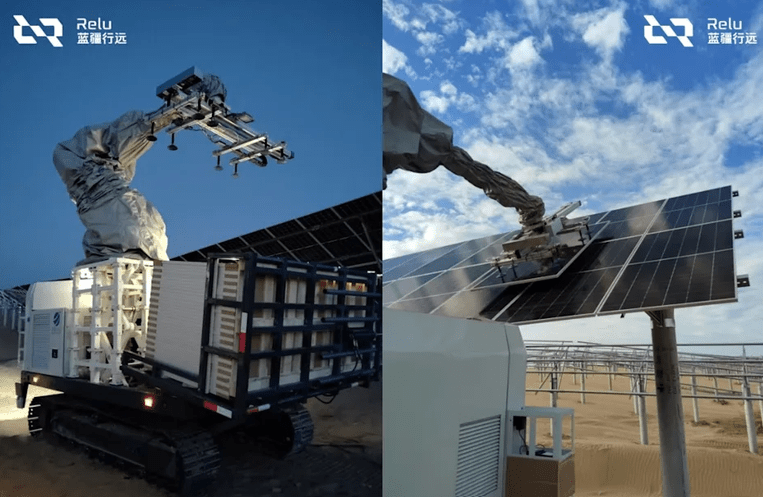
Designed for remote solar projects, the platform is equipped to operate in challenging environments, with a maximum climbing capability of 20 degrees, the company said. It can reportedly function within a temperature range of -20 C to 60 C, with a vehicle protection rating of IP54 and core component protection rating of IP65.
The platform measures 5,200 mm × 2,100 mm × 2,450 mm and is equipped with an extended-range diesel power system, supported by a 33.4 kWh CATL battery and a 30 kW range extender. The robot operates on steel tracks measuring 3,440 mm in length and 400 mm in width, enabling deployment across varied terrain, including sand, desert, wasteland, hills, and gentle slopes. With an average fuel consumption of 2 L/h, the system can reach a maximum speed of 4 km/h and operate at elevations of up to 5,000 meters.
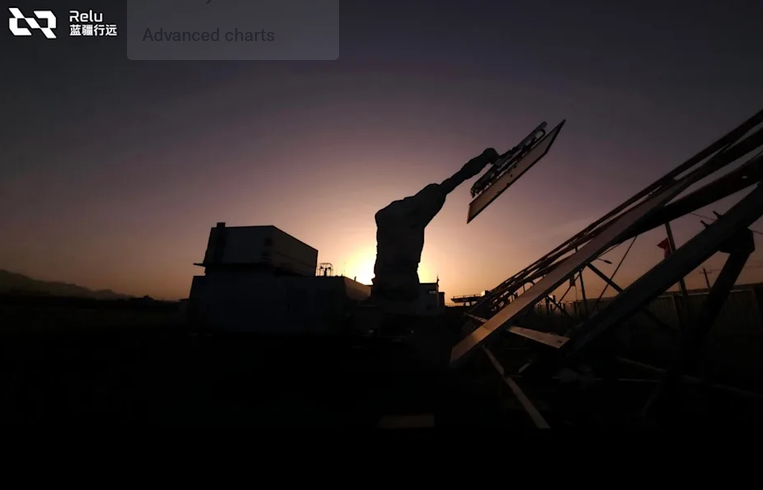
Relu Robotics said the Bison Series has undergone field validation in regions including Inner Mongolia and Xinjiang, where harsh conditions such as sandstorms, high temperatures, and significant temperature variations are common.
For extended operation at remote construction sites, the robot is equipped with a 200-liter fuel tank. Based on a typical 10-hour working day, fuel consumption is reportedly below 20 liters per day, allowing up to 10 days of continuous operation on a full tank, according to the manufacturer.
The robot operates through a three-step process combining perception, intelligent decision-making, and robotic execution. First, its vision systems identify PV modules, mounting structures, and surrounding conditions. Second, its AI control system analyzes the environment, plans movement paths, and determines positioning requirements. Finally, the robotic arm performs module pickup, transport, alignment, and installation.
The post AI-powered 9-ton tracked robot for large-scale PV construction appeared first on pv magazine Global.


