

When there is excess daytime solar you can give it away for free instead of dumping it. This is the new solar sharer retail tariff available in Australia.
Families can absorb up to 24 kWh of free electricity per day between the hours of 11 am and 2 pm. This can be used to run heavy loads such as dishwashers, clothes washers, clothes dryers and water storage heaters. Houses can be heated or cooled, and home batteries and electric vehicles can be recharged. All this is available by scheduling timers on appliances.
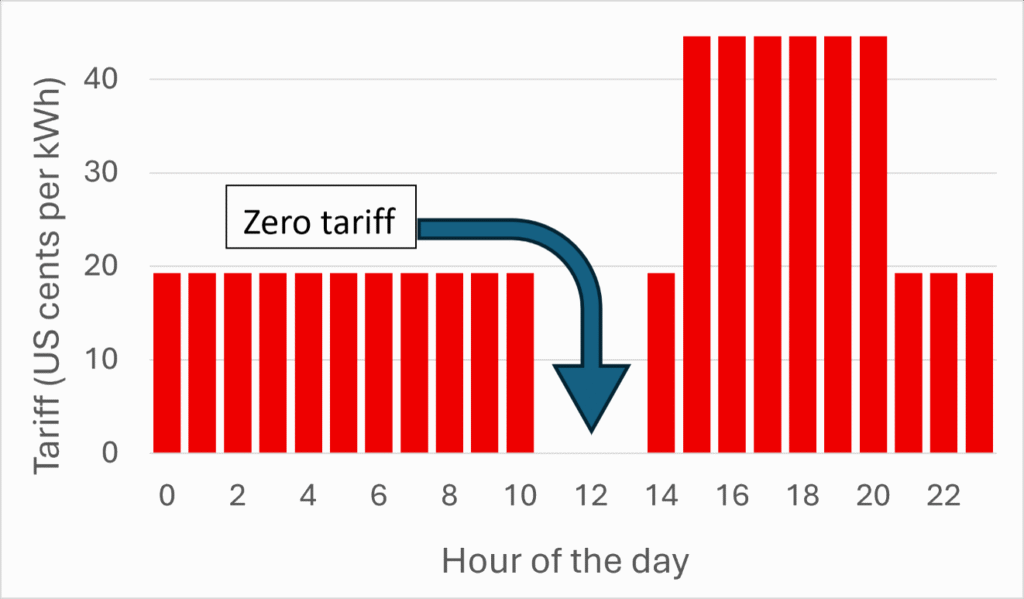
The figure shows the solar sharer tariff offered by a large utility in Sydney. For most hours, electricity costs 19 US-cents per kWh, rising to 45 cents during evening peak hours. However, there are 3 hours in the middle of each day when electricity is free. There is also a fixed annual grid connection fee of $450.
Families living in an all-electric house with rooftop solar, an EV and a home battery can nearly eliminate purchase of energy: zero vehicle fuel, zero natural gas, and only occasional purchase of electricity from the grid. The all-in annual energy bill is $500-1,000 which is the cheapest domestic energy in history. These households are also resilient to local and global disruption to energy supply. One of the authors lives in such a household with total annual energy bill of $600.
Apartment dwellers with insufficient roof space for solar panels can finally benefit from the Australian rooftop solar boom, in which 40% of dwellings now have a rooftop solar system at an unsubsidized turnkey cost of around $10,000 for a typical 10 kW system.
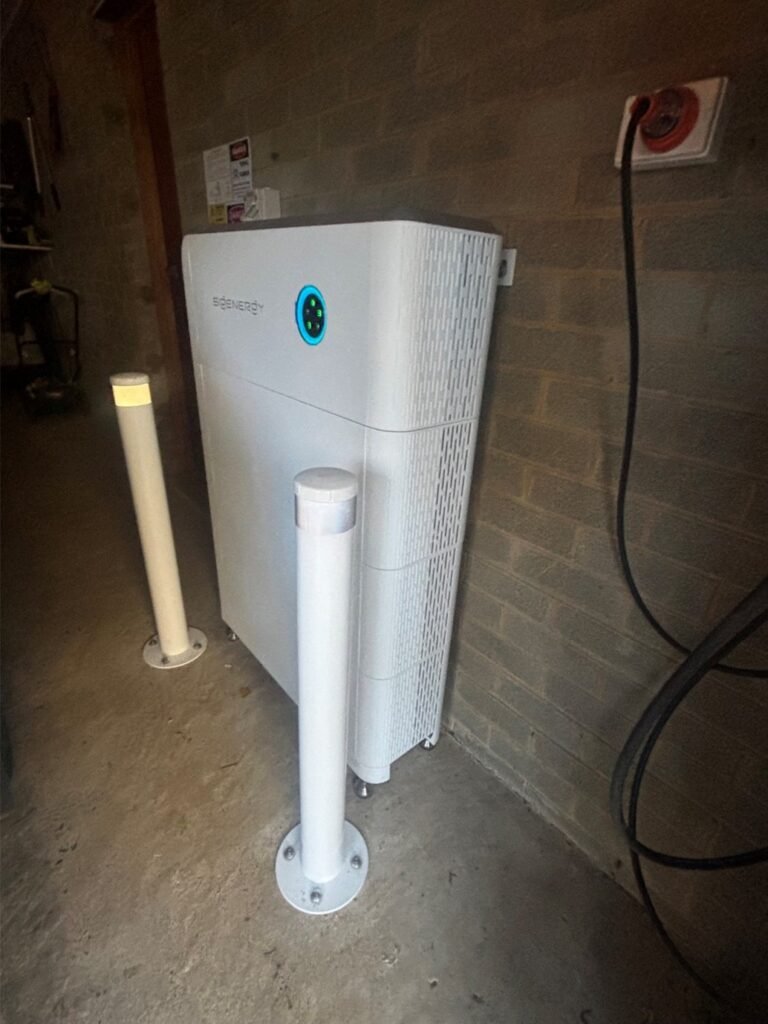
A home battery (5-25 kWh) allows full advantage to be taken of the solar sharer tariff because high evening peak prices can be avoided. The fraction of Australian houses that have home batteries has tripled in the past year to 6% and is following a similar growth path to rooftop solar: start with subsidies that fade away after a few years as costs fall.
For dwellings that can’t move most loads into the middle of the day, or which lack a home battery or EV, the solar sharer tariff is not ideal. Less peaky tariffs are available.
Australia generates much more solar per capita than other countries: 35% more than the second largest country (Netherlands) and more than twice as much as in the European Union, China and the USA. Excess daytime solar is being managed via several straightforward mechanisms.
Large numbers of utility and home batteries are being installed to time-shift solar and wind generation during each day. Despite its small population, Australia is currently the world’s third largest market for batteries.
Although starting from a small base, electric vehicle uptake in Australia is rapidly growing, partly in response to the latest war in the Middle East. The large batteries in EVs can be readily charged when solar and wind is available and prices are low. Vehicle-to-load and vehicle-to-grid will be introduced over the next few years, so that EVs play a dual role: transporting people and as batteries on wheels.
New time-of-use tariff structures encourage a shift in demand to daytime and thereby reduce morning and evening peak demand. This benefits everyone because peak prices fall when demand moderates. New pumped hydro storage systems are being built, including Snowy 2.0 with 350 GWh of storage, corresponding to the capacity of approximately 7 million EV batteries. Snowy 2.0 will quadruple rechargeable energy storage in Australia when completed in 2029. Australia will then have 18 kWh per person of rechargeable battery and pumped hydro storage, which is the largest in the world.
The advantage of rechargeable storage compared with once-through storage, as biomass or in large hydroelectric reservoirs, is that it can be recharged many times per year whenever solar and wind is available. For example, Snowy 2.0 could be recharged 25 times per year to make it equivalent to once-through storage of 8000 GWh.
An important interim grid balancing mechanism is flexing coal. Australian coal output typically flexes daily between 8 GW and 15 GW. Fossil gas is uncompetitive and has fallen to just 4% of annual generation in the national electricity market.
Claims that Australia has high domestic electricity costs, “caused by renewable energy,” are plain wrong. These claims focus on peak period tariffs. They compare prices today with past years without adjusting for inflation. They ignore attractive new tariffs such as solar sharer. And they ignore the reality that low annual energy costs are readily obtainable by electrifying everything and installing rooftop solar and home batteries.
A key lesson from Australia is that market innovation and occasional government intervention allows rapid growth in solar deployment at low cost.
The post Giving away excess daytime solar for free appeared first on pv magazine Global.


