
A Huron County cover crop specialist continues to fine-tune his production of black oats — a separate species from regular oats that grows taller and has smaller seeds — and is confident they’ll soon gain in popularity due to their benefits for soil health.
“North America is pretty much the only place left in the world where using regular spring oats as a cover crop is common,” Stefan Zehetner said at the Ontario Soil and Crop Improvement Association’s Summer Farm Day and Tour on Aug. 15 in Exeter. “In Brazil, they use black oats almost exclusively. And in Europe, it’s the same.”
The original plan for the OSCIA event was to welcome participants to Zehetner’s farm to see the range of plots he tends under the Huron Cover Crops banner.
However, sunny weather dictated that his oat fields required combining the previous day so instead he cut some plants, bagged some seed and brought those samples along as he outlined the latest knowledge about cover crops under the cover of the pavilion at the Morrison Dam conservation area.
Challenges posed by traditional oats include the ever-increasing risk of diseases like rust as well as the difficulty of using the large-seeded plant as part of a multi-species cover crop.
“When you start adding very small seeds like clover to a mix that has oats, it tends to shake out to the bottom and you no longer have a good mix of seeds,” Zehetner explained.
- READ MORE: Deciding which cover crops to use
A few years ago, Huron Cover Crops formed a partnership with a German company to bring black oats to Canada. In three years of growing the crop, Zehetner has seen zero rust. And with approximately three times as many seeds per pound as regular oats, it’s much less likely to separate out in a multi-species mix.

Other benefits are that it typically heads out two weeks later than regular oats, meaning more of the plant’s energy remains devoted to building increased biomass — both above-ground in the form of plant height and below ground in the form of a more extensive root mass.
Black oats can be harvested for forage. But for growers putting a focus on chopped feed from oats, Zehetner suggested forage oats. The variety sold by Huron Cover Crops has low lignin content, “so even when they head out, they’re still meant for feeding.”
This year, with limited moisture, his crop of forage oats was only a few inches taller than his regular spring oat variety. But last year, he recalled that a grower sent him a photo standing in a forage oat field with the grower almost obscured by the crop.
“If you have enough moisture and everything’s right with the field, these things can be monsters.”
What’s the most popular mix?
The most common mix Zehetner sells is oats, Austrian winter peas and sunflowers — meant to be planted after wheat. He has had bad experiences trying to grow corn after switching out the winter peas for black forage peas, so he doesn’t sell the forage variety anymore.
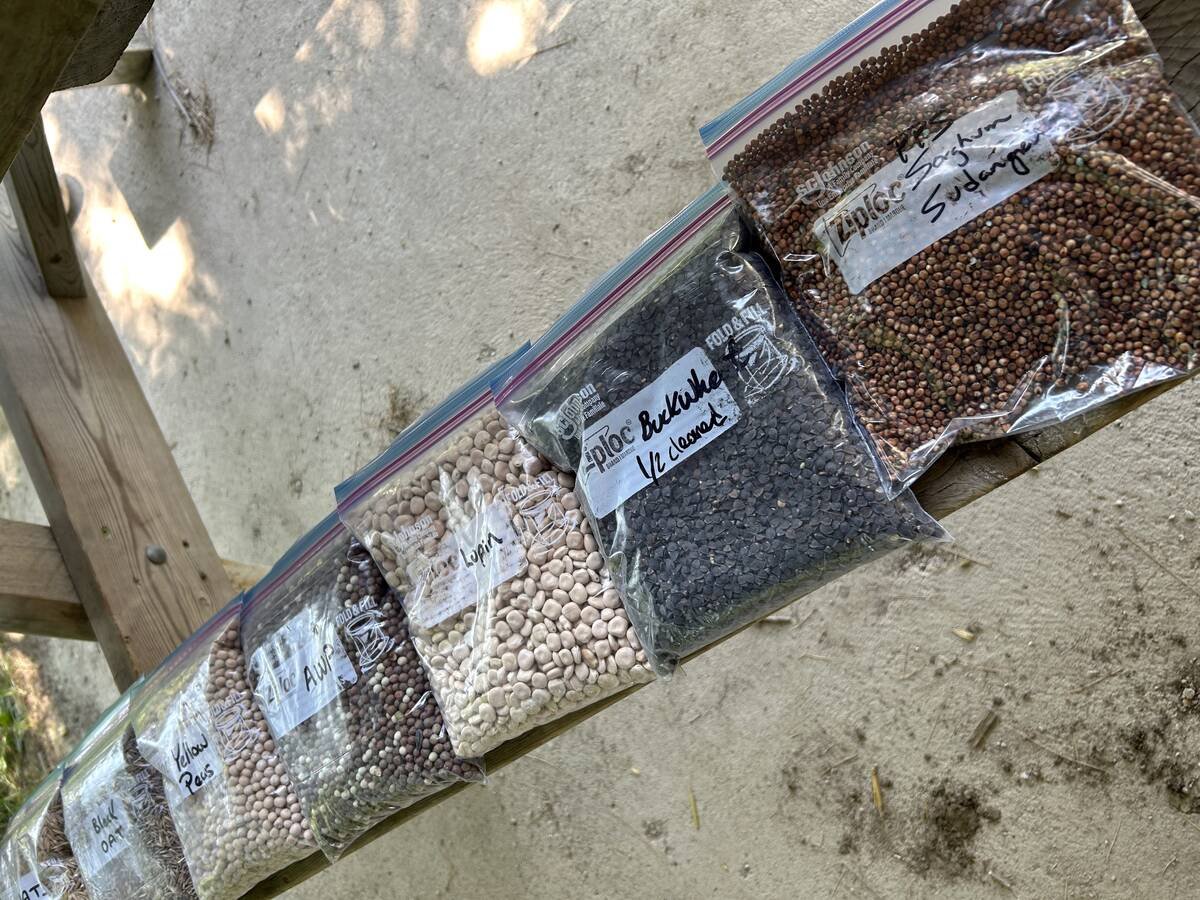
Yellow peas, meanwhile, have a significantly larger seed than the Austrian variety. “I tell growers they should think about what’s more important — cost per seed versus cost per pound.”
One dairy customer, aiming to get as much biomass per acre as possible per growing season, plants a mix of Austrian winter peas and fall rye after corn silage harvest. This is chopped in the spring and followed by a crop of photo-sensitive sorghum Sudangrass, a variety that won’t go to seed until the hours of daylight decrease to a specific duration.
“Right now, that field is over six feet high; it looks like a fully-grown corn crop,” Zehetner related. The grower still has a couple of weeks, he added, before the sorghum Sudangrass forms a head and must be harvested.
The post Alternative oats brought into Ontario cover crop mixes appeared first on Farmtario.


