Save to Inbox
Sign me up for the free Visual Capitalist daily newsletter.
Americans Spend More Time With AI Companions Than Dating Apps
Key Takeaways
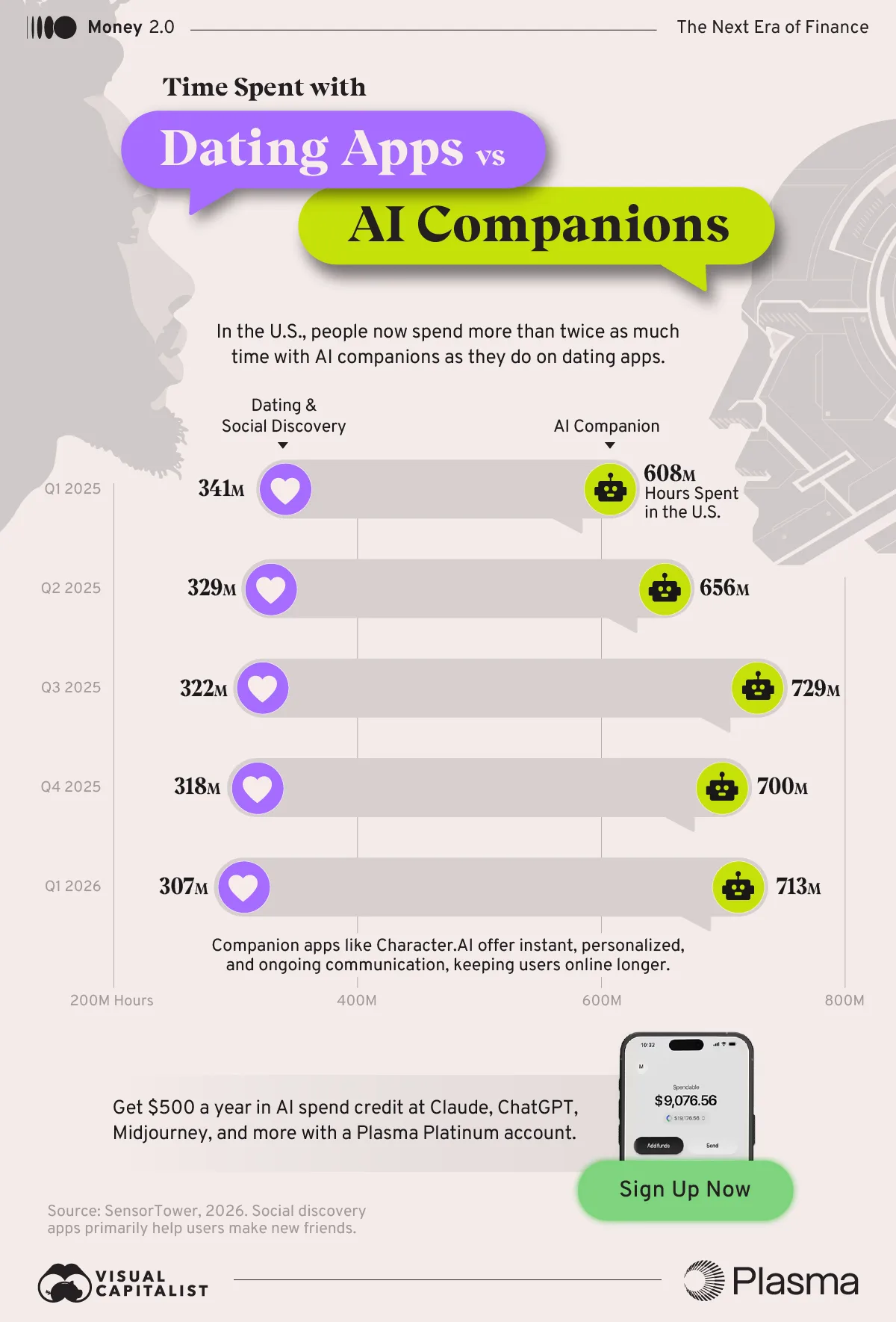
- In the first quarter of 2026, Americans spent 2.3 times as many hours on AI companion apps as they did on social discovery and dating apps.
- Compared to the same quarter last year, Americans are spending 10% less time on social discovery and dating apps and 17% more time on AI companion apps.
Amid growing concerns about loneliness in America, modern AI companions have emerged as a new way for people to feel a sense of connection. These apps offer everything from virtual friendships to romantic conversations, raising questions about how they’re changing people’s social lives.
This graphic, created in partnership with Plasma, highlights how much time Americans are spending on AI companion apps and dating apps.
Hours Spent on Dating Apps vs. AI Companion Apps
Back in the first quarter of 2025, Americans spent about 1.8 times as much time with AI companion apps as they did with social discovery (friend-making) and dating apps.
In the last year, that gap has grown even wider. People have begun spending even fewer hours with apps focused on friendships and dating. At the same time, people have increased the time they spend on AI companion apps.
| Time Period | Millions of Hours Spent in the U.S. on AI Companion Apps |
Millions of Hours Spent in the U.S. on Social Discovery & Dating Apps |
|---|---|---|
| Q1 2025 | 608 | 341 |
| Q2 2025 | 656 | 329 |
| Q3 2025 | 729 | 322 |
| Q4 2025 | 700 | 318 |
| Q1 2026 | 713 | 307 |
Source: Sensor Tower, 2026. Social discovery apps primarily help users make new friends. Data is iOS and Google Play combined.
As of the first quarter of 2026, Americans spend 2.3 times as many hours with AI companion apps as they do with social discovery and dating apps. Character.AI, one of the most popular AI tools in 2026, is an example of an AI companion.
The structure of the respective apps plays a role. For instance, apps focused on helping users make in-person friends or romantic partners can be transactional. Once the user finds a successful match, they typically stop using the app.
On the other hand, AI companions are designed for personalized, ongoing relationships that encourage users to spend more time on the app. For instance, these apps typically allow users to customize existing personas, some based on celebrities or fictional characters, or to create a brand new character.
On top of this, companions remember past conversations and offer continual validation, nonjudgmental acceptance, and reliable availability. These features have made AI a popular way to form connections: 18% of Americans under 30 said they have an ongoing personal friendship with an AI chatbot, according to YouGov.

Get $500 a year in AI spend credit at Claude, ChatGPT, Midjourney, and more with a Plasma Platinum account.
-
 Ecommerce1 week ago
Ranked: Countries Where People Still Pay Cash for Online Orders
Despite digital payments surging, millions of people still pay with cash, even for online shopping. See which countries lead.
-
 AI1 month ago
The Explosive Rise of AI App Spending (2022–2026)
Globally, AI app purchases have grown nearly 200-fold in just four years. See which regions are driving the surge in 2026.
-
 Cryptocurrency2 months ago
Stablecoin Card Spending Has Surged to $1 Billion a Month
Stablecoin card spending has grown nearly 2,000-fold since 2023. See what’s fueling their rise and why the market may just be getting started.
-
 Wealth2 months ago
Ranked: Where Are Ultra-Rich Populations Forecast to Grow the Fastest?
Global wealth is expanding beyond traditional hubs. Through 2031, Indonesia is forecast to see the fastest ultra-rich population growth.
-

 Cryptocurrency5 months ago
Gold and U.S. Debt: Will Tether Be a Mega-Holder by 2030?
By 2030, Tether’s gold and U.S. debt holdings could rival what major countries currently own. See how the projections break down.
-
 Housing5 months ago
The States Where Housing Prices Have Surged the Most (2021–2026)
Maine and Vermont lead the nation in home price growth. Explore the latest data shaping the U.S. housing market.
-
 Inflation5 months ago
How Much Value $100 Loses in the World’s Highest-Inflation Countries in 2026
In Venezuela, $100 could be worth just $31 by year-end. See where inflation is eroding money’s value fastest in 2026.
-

 Personal Finance9 months ago
Where $2.6T in Daily Cross-Border Currency Trades Happen
Foreign exchange markets are the backbone of global trade and finance. Where do the $2.6 trillion in daily cross-border currency trades originate?
-
 Personal Finance1 year ago
Inflation Watch: Countries Losing the Most Purchasing Power in 2025
When prices rise, money’s value melts away. See how inflation could shrink the value of $100 by the end of 2025 in the hardest-hit countries.
-
 Technology1 year ago
Unbanked in a Connected World: Account Ownership vs Phone Ownership
In many unbanked countries, fewer than one in three adults have a financial account, but most own a mobile phone.
-
 Technology1 year ago
Ranked: The Biggest Buyers of U.S. Debt
Stablecoin Week: See how stablecoin issuers stack up against countries like Japan and Singapore as major buyers of U.S. debt.
-

 Technology1 year ago
Mapped: Stablecoin Regulation Globally
Which countries have stablecoin regulation proposed or in place, and which have no tailored laws? Find out in this Stablecoin Week piece.
-

 Technology1 year ago
Stablecoin Evolution: Milestones of the New Payment Rail
The GENIUS Act marks a turning point for stablecoin. Explore 8 key milestones in the digital dollar’s rise to mainstream finance.
-
 Technology1 year ago
Is the U.S. Dollar Primed for a Digital Rebound?
U.S. dollar influence is shrinking in some spaces, but stablecoins could give the currency a new chapter of global dominance.
-
 Money1 year ago
Ranked: The Biggest Currency Drops So Far in 2025
In the first half of 2025, one currency dropped over 50% against the U.S. dollar. What led to the decline?
-
 Technology1 year ago
Ranked: Countries With the Highest Remittance Costs
To send money across borders, workers can be charged high remittance fees—over 50% of the amount transferred in some cases.