
Uranium demand is gaining momentum as nuclear power returns to the center of global energy strategies. Governments are investing in domestic fuel production, utilities are securing long-term uranium supplies, and advanced reactor developers are signing agreements to access specialized nuclear fuel. These developments are creating new opportunities across the nuclear fuel supply chain.
Recent developments in the United States highlight this shift. Agreements involving Oklo and Centrus Energy, alongside new licensing progress for Standard Nuclear’s TRISO fuel facilities, show how companies are preparing for the next phase of nuclear expansion.
At the same time, uranium prices and supply constraints remain important market drivers. The challenge is no longer simply securing uranium ore. The industry must also expand conversion, enrichment and fuel fabrication capacity to support both conventional reactors and emerging nuclear technologies.
Uranium Prices Reflect Growing Supply Concerns
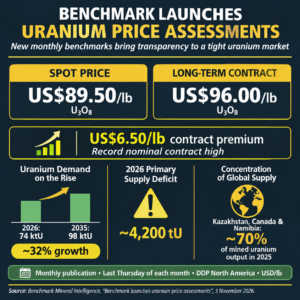
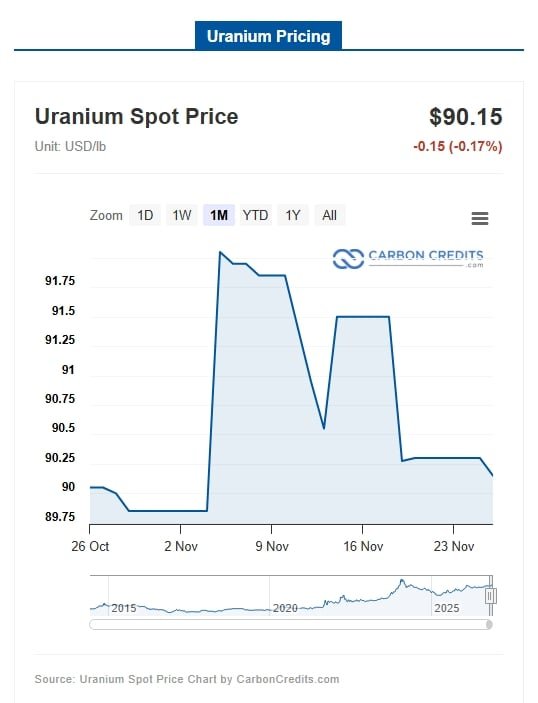
Uranium prices remain elevated as nuclear utilities compete to secure future deliveries. Benchmark Mineral Intelligence’s November 3 assessment placed the North American delivered spot price at US$89.50 per pound of U₃O₈. Its long-term contract price reached US$96 per pound, a nominal record.
The World Nuclear Association also reported a long-term uranium price indicator of US$96.50 per pound at the end of August 2026. These assessments highlight the importance of long-term contracting as utilities prioritize dependable fuel supplies.
Unlike many commodities, uranium relies heavily on private long-term agreements between producers and nuclear utilities. Therefore, spot prices do not fully reflect the market’s underlying demand and supply conditions.
Cameco’s third-quarter 2026 results offer another indication of this trend. The Canadian producer reported average annual delivery commitments exceeding 28 million pounds of U₃O₈ over the next five years. Stronger contracting activity provides producers with greater revenue visibility and supports investment in future production.
Oklo and Centrus Strengthen the HALEU Supply Chain
One of the most significant recent developments involves Oklo and Centrus Energy. The companies finalized multiple multi-year agreements to supply high-assay low-enriched uranium (HALEU) for Oklo’s advanced reactor projects.
The agreements will secure enough fuel to support up to five Aurora powerhouses for multiple years. Deliveries from Centrus’s American Centrifuge Plant in Piketon, Ohio, are expected to begin in 2029.
The arrangement also supports Oklo’s planned nuclear power campus in Ohio, which aims to meet growing electricity demand from data centers and other energy-intensive operations.
HALEU contains between 5% and 20% uranium-235, compared with the lower enrichment levels used in conventional commercial reactors. Several advanced reactor designs require this higher enrichment level to achieve their intended performance.
The agreement highlights a growing trend in the nuclear industry. Reactor developers are securing fuel years before their planned commercial operations, while advance payments can help suppliers finance production capacity.
Standard Nuclear Advances TRISO Fuel Production
Another important development comes from Standard Nuclear, which submitted Documented Safety Analyses for two proposed TRISO fuel production facilities to the US Department of Energy on November 24.
The proposed facilities in Tennessee and Idaho represent an important step toward expanding domestic advanced nuclear fuel manufacturing. The company submitted the Tennessee analysis on November 6 and followed with the Idaho submission on November 12.
Both facilities had previously received approval for their Preliminary Documented Safety Analyses in July 2026. However, they still require further regulatory review and authorization before operations can proceed.
TRISO fuel contains tiny uranium-bearing particles surrounded by multiple layers of carbon and ceramic materials. These protective layers help retain radioactive fission products during reactor operation.
The technology is particularly relevant to advanced reactor developers exploring high-temperature gas-cooled and other next-generation reactor designs.
Standard Nuclear’s progress also highlights a potential investment opportunity beyond uranium mining. As advanced reactors move closer to commercial deployment, demand for specialized fuel manufacturing could increase.
US Investment Targets Domestic Uranium Enrichment
The US government is also working to reduce its dependence on foreign nuclear fuel suppliers.
In January, the Department of Energy awarded US$2.7 billion to Centrus Energy, General Matter and Orano Federal Services to expand domestic uranium enrichment capacity. Each company received US$900 million in funding.
Centrus subsequently secured a US$900 million DOE contract in June to establish commercial HALEU enrichment capacity at its Piketon facility. The agreement includes a target to deliver one metric tonne of HALEU uranium hexafluoride by March 2032.
These investments address an important weakness in the US nuclear fuel chain. Although the country operates a large nuclear reactor fleet, it has historically relied on foreign suppliers for significant portions of uranium conversion and enrichment.
Uranium Supply Struggles to Match Growing Demand
The long-term uranium outlook remains supportive, but supply growth presents a challenge.
Benchmark Mineral Intelligence estimates that global uranium demand could increase from approximately 74,000 tonnes of uranium in 2026 to 98,000 tonnes by 2035. Its estimates also point to a primary supply shortfall of approximately 4,200 tonnes in 2026.
Kazakhstan, Canada and Namibia remain major uranium-producing countries. However, concentrated production creates supply-chain risks, particularly when mining disruptions affect major suppliers.
The World Nuclear Association’s 2025 World Nuclear Fuel Report projects global nuclear capacity rising from approximately 398 gigawatts electric in 2025 to 746 gigawatts by 2040 under its reference scenario. Annual uranium requirements could consequently exceed 150,000 tonnes by 2040.
Growing electricity demand from artificial intelligence and data centers adds another potential driver. Technology companies increasingly view nuclear power as a source of reliable, low-carbon electricity.
The Uranium Investment Opportunity Extends Beyond Mining
The latest developments suggest that the uranium market is becoming a broader nuclear fuel supply-chain story.
Established producers such as Cameco could benefit from stronger utility contracting, while Centrus and other enrichment companies stand to gain from investments in domestic fuel production. Meanwhile, Standard Nuclear and other specialized manufacturers could benefit as advanced reactor developers seek HALEU and TRISO fuel.
However, higher uranium prices alone cannot resolve the industry’s supply constraints. New mines require significant capital, infrastructure, and regulatory approvals. Enrichment and fuel fabrication facilities also face technical and licensing challenges.
For investors, the key question is whether the industry can turn growing demand and new supply agreements into reliable commercial production. Companies that successfully expand capacity across mining, enrichment, and fuel manufacturing could benefit from the next nuclear expansion cycle.
The post Uranium Market Heats Up as New Fuel Deals Signal a Bigger Nuclear Expansion appeared first on Carbon Credits.


