
Plastics underpin modern life. They are used in packaging, textiles, and medical devices, and are critical to clean energy technologies such as solar panels and EV components. Nearly all plastics today are derived from fossil fuels and originate from a small set of primary chemicals known as olefins.
Olefins are highly versatile chemical building blocks. The most widely produced olefins are ethylene and propylene, which are made into products such as polyethylene, polypropylene, PET, and polyester which are used to create packaging films, automotive components, textiles, insulation, and medical devices.
Demand for these materials is already large and continues to grow. Ethylene represented a $210 billion market in 2024, with more than 315 million metric tons produced annually, propylene, often co-produced with ethylene, represents a $133 billion market with 187 million tons produced each year. Both critical markets are projected to more than double in volume by 2050 even in net zero scenarios. These markets are driven by rising standards of living, food preservation, medical applications, consumer goods, and products required for the energy transition.
Their market size is reflected in their emissions profile. Global chemical production accounts for up to 4% of global greenhouse gas emissions, a share higher than either the aviation or shipping sectors.
A major contributor to those emissions is steam cracking, the dominant process for producing olefins, which contributes 1% of global emissions and roughly 8% of total chemical industry energy consumption by itself.
Steam cracking operates continuously at temperatures exceeding 500°C, using fossil feedstocks such as naphtha, ethane, or propane. The process is highly energy-intensive, with significant scope 1 emissions from natural gas combustion. On a cradle-to-gate basis, approximately 1.25 kg CO₂ is emitted per kilogram of ethylene or propylene produced.
Fossil feedstocks drive much of the footprint. Fossil extraction, processing, and transport can account for more than 60% of well-to-gate emissions from olefin production.
A lesser-used method to produce olefins is methanol-to-olefins or MTO. When powered by coal or natural gas-derived methanol, it can be even more emissions-intensive than steam cracking, emitting about 1.59 kg CO₂ per kg of olefin produced. This process is often favored in geographies with cheap coal, such as China.
Both conventional steam cracking and fossil-based MTO face the same challenges: fossil fuel dependence, high feedstock emissions, and energy intensity of the process itself.
There are retrofit options that can reduce emissions from existing steam cracking assets. According to RMI’s Chemistry in Transition report, carbon intensity reductions of up to 36% are achievable through measures such as electrification, methane leak mitigation, carbon capture and storage, and fuel switching.
window.addEventListener(“message”,function(a){if(void 0!==a.data[“datawrapper-height”]){var e=document.querySelectorAll(“iframe”);for(var t in a.data[“datawrapper-height”])for(var r,i=0;r=e[i];i++)if(r.contentWindow===a.source){var d=a.data[“datawrapper-height”][t]+”px”;r.style.height=d}}});
These measures are technically deployable today and can incrementally lower emissions. However, they do not fundamentally eliminate fossil feedstock dependence.
For full defossilization, alternative production pathways are required. We explore a selection below.
Pathways to defossilize olefins
Methanol-to-Olefins (MTO)
MTO converts methanol over a catalyst into a mixture of ethylene, propylene, and water. The products are then separated to yield polymer-grade olefins. The process operates at lower temperatures than steam cracking and is already commercially deployed at scale.
Today, methanol for MTO is produced from coal or natural gas. However, emerging pathways offer the potential for low-carbon or fully defossilized production:
- E-methanol produced from green hydrogen and CO₂ (via direct air capture or biogenic CO₂)
- Bio-methanol derived from biomass-based CO₂
Because MTO is commercially mature, it has a significant advantage over more nascent technologies as a near-term solution if the methanol production itself is decarbonized.
Ethanol Dehydration
Ethanol dehydration converts bio-ethanol (e.g., from sugarcane or corn) into ethylene. While technically established, it raises concerns around sustainable feedstock sourcing, land use change, and food system impacts.
Direct CO₂ Electrolysis
An even more nascent pathway involves the direct electrolysis of CO₂ to ethylene using renewable power. As outlined in RMI’s Applied Innovation Roadmap, this technology could enable fully defossilized production but remains at laboratory-to-early-commercial stages.
Among these pathways, MTO stands out as commercially ready, making it a credible near-term lever for defossilizing olefin production.
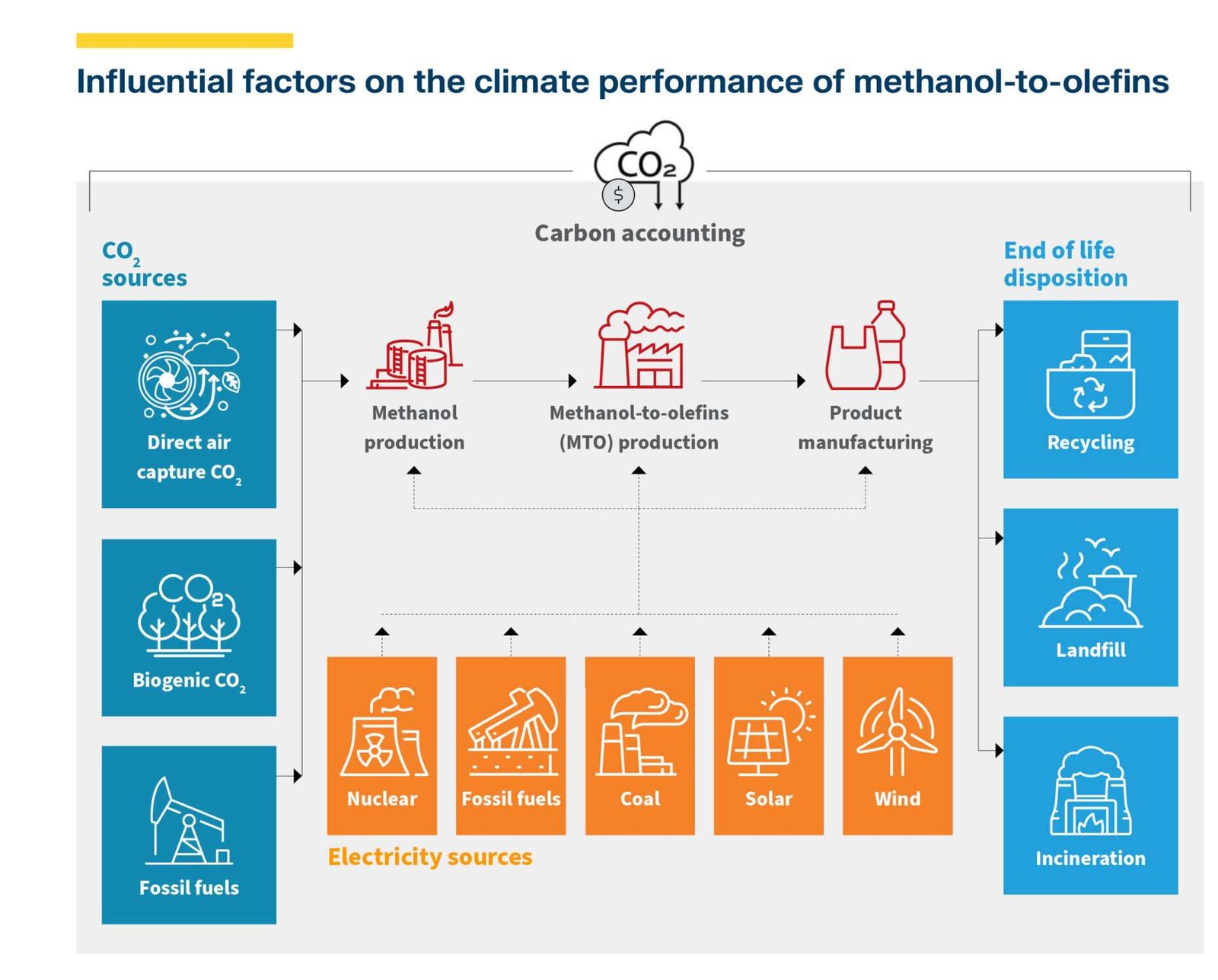
However, the climate performance of MTO depends heavily on a variety of factors:
- The carbon source for methanol
- The carbon intensity of electricity used
- Whether CO₂ uptake credits are applied
- The product’s end-of-life disposition and accounting
Direct Air Capture (DAC) CO₂ and biogenic CO₂ can sometimes be perceived as negative emissions inputs because they remove carbon from the atmosphere and embed it in products. However, whether that removal is durable depends entirely on what happens at end of life.
If a plastic made from captured CO₂ is incinerated, the carbon is re-emitted to the atmosphere. If it is reused, recycled, or potentially landfilled without degradation, the carbon may remain “stored” for longer durations.
Eligibility for uptake credits and product claims of “net zero” or “net negative” must incorporate full lifecycle analysis, including end of life.
This leads to wide variability in emissions outcomes. For example, DAC-based MTO can range from –5.4 kg CO₂e/kg to 11.51 kg CO₂e/kg, depending on electricity mix and uptake credit assumptions, whereas bio-based MTO can range from –13.66 kg CO₂e/kg (waste biomass with uptake credits) to 7.54 kg CO₂e/kg (first-generation biomass without credits on a carbon-intensive grid).
The same technology can therefore be deeply negative or highly emissive depending on system boundaries and assumptions.
Unpacking “end of life”
As mentioned, the method in which plastics are eventually disposed of can have a strong impact on whether it can claim to be zero emissions. Plastics can follow several end-of-life routes, each with its own positives and negatives, as described below.
No matter the disposal route chosen, robust standards for end-of-life, uptake credits, and net negativity are essential to avoid the risk of overstating the climate benefits of a given material.
window.addEventListener(“message”,function(a){if(void 0!==a.data[“datawrapper-height”]){var e=document.querySelectorAll(“iframe”);for(var t in a.data[“datawrapper-height”])for(var r,i=0;r=e[i];i++)if(r.contentWindow===a.source){var d=a.data[“datawrapper-height”][t]+”px”;r.style.height=d}}});
MTO’s opportunity
Despite accounting complexity, MTO’s commercial pedigree offers a unique advantage. And, unlike direct CO₂ electrolysis or other breakthrough processes, MTO plants operate today at industrial scale. Still, barriers remain, such as the cost of low-carbon methanol, a lack of clear, harmonized carbon accounting standards, and unease over the market’s willingness to pay for lower-emissions materials.
Despite these barriers, with appropriate guardrails around methanol sourcing, electricity emissions, and end-of-life treatment, MTO can enable low-carbon and potentially net-negative olefins. To scale defossilized olefins we need two essential things:
- Demand Signals
Demand aggregation for low-emission chemicals and corporate offtake agreements can provide producers with confidence to invest. Brand commitments to reduce Scope 3 emissions create willingness to pay for lower-carbon inputs. Consumer pressure and coalition-based purchasing can further accelerate deployment.
- Accounting and Regulatory Clarity
Voluntary standards are paving the way, but standards alignment will be needed. Clear rules on CO₂ uptake credits; eligible feedstocks (biomass, DAC, ethanol, etc.); electricity emissions thresholds; end-of-life assumptions; and lifecycle analysis requirements in product carbon footprinting are necessary to ensure environmental integrity and long-term market confidence.
Without consistent accounting frameworks, the variability in lifecycle emissions risks undermining credibility.
The way ahead
Today’s fossil-based system adds net carbon to the atmosphere. Alternative pathways introduce nuance, but also opportunity.
Methanol-to-olefins is a commercially mature, near-term pathway that can defossilize olefin production if deployed with clear lifecycle accounting and end-of-life assumptions. With aligned demand signals, standardized accounting frameworks, and supportive policy, MTO can move the chemical industry toward net-zero and even net-negative production.
The author wishes to thank Brianne Cangelose and Anisha Krishnakumar for their contributions to this article.
The post Beyond Fossil Feedstocks: Methanol-to-Olefins and the Future of Sustainable Chemical Manufacturing appeared first on RMI.


