
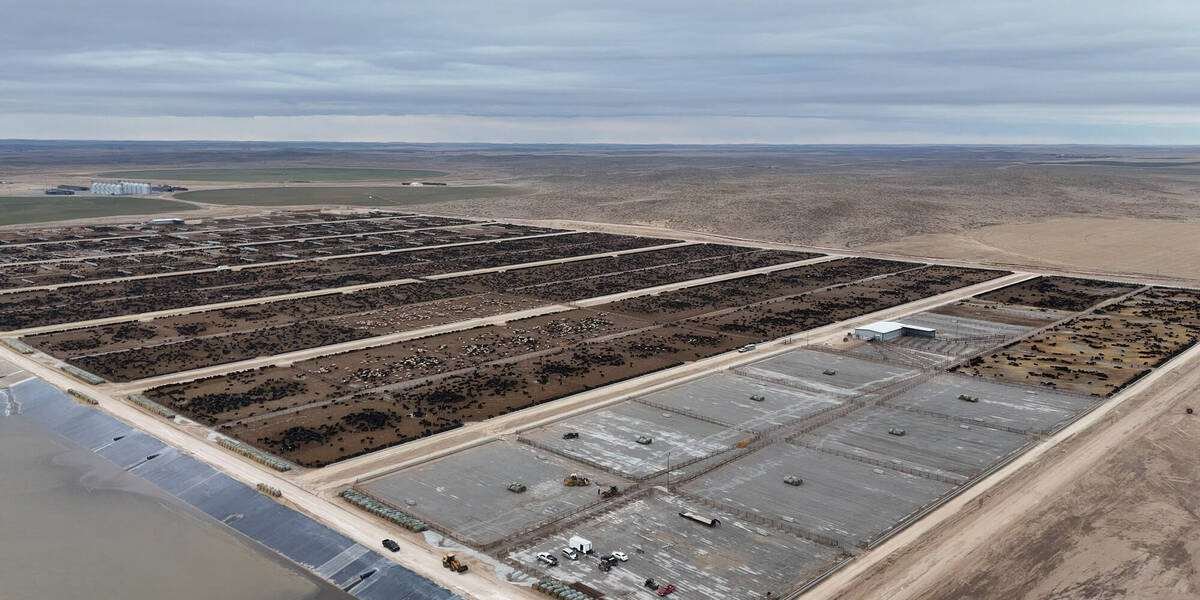
One of the largest single-site beef cattle feedlots in North America continues to build capacity.
Dr. Kee Jim, one of the feedlot company’s three founders, told the recent Livestock Markets Association of Canada convention in Medicine Hat that Blackshirt Feeders near Haigler, Nebraska, is now in Phase 4 of its growth strategy.
By the end of 2026, it will be at 150,000 head and hopes for full capacity at 200,000 in 2027.
Why it matters: Blackshirt Feeders offers a case in which the founders aim to see how far they can go in implementing best management practices.
A biodigester is also featured to turn manure into renewable natural gas as an additional revenue stream.
“I can guarantee you, there’s no place in Alberta that you will ever get a 200,000-head feedlot permitted, end of story,” Jim, a Canadian feedlot consultant, told LMAC.
“Also, if you want to build a biodigester, and you don’t want to go through a four-year fight, you aren’t doing that in Alberta, either.”
Jim said the company secured its biodigester permit in 63 days.
Beyond the favourable regulatory environment, the location for Blackshirt was scouted extensively.
Dundy County, about 300 km east of Denver in the lower far southwestern corner of Nebraska, is in the largest corn-producing area in the United States and 11 major packers are nearby in that state and in neighbouring Colorado and Kansas.
Jim said average rainfall is near perfect thresholds, averaging 20 inches a year.
Concrete and steel
The feedlot is on 100 per cent roller-compacted concrete (RCC), with 700 acres of concrete (a full square mile) and will have no rebar when complete. The facility is all concrete and steel construction, with no wood.
“You cannot bio-digest unless you have a concrete surface because the manure gets too contaminated with a dirt floor, and your manure is going to be between 20 and 40 per cent dirt, depending on the time of the year,” Jim said.

“The other thing it does, it allows you to mitigate the effect of weather, particularly mud. We get an average of 20 inches, but you can get a lot of deviations around that.”
He said the RCC allows the feedlot to put cattle at a two-to-one density ratio compared to dirt floors, which also cuts down on maintenance costs.
Jim said the project was researched using the best elements of 17 other feedlots in which he has been involved.
The design allows for better groundwater protection, with good runoff of the surface water collection in large lined containment ponds. It also reduces dust, flies and odour.
The manure cushion is slightly less than one inch on 40 days of feed, and gets to approximately two-and-a-half inches at 120 days.
Non-human resources
Someone at the convention asked about labour requirements, and Jim said that at full capacity, he estimates there will be 82 employees at Blackshirt, well below the rule-of-thumb of one per 1,000 head, thanks to the facility’s technology.
There is automation throughout the entire yard, particularly at the feed mill, where there will be one employee feeding 200,000 head of cattle, he added.
“One thing I did notice pretty significantly was the reduction in operational costs per head as you increase the size of the feedlot. I think the only limitation on feedlot size is your ability to disperse the manure,” said Jim.
“We’re fortunate we have all these farmers around us that want to take the manure.”
The post Blackshirt Feeders looming largest in North America’s feedlot industry appeared first on Farmtario.


