

Global solar resource was redistributed through the first half of 2026 as early-year blocking patterns and polar vortex disruption in the Northern Hemisphere gave way to developing El Niño conditions from April, according to analysis using the Solcast API. Much of Europe, the United States, Southeast Asia, South America and Central Africa saw irradiance 5–10% above the long-term average, while most of Canada, Mexico, South Africa, Northern Africa, parts of Western Russia and Central Asia were 5–10% below average.
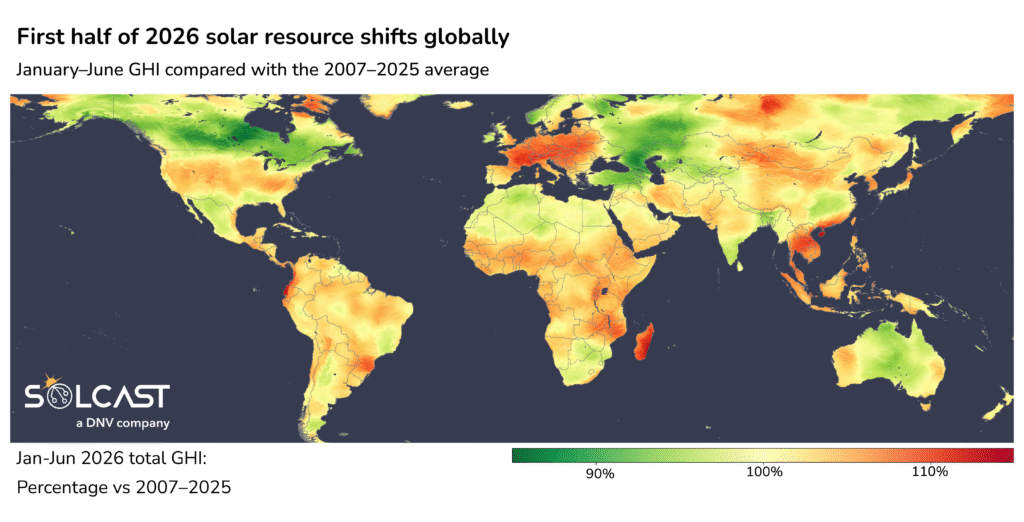
Most of Europe saw significantly more solar than normal across the first half of 2026. The pattern began in winter, when cold, dry air reduced cloud cover across parts of eastern and northern Europe, lifting irradiance even as storm systems reduced solar resource farther west. Spring reinforced the surplus. In April, persistent high pressure over the North Sea kept skies clearer across western and northern Europe, with France 13% above the 2007–2025 baseline, Germany 11% above average, and Finland 16% above normal. May continued the pattern as clearer skies extended from Spain to Ukraine, with the strongest anomalies centred around Austria, where irradiance reached as much as 25% above normal. For solar production, the practical impact was extended periods of stronger irradiance across several major European markets, despite local reductions around the edges of the weather systems.
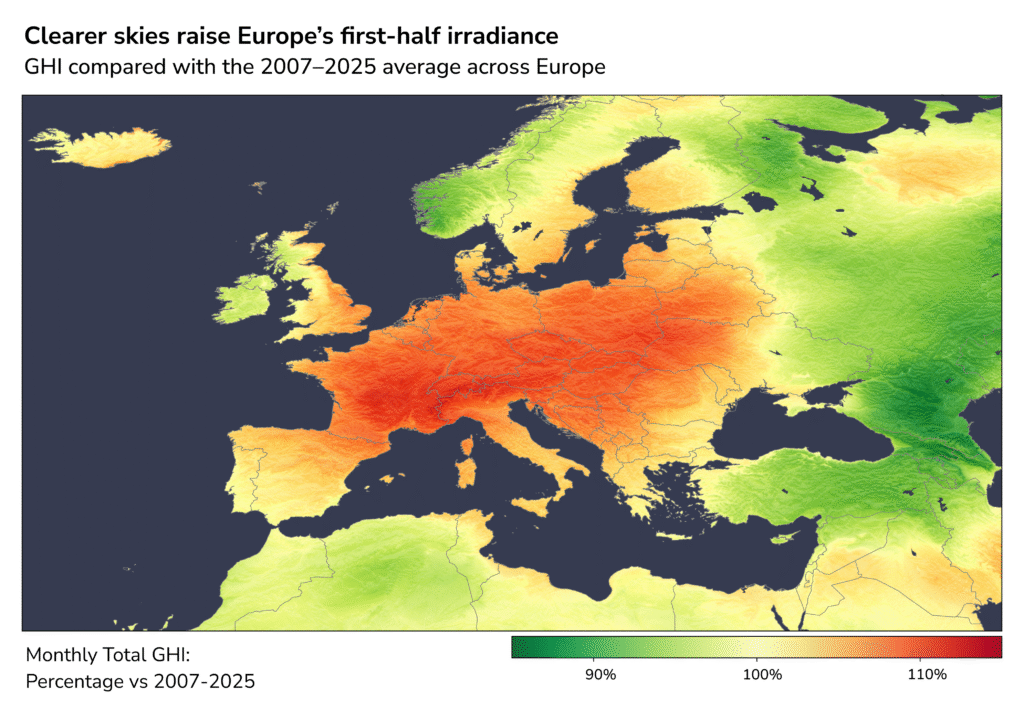
Saharan dust is a recurring feature of Europe’s solar resource, with multiple events each year reducing irradiance and increasing soiling across impacted regions. Below an example from March shows one such dust transport event, with material carried from North Africa over Europe reducing solar resource.
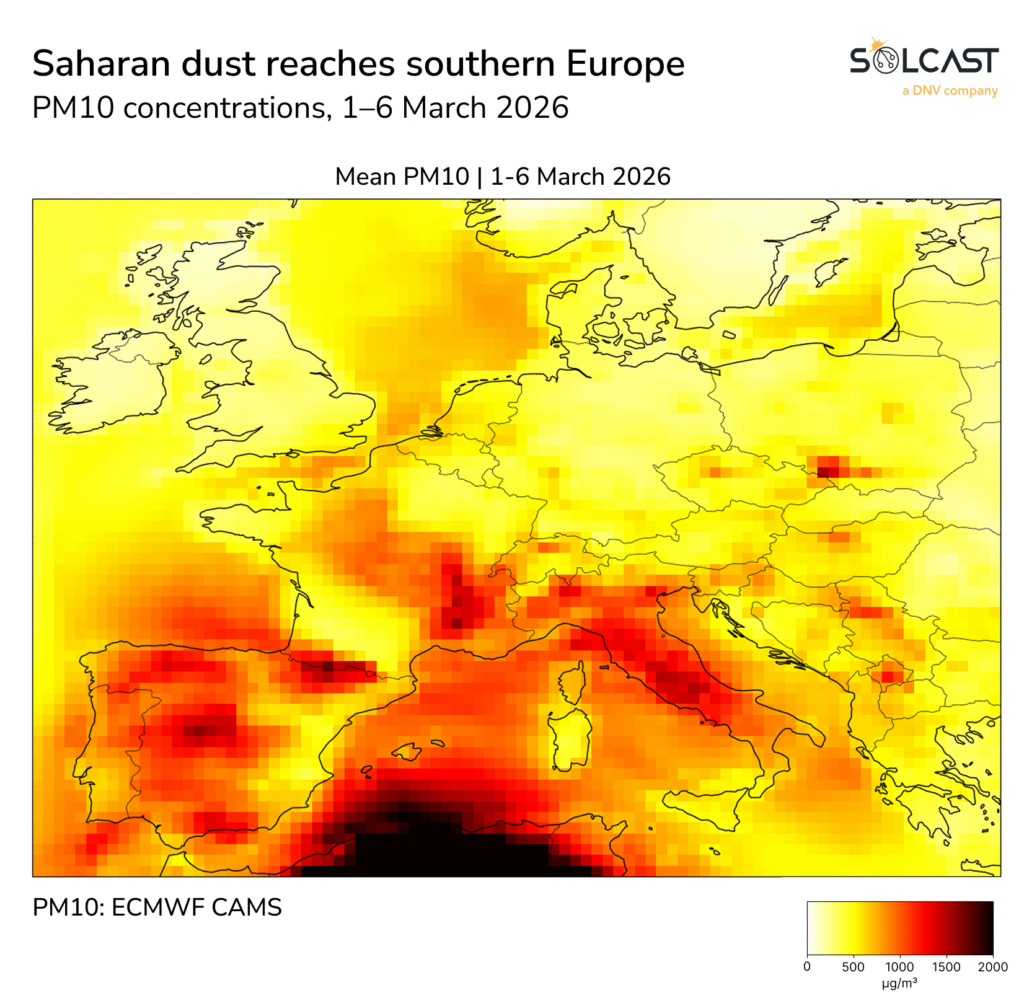
Solar performance in North America was more varied. The United States saw repeated periods of above-average irradiance through winter and early spring, after late-January storm disruption gave way to clearer conditions across large parts of the central, eastern, southern and western U.S. The pattern changed in the second quarter. Western and interior markets remained near or above average, while Texas and the Gulf Coast moved negative as moisture, cloud and rainfall reduced irradiance. California’s Central Valley also recorded below-average irradiance, where persistent tule fog suppressed solar resource during extended periods as can be seen in the maps below. The seasonal shift in North American irradiance is clear when comparing the first and second quarters. Broader gains across much of the United States in winter and early spring gave way to a more regional pattern from April, with clearer contrasts between inland regions and reduced irradiance across the south, particularly impacting Texas and solar production in ERCOT.
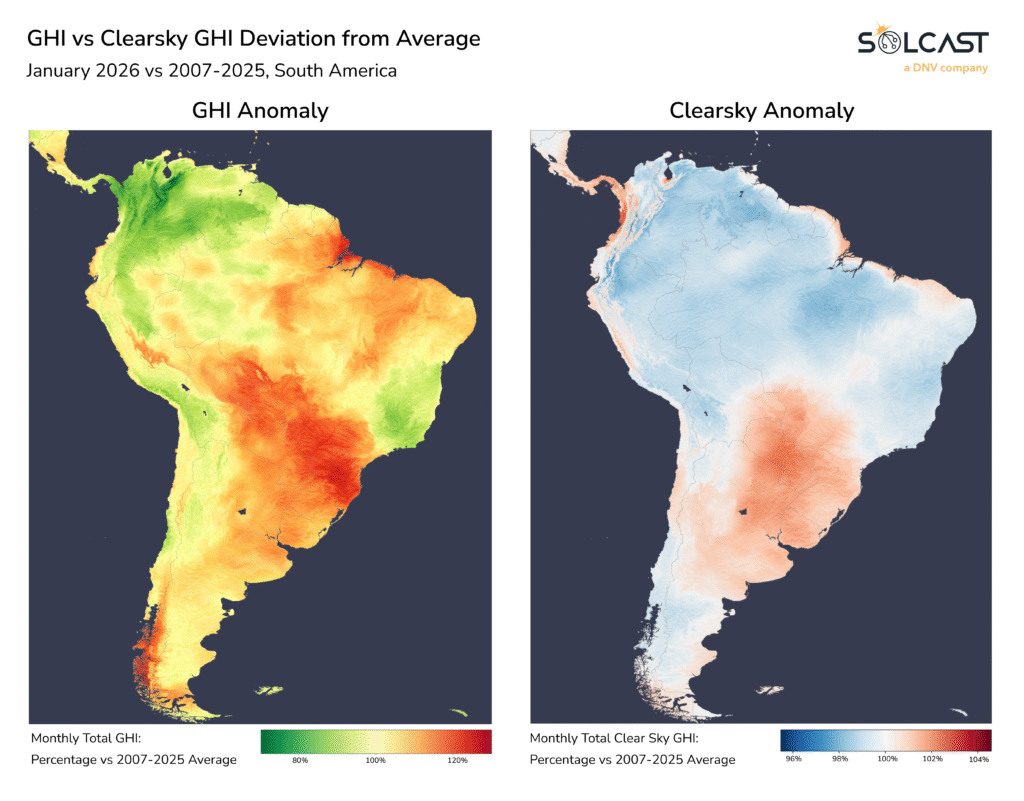
South America showed in January how wildfire smoke can reduce solar resource even when broader conditions are otherwise clear. Northern regions saw irradiance reductions of up to 15% as rainfall and storm activity increased cloud cover. Farther south, hotter and drier conditions across northern Argentina and central Chile reduced cloud formation and lifted irradiance in some areas, but wildfire smoke reduced available sunlight during otherwise clearer periods. For solar sites, this meant clear-sky conditions did not always translate into the same gain in surface irradiance.
Asia’s first-half pattern did not follow a single regional split, instead shifting between northern and southern markets as cloud and rainfall patterns changed. Southern and
coastal China started strongly in January and February, as reduced cloud cover and lower aerosol levels lifted irradiance, with Hong Kong more than 25% above average in January and parts of southern China and Taiwan remaining above average in February.
By April, the strongest gains shifted south into mainland Southeast Asia, where clearer, drier conditions lifted irradiance and Bangkok recorded its sunniest April since 2007. At the same time, persistent cloud and rainfall reduced irradiance across eastern China, with the Yangtze Delta around 10% below average.
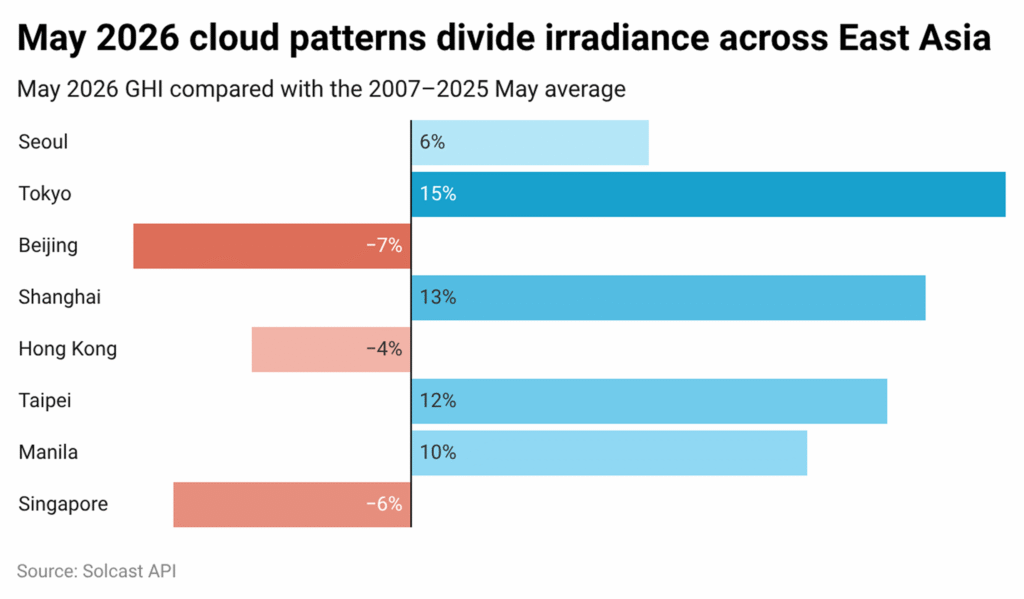
By May, the contrast had shifted again, with stronger irradiance returning to parts of coastal East Asia while cloud and rainfall reduced solar resource elsewhere across the
region.
The May snapshot highlights how neighbouring markets recorded very different irradiance outcomes under these cloud and rainfall patterns.
Australia followed a clear central–coastal contrast through the first half, with below-average irradiance across central Australia and stronger solar resource along parts of the east and west coasts. Repeated cyclone-driven cloud and rainfall suppressed irradiance inland, while coastal regions experienced more frequent clear periods.
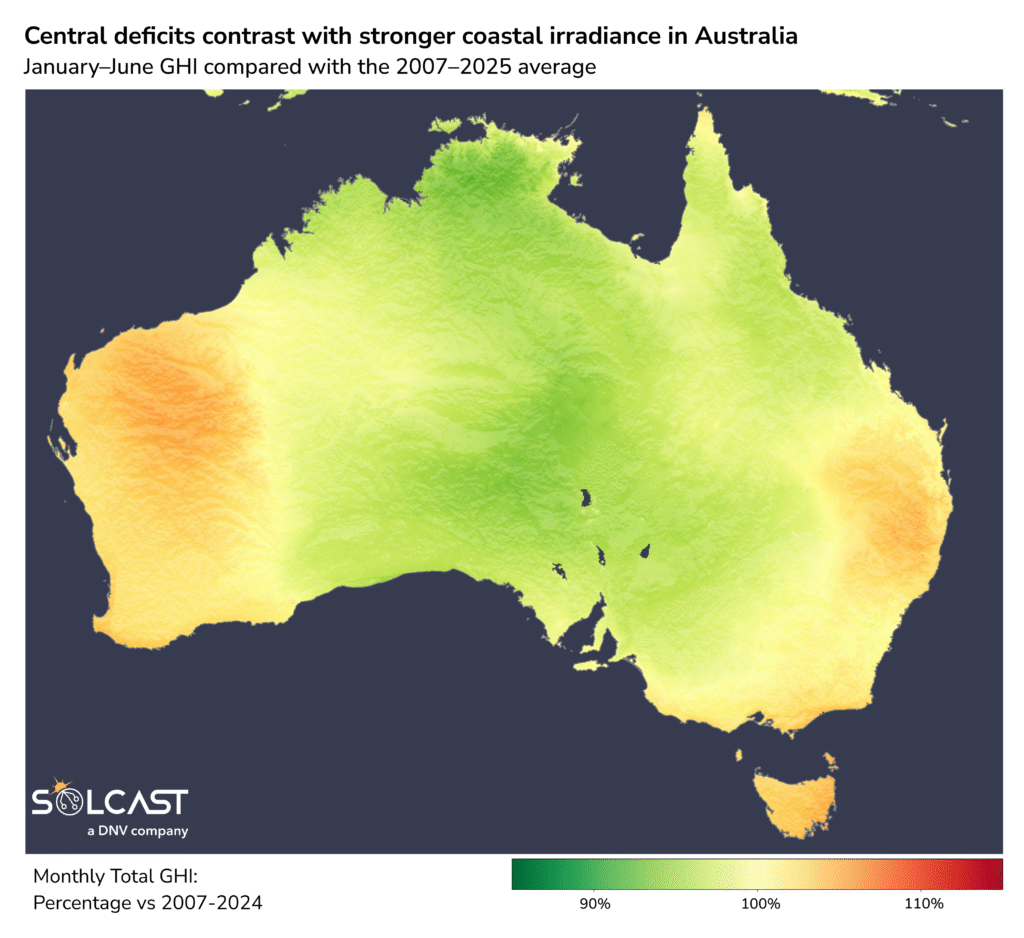
January was mostly above average, but monsoonal cloud and Tropical Cyclone Koji reduced irradiance in the tropical north. Cyclone Mitchell contributed to Australia’s wettest February since 2011, driving 15–30% irradiance deficits across central and eastern regions, before Cyclone Narelle brought cloud, rainfall and dust impacts across
Queensland, the Northern Territory and Western Australia in March. Cyclone Malia later limited April irradiance gains in Far North Queensland and the Northern Territory. For solar operators in affected inland and northern regions, the pattern meant more variable irradiance, higher soiling risk from dust, and more challenging site conditions during periods of heavy rain and cyclone activity, while coastal regions saw stronger resource in parts of the east and west.
Across the first half of 2026, Europe saw broad irradiance gains, while the United States remained above average overall despite more localised disruptions across Texas, the Gulf Coast and parts of California. Asia, South America and Australia showed more regional variability driven by cloud, rainfall, dust, smoke and tropical systems. From April,
developing El Niño conditions added another layer by reshaping rainfall and cloud cover across Asia and Australia.
Solcast produces these figures by tracking clouds and aerosols at 1-2km resolution globally, using satellite data and proprietary AI/ML algorithms. This data is used to drive irradiance models, enabling Solcast to calculate irradiance at high resolution, with typical bias of less than 2%, and also cloud-tracking forecasts. This data is used by more than 350 companies managing over 300 GW of solar assets globally.
The post Blocking, El Niño and extreme events redistribute solar resource in 2026 so far appeared first on pv magazine Global.


