

Support CleanTechnica’s work through a Substack subscription or on Stripe.
A night on a European cruise is taxed 40% less than a hotel despite their high environmental costs and contribution to overtourism. T&E calls for tax reforms to ensure that cruise ships pay their fair share.
A night on a cruise ship is taxed almost half as much as a night in a hotel, a new T&E study shows. That is despite their high environmental and climate costs, and the strain they put on local infrastructure¹. T&E calls for adjustments to tax rules to help cities to deal with the external costs of cruising.
The analysis looked at the taxes for €100 a night hotels in France, Italy and Spain, and compared them to cruises with similar prices. On average, people who stay at hotels will pay 23% of the price in taxes, while cruise passengers will only pay 12%.
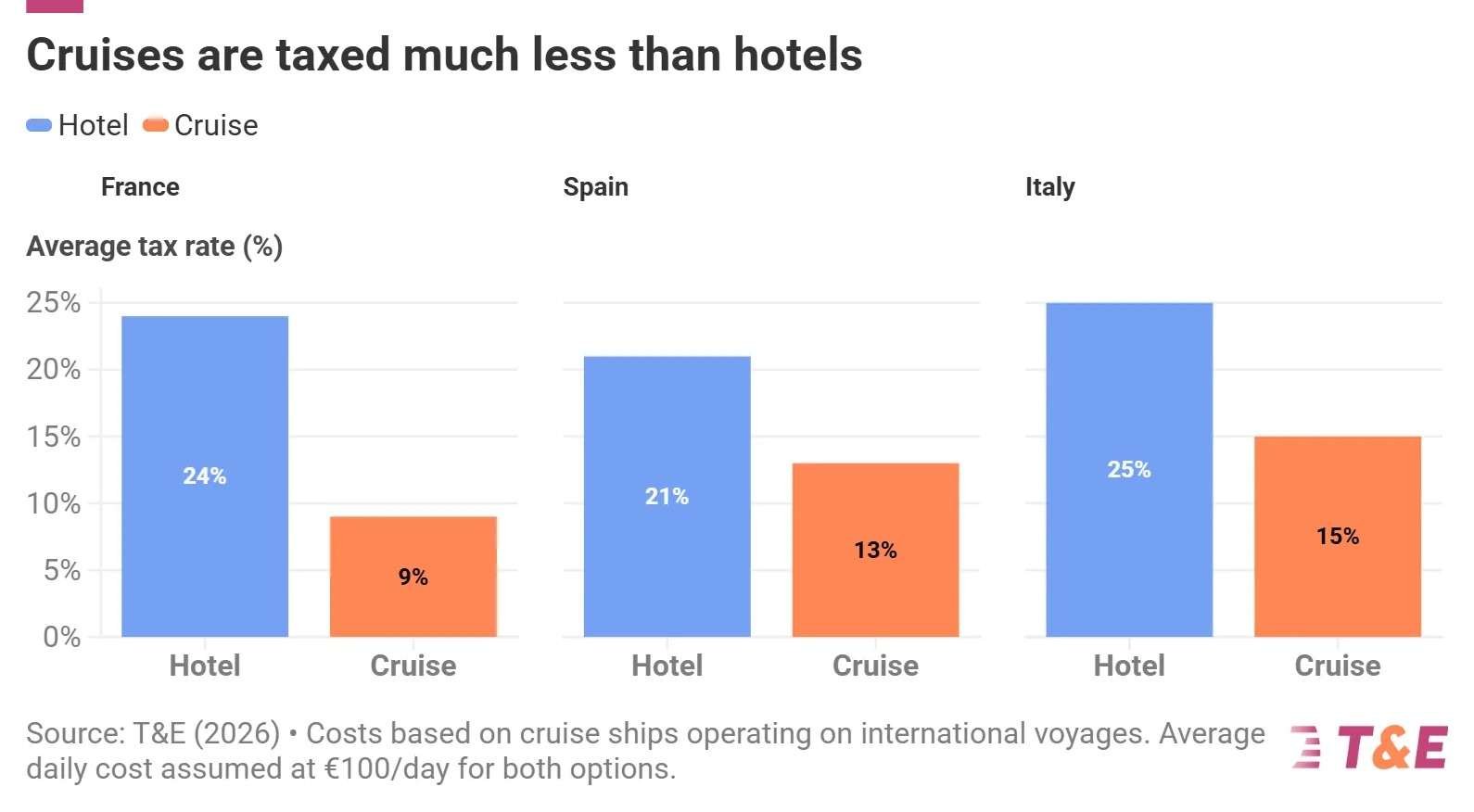
Cruises are legally classified as a form of maritime transport, while in practice they function as holiday accommodation. This loophole allows them to avoid paying VAT and fuel taxes, among other things. Fanny Pointet, Shipping Manager at T&E, said: “We are treating floating hotels like they are essential maritime infrastructure. Cruises are not a mode of transportation but the destination itself, yet we are giving them the same benefits as freight transport. Taxing cruise ships properly would help cities to tackle the pollution and to address concerns of overtourism.”
The study shows that a large share of negative externalities — coming from greenhouse gases and air pollutants emissions — generated by cruise ships are not covered by existing policies. In France, Spain and Italy, those external costs ranged between €790 million and €1.3 billion in 2025². On average, the climate-related external costs of this sector exceed ETS revenues by a factor close to two to three. For costs related to air pollution, there is no such tax existing at the EU level.
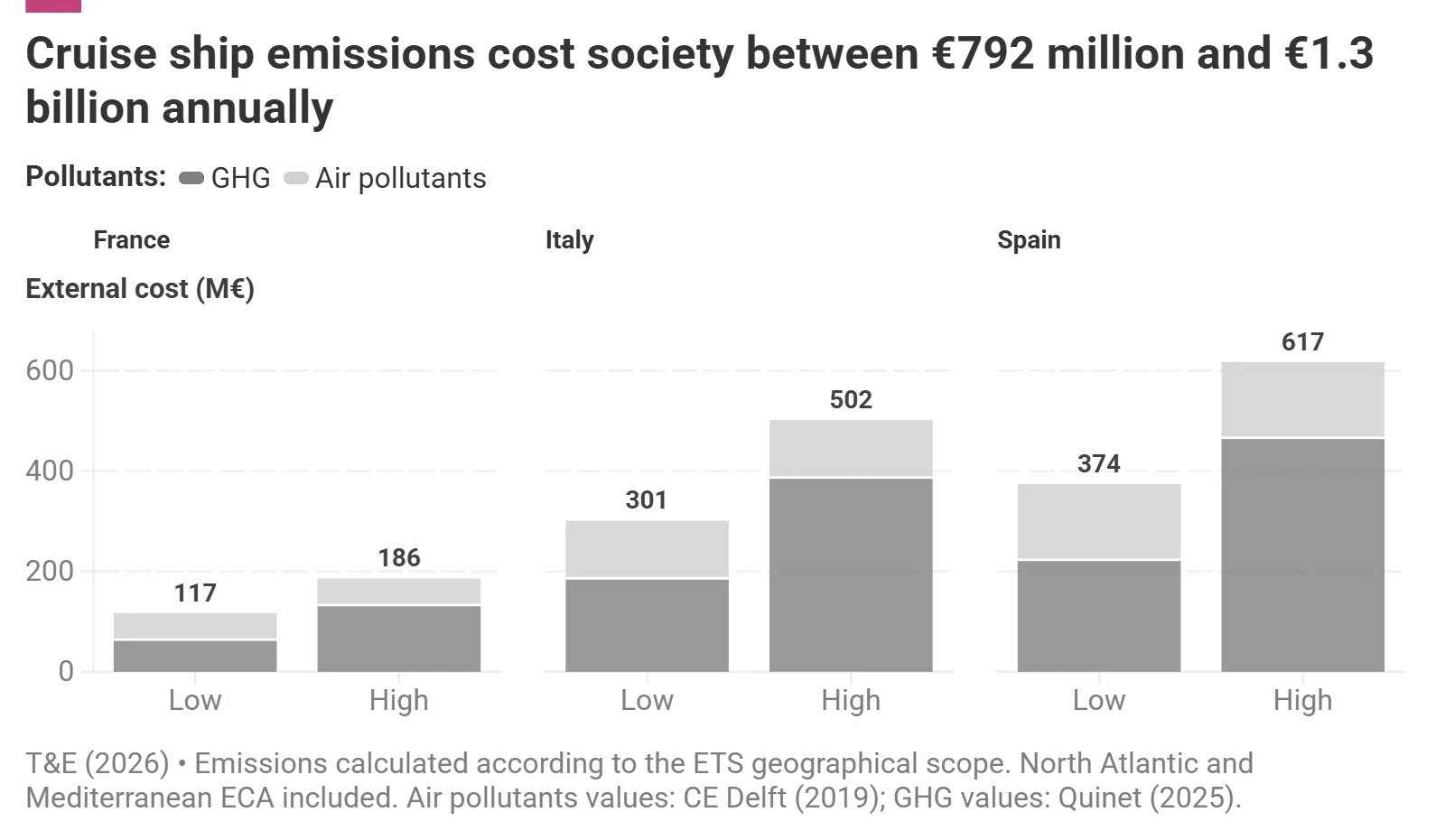
A €15 tax per passenger per port call would raise €335 million a year in Italy, France, and Spain combined, according to T&E’s modelling. These revenues could go back to national budgets, be earmarked for the protection of ecosystems in coastal areas or used to finance green infrastructure like onshore power supply.
But these taxes won’t be enough by themselves to close the gap between the environmental cost of cruises and what they pay to compensate. “A cruise ship levy must be viewed as part of a broader regulatory mix. To fully mitigate the sector’s environmental footprint, parallel supply-side policies are necessary,” Fanny Pointet concluded.
T&E recommends strengthening EU regulations on sustainable marine fuels (FuelEU Maritime) and tightening energy efficiency benchmarks. Cruise ship traffic could also be restricted when necessary, for example by capping the number of daily or annual port calls. Finally, VAT for cruise ships should be aligned with land-based tourism, says T&E.
Notes
¹ According to ICCT, a cruise passenger generates two to four times more CO2 than holidaymakers flying or driving for their vacation and staying in land-based hotels.
² The estimated range is based on two alternative carbon values calculated by CE Delft (2019) and Quinet (2025). Full methodology and sources to be found in the briefing.
Article from T&E.
Read full briefing here.
Sign up for CleanTechnica’s Weekly Substack for Zach and Scott’s in-depth analyses and high level summaries, sign up for our daily newsletter, and follow us on Google News!
Advertisement
Have a tip for CleanTechnica? Want to advertise? Want to suggest a guest for our CleanTech Talk podcast? Contact us here.
Sign up for our daily newsletter for 15 new cleantech stories a day. Or sign up for our weekly one on top stories of the week if daily is too frequent.
[embedded content]

[embedded content]
CleanTechnica uses affiliate links. See our policy here.
CleanTechnica’s Comment Policy


