
By Blair Shipp, ASA State Policy Communications Coordinator
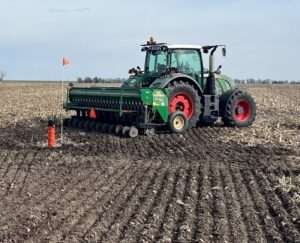
Photo courtesy of Brandon Wipf
For Brandon Wipf, discussions around monarch butterfly conservation are about more than protecting a species. They are also about recognizing how voluntary conservation practices can support both the environment and the long-term financial strength of farm operations.
Earlier this year, the South Dakota Legislature passed Senate Concurrent Resolution 605, sponsored by Wipf, knowing the importance of monarch butterflies and encouraging cooperative, voluntary conservation efforts across the state. Wipf serves in the South Dakota State Senate representing District 22 while also farming soybeans and row crops near Huron, South Dakota, and serving as a director with the American Soybean Association.
The resolution comes as the U.S. Fish and Wildlife Service considers listing the monarch butterfly as a threatened species under the Endangered Species Act. During the passage of the resolution, Wipf emphasized that conservation efforts should remain voluntary and locally driven.
“Monarch butterflies are an important part of our natural heritage and our agricultural landscape,” Wipf said. “This resolution affirms that conservation efforts in South Dakota can and should be voluntary, locally driven, and respectful of private property rights and our state’s strong agricultural tradition.”
Monarch butterflies rely exclusively on milkweed plants to lay eggs and sustain larvae, making habitat availability critical to their survival. The South Dakota resolution encourages state agencies, local governments, and land managers to preserve existing milkweed where practical and to incorporate pollinator-friendly native seed mixes into restoration and conservation plantings when appropriate.
The issue is also closely connected to farm economics, a point Wipf made examining the impact of consistently low-producing acres on farm profitability and crop insurance guarantees. Wipf noted that many farms have marginal acres that can weigh down a farm’s production history over time, lowering the revenue guarantees farmers can insure through federal crop insurance programs.
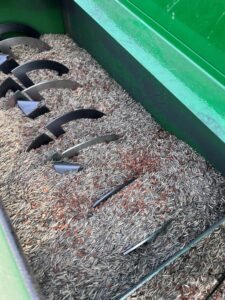
Milkweed seed scattered in with grass in the drill
Rather than continuing to invest inputs into acres that rarely generate a return, he pointed to conservation programs and pollinator habitat as an opportunity to strengthen both farm resilience and monarch habitat.
“Every farm has them,” Wipf said. “The sandy ridge that burns up in July. The low spot that drowns in June. The salty patch that never keeps up.”
Programs such as the Conservation Reserve Program can provide stable conservation payments while reducing input costs on acres that consistently underperform. At the same time, perennial habitat can improve soil structure, reduce erosion, hold moisture, and support pollinators and wildlife across the landscape.
“At the same time, you’re building resilience,” Wipf said. “Pollinator habitat and other perennial covers improve soil structure. It reduces erosion. It helps hold moisture. It supports pollinators and wildlife.”
The resolution also urges federal agencies, including the U.S. Fish and Wildlife Service and U.S. Department of Agriculture, to work cooperatively with producers and landowners by prioritizing technical assistance, flexibility, and voluntary participation while avoiding unnecessary regulatory burdens on agriculture.
Wipf said collaboration between farmers, landowners, and conservation partners will be essential moving forward.
“Through collaboration and voluntary efforts, our state’s farmers, ranchers, and landowners can support monarch conservation while maintaining the thriving, productive agricultural operations that are the backbone of South Dakota,” he said.
The post Brandon Wipf Sees Opportunity in Monarch Conservation appeared first on American Soybean Association.


