

California has a long history of leading the world in the development and deployment of cleaner cars and trucks and the innovative policies that have led to cleaner air and lower climate pollution. CA’s new Governor will be taking the helm when this progress is being threatened, climate action has become more urgent, poor air quality continues to impact millions of Californians, and affordability is a top concern. Federal attacks on CA’s authority under the Clean Air Act to adopt and enforce its own, more health-protective vehicle pollution standards have stalled policy implementation—essentially letting automakers off the hook for delivering cleaner cars and heavy-duty trucks. Federal EV incentives for new and used vehicles have been revoked, undercutting what was a strong and growing market for EVs in CA. CA’s continued investments and incentives have helped to counter these headwinds and saved Californian’s billions of dollars in avoided gasoline spending at the pump, but alone are insufficient to move forward at the speed necessary to avoid the worst climate impacts or provide relief to communities suffering the most from air pollution.
California’s new governor needs a bold agenda to give our state’s residents access to clean, affordable transportation, healthy air, and a safe climate. Here’s how California’s new governor can lead on vehicle electrification:
Make electric cars more affordable for more people
Move quickly to develop new vehicle standards to ensure CA drivers have access to a growing number of affordable electric vehicles. There’s a reason California is the birth place of the modern EV – years of consistent regulatory policy have compelled automakers – the whole industry, not just one or two manufacturers – to invest in cleaner gasoline and electric vehicles. While incentives can help support individual automaker ambition and consumer purchases, its regulatory requirements that compel the industry to move forward, bring models to market, and lower technology costs. Federal actions to rollback national pollution and efficiency standards and block CA’s rules have led to tens of billions of dollars of divestment by automakers in their former EV plans and cancelation of existing and planned EV models (Goodbye Ford Lightning and Honda Prologue. Would have been nice to meet you Kia EV4.). Many of Californian’s clean car rules are currently on hold while caught up in litigation as the state works to defend its right to regulate. The new Governor must work to protect California’s right to regulate while moving forward with the California’ Air Resources Board (CARB) plans under their Drive Forward Initiative to establish new standards.
Provide secure funding for EV incentive programs by placing a fee on new luxury vehicles. Driving is expensive. But not everyone experiences those costs the same way. Lower income households use a much larger share of their household income on transportation expenses and have less money available to purchase a new or used vehicle. With new vehicle costs at record highs and monthly loan payments for new and used vehicles at well over $500/month, many Californians need help to transition to an EV. The Clean Cars 4 All program is a successful program helping lower income households get rid of their older, higher polluting cars and replace them with an EV which is not only cleaner, but can save them on maintenance and fuel costs. Governor Newsom also announced a program this past summer with 13 automakers to offer instant rebates for first time EV buyers. But neither of these programs has sustainable funding. The new governor should support an effort to secure on-going, sustainable funding to support the transition to affordable EVs. One approach is to look at revenue opportunities in the vehicle market itself. For example, a fee on new luxury vehicle sales could provide on-going revenue to support incentive programs paid by those who are most able to afford it. Incentives could be targeted not only to households most in need with the oldest, dirtiest cars, but apply to only the most affordable EVs on the market. What’s in it for everyone else? Cleaner, healthier air. It turns out the oldest cars on the roads, namely those manufactured prior to 2004, produce a disproportionate amount of air pollution so getting them off the road is a priority. A luxury vehicle tax isn’t a novel idea. Washington state implemented one earlier this year to support transportation investments.
Get the most out of EVs: Implement SB 59 and direct the PUC to improve access to managed and bidirectional charging programs and facilitate backup power. EVs are great at moving people around but they can do a whole lot more – especially when they are parked unused for 95 percent of the time. Smart charging can actually support a lower cost, renewably powered grid; bidirectional charging capabilities can go a step further – putting power back on the grid when needed, providing back-up power to homes, and further lower electricity grid costs. The new administration should start by implementing Senate Bill 59. SB 59 – passed in 2024 – authorizes the California Energy Commission to require EVs to have bidirectional capabilities when they’ve identify beneficial use cases for the EV owner or to the electric grid. There are more than 2 million EVs on California’s roads already and more are on the way – unfortunately only a small fraction of these vehicles are capable of bidirectional charging or providing home backup power. Making sure new EVs sold have the ability to export power will ensure EV owners (the original buyers as well as any future owners) can participate in bidirectional charging utility programs to lower their cost of ownership and provide valuable grid benefits (UCS found managed and bidirectional charging could save CA on the order of $10 billion per year by 2045 in avoided electric grid costs). Having millions of vehicles capable of providing emergency back-up power at a time when the state faces continued climate-fueled disasters would make all of our communities safer and more resilient.
Adopt and implement a robust statewide EV battery recycling program. EVs dramatically reduce climate pollution compared to gasoline cars but that’s not their only benefit. When an EV is at the end of it’s life, the battery can be repurposed or recycled to provide raw materials for a new battery. As EV adoption ramps up and more vehicles are retired, battery recycling could meet as much as half of the lithium demand for new batteries. But without a robust recycling and reuse program in place, EV batteries can fall through the cracks. Colorado recently adopted a first in the nation policy to implement a robust EV recycling program. As the state with the most EVs on the road, CA should be next.
Zero out freight pollution by electrifying the largest, most polluting vehicles on the road
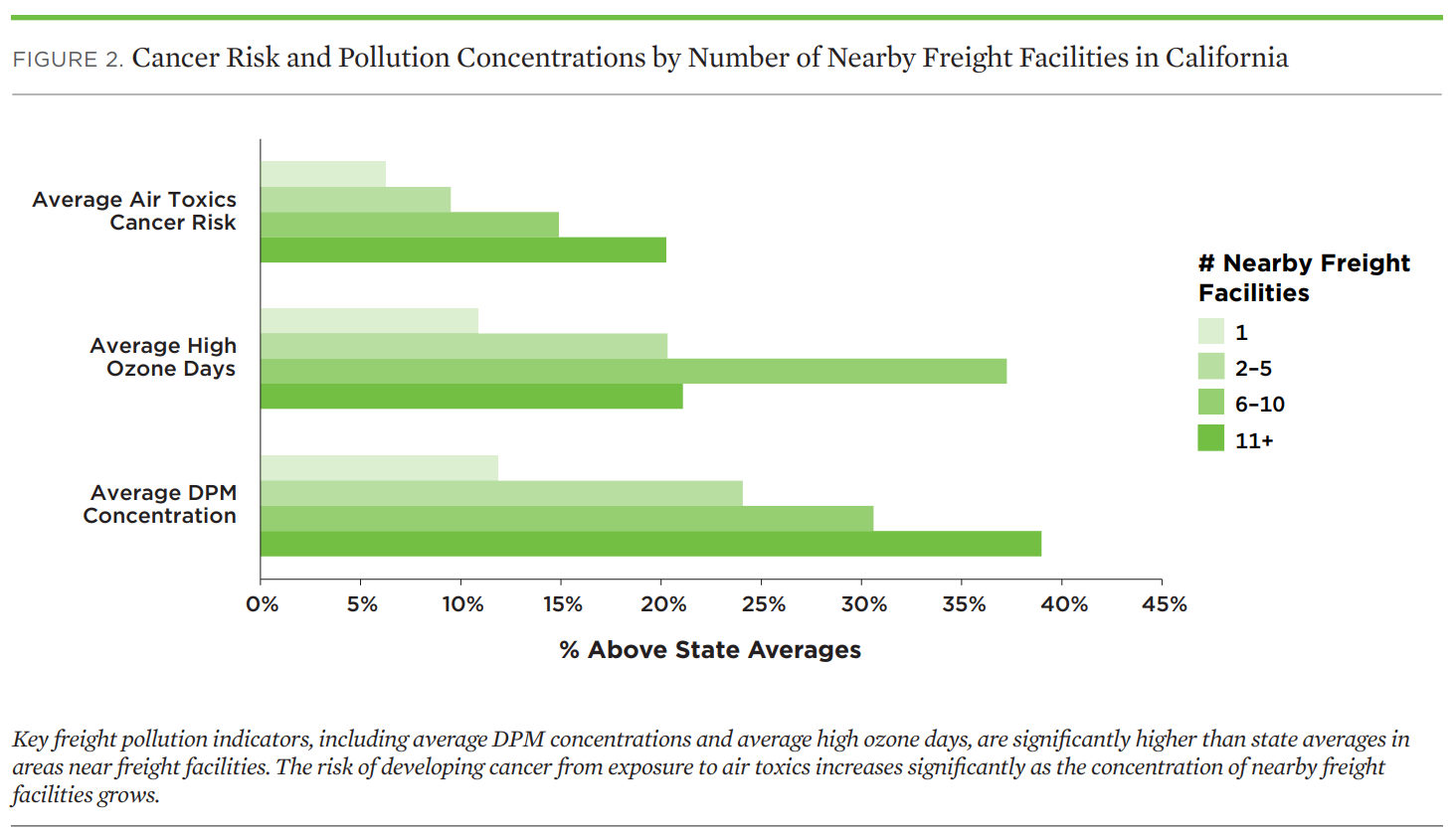
Diesel pollution is deadly. Diesel trucks alone are the largest source of nitrogen oxide pollution and responsible for more than half of the fine particulate matter emitted by on-road vehicles in the state. But trucks are only part of the problem. Those living closest to ports, railyards, warehouses, and freeways suffer the most from our diesel-powered freight system which include trucks, trains, cargo handling equipment, and more. More than 1 in 4 – or 10.5 million Californians – live near major freight facilities and corridors and experience diesel PM concentrations 40 percent higher than the state average. [See our new CA freight pollution factsheet.] Heavy-duty trucks – from delivery trucks to big rigs – are also a disproportionate share of climate emissions from the transportation sector. They make up about only about 7% of vehicles on the roads but more than 25 percent of global warming pollution from all vehicles.
Recent price spikes in diesel fuel costs are just the most recent reminder of the other economic costs of relying on fossil fuels to power the movement of goods. Average diesel prices reached an all-time high in October of $8.45 per gallon according to AAA. These prices aren’t just painful for truck drivers and fleet owners, but we’re all paying in the form of higher prices on every day goods or directly through fuel surcharges.
Electric trucks are increasingly a viable alternative to internal combustion trucks across all types of trucking, offering an alternative to diesel pollution and $8+ diesel fuel prices. California’s previous investments in programs, regulations, and investments have led to a growing number of models and record levels of deployment. Electric buses and smaller delivery trucks are leading the way with market shares in 2025 of nearly 50% and 30% respectively. But for the largest trucks on the road (larger straight trucks and tractor trailers) zero emission models only comprise about 3 percent of sales (based on UCS analysis of S&P new registration data for calendar year 2025). Keeping up momentum on electric truck deployment is critical for addressing the inequitable harms caused by diesel pollution, reducing climate emissions, and protecting Californians from volatile fossil fuel prices.
California’s new Governor should recommit the state to transitioning to zero emissions freight and do the following:
Defend California’s right to protect its residents from pollution and develop new regulations for truck pollution. I already said this above, but it bears repeating. New vehicle standards have been instrumental in reducing air pollution and climate emissions and driving innovation. There are decades of evidence that they are an effective strategy for ensuring the entire market for new trucks moves toward lower emissions quickly. California must defend against on-going attacks on this authority by the current federal administration and work to reestablish new vehicle and fleet standards. In addition, California can move forward with additional regulatory approaches that do not require federal approval to ensure progress toward electric trucks continues regardless of courtroom outcomes. For example, a Clean Miles Standard for freight would compel major shippers to have a growing share of their freight miles be zero-emissions. This type of requirement would be complementary to zero emission truck standards for manufacturers and trucking fleets, ensuring that the companies moving their goods by trucks are supporting the transition to electric trucks even if they don’t own the trucks themselves. This approach and others should be included in the heavy-duty vehicle part of CARB’s Drive Forward Initiative. Getting the dirtiest trucks off the road—especially those operating closest to communities such as drayage trucks—should continue to be the highest priority with the fastest timeline for transition.
Support sustained financial incentives for electric trucks. California has provided significant financial support for electric truck deployment in addition to setting requirements. It has been instrumental for supporting early proof of concept and demonstration projects and more recently provided support for early deployment of electric class 8 tractor trucks—the largest trucks on the road. On-going support for these programs, like the Clean Fuel Reward program – is critical as manufacturers are finally bringing to market electric models in the heaviest classes of trucks. But as we have seen with the passenger EV market, as sales volumes increase, incentive programs can become harder to sustain as they get more costly. To support the next stage of the market for electric trucks, California could pass a sales tax exemption for these vehicles. California currently imposes a state 7.25% sales tax on new vehicle purchases. This tax can add up on electric heavy-duty trucks that can cost more than $200,000 per vehicle. Passing a limited time sales tax exemption for electric trucks could limit any revenue impacts to the state while providing a sustained incentive for the early market of electric trucks.
Adopt a statewide Indirect Source Rule Freight facilities, like warehouses, ports and railyards draw high concentrations of diesel trucks and trains, increasing air pollution in the communities they are located in. These communities are disproportionately impacted by the freight system, suffering higher levels of exposure to diesel particulate matter and experience elevated cancer risks. Indirect sources rules aim to tackle this pollution by establishing facility-specific targets for emissions and a flexible set of compliance strategies that can be used to meet those targets. For example, options can include investing in charging infrastructure for electric trucks and electric truck visits. The South Coast Air Quality Management District has pioneered this type of policy in CA which has been helping to reduce pollution and advance zero emission truck deployment. Establishing a state-wide ISR would provide similar benefits to freight-adjacent communities around the entire state.
Targeted fees to support electrification can drive affordability and cut our fossil fuel bill
Investing in clean, affordable transportation requires money. Some may argue that we can’t afford to do that right now when so many costs are rising. But staying tied to fossil fuels and internal combustion engine vehicles is the most costly option of all.
- Recent gasoline price spikes are only the recent reminder. California’s paid on average 85 cents more per gallon in 2026 than they did the previous year (Jan – Sept. based on EIA weekly average CA gasoline prices).With average monthly gasoline consumption in CA topping 1 billion gallons per month, that added cost amounts to an extra $900 million dollars being spent by Californians at the pump EVERY MONTH compared to last year.
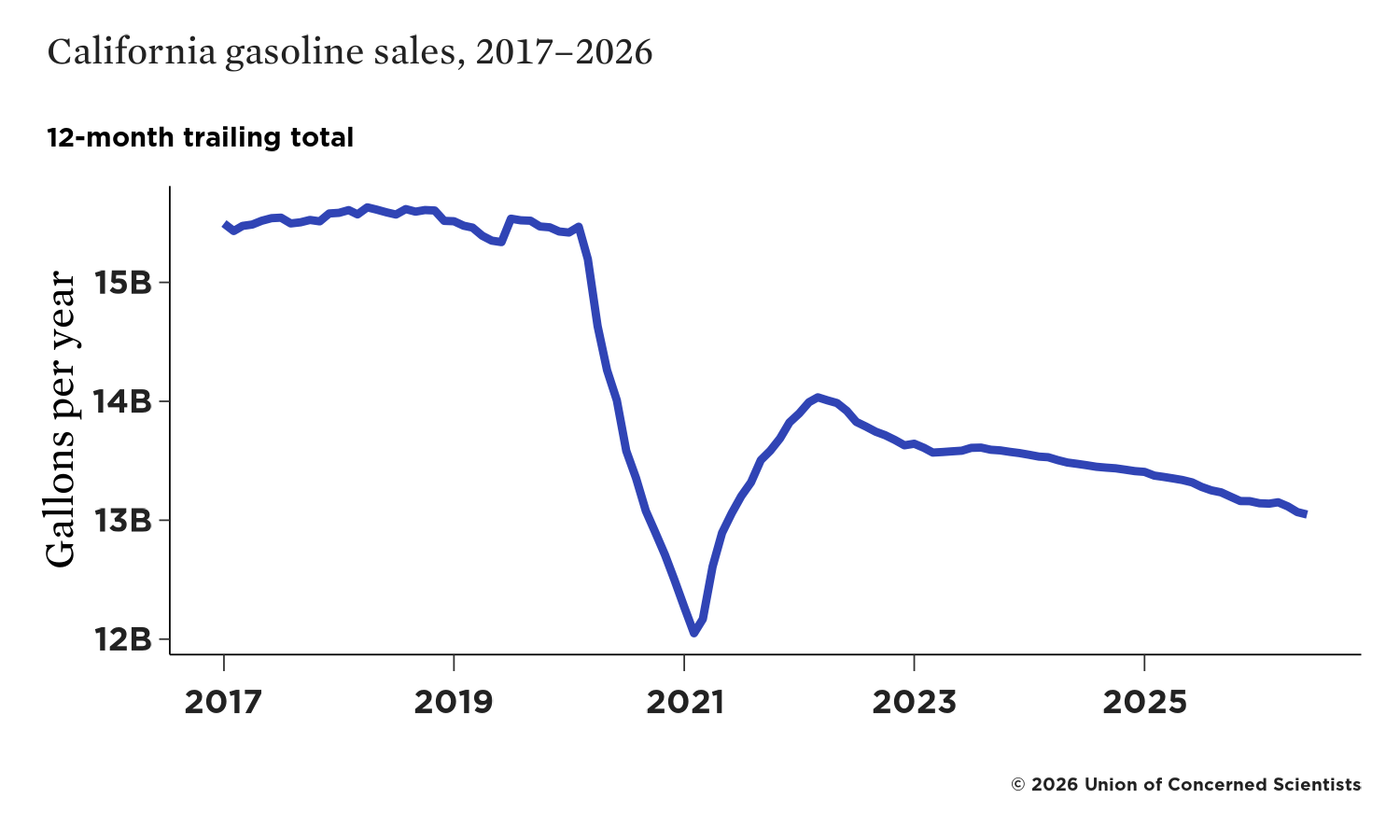
- While it may be hard to believe, it actually could be a whole lot worse. California’s investments in alternatives to our fossil fuel transportation system have already paid dividends and will continue to do so. More efficient gasoline cars and trucks, the deployment of about 2 million fully electrified vehicles, and fewer miles driven have helped to contribute to a decline in annual California gasoline consumption of 2.5 billion gallons between 2017 and mid-2026.
- If California used as much gasoline in the first 6-months of 2026 as it did during that same time period in 2017, Californians would have spent, on average, an additional $1.3 billion dollars more PER MONTH at the pump.
- In other words, without Californian’s efforts to reduce pollution, deploy EVs, and promote alternatives to driving, all of which have driven down gasoline consumption, the pain of recent high gas prices would be more than twice as bad as it has been (more than $2 billion/month vs about $1 billion).
Continuing to invest in the transition to electrification by helping more households switch from a gasoline car to an EV not only reduces pollution, but makes our economy more resilient to volatile fossil fuel prices.
Raising revenue is a serious business though and California’s leaders need to be thoughtful about how they tackle the problem. They must avoid exacerbating the affordability crisis for families suffering the most by focusing on those most likely to be able to afford it (as a luxury vehicle tax would) or spreading the costs out to minimize any individual impact.
How the funds are invested are as important as how the money is raised. Some households and businesses need greater support for transitioning to EVs. These programs should be designed with community input and designed to also go after the most polluting internal combustion vehicles to maximize the overall public benefit. Clean Cars 4 All is one example of a program helping to retire the oldest, dirtiest gasoline vehicles while incentives to replace drayage trucks operating at the state’s ports are helping to get some of the oldest and dirties diesel trucks off the road.
Transportation is critical to California’s economy but it’s also the largest source of climate pollution in the state, a leading cause of inequitable exposure to unhealthy air, and a top household expense at a time when affordability is top of mind for so many Californians. California’s new governor can tackle these challenges by accelerating our state’s transition to electric cars and zero emissions freight.


