
Requirements for milk by Canadian dairy processors grew in May 2026, while production declined, but the volume of production still meant national butter stocks increased.
The Canadian Dairy Commission’s latest monthly report showed that 405 tonnes were added to national butter stocks, which is done to help balance the market.
WHY IT MATTERS
Canadian dairy farmers can use market projections to help plan the number of cows they will need to fill the kg of butterfat quota they own.
The CDC expects moderate growth of 1.9 per cent for January to December 2027.
The challenges in the current economy have led to the low rate of growth.
Total requirements for butterfat by processors increased 4.18 per cent from April 2026, but showed a decline of 2.85 per cent from May 2025.
Increasing consumption of cream and ice cream contributed to the rise in requirements.
Total requirements year over year from May 2025 to May 2026 show an increase of 2.01 per cent from the equivalent period last year in daily average.
Imports decline year-over-year
The equivalent of 86,195 kg of butterfat on a daily equivalent basis entered Canada as imports in May 2026.0
Imports over 12 months ending May 2026 were 25.2 million kgl of butterfat, a 1.8 per cent decrease compared to the equivalent period in the previous year.
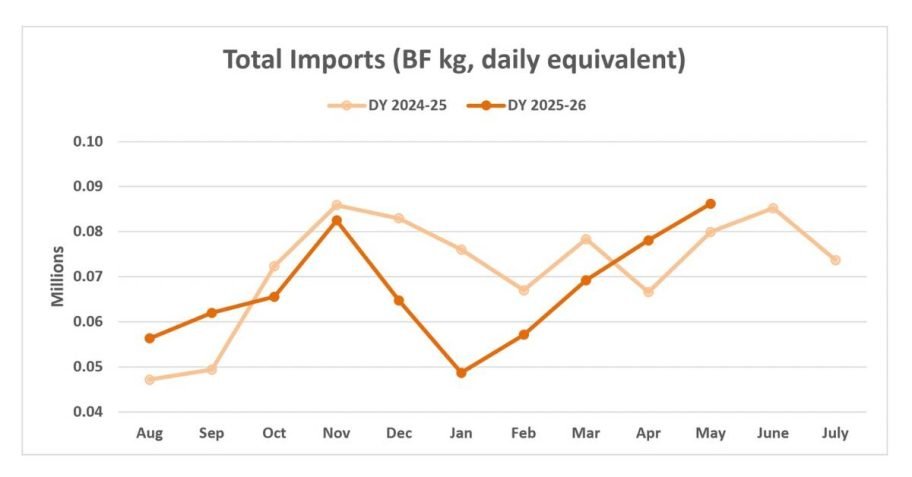
Milk, cream and butter tariff rate quotas for import are measured on a dairy year basis. So far, during this dairy year, there have been above average butter imports from CUSMA and the World Trade Organization (WTO).
Yogurt, ice cream and cheese are measured on a yearly basis, with yearly TRQs.
Imports of these products have been steady from the WTO, and ‘moderate’ from Europe and North American sources.
The post Canadian butter stocks increase in May appeared first on Farmtario.


