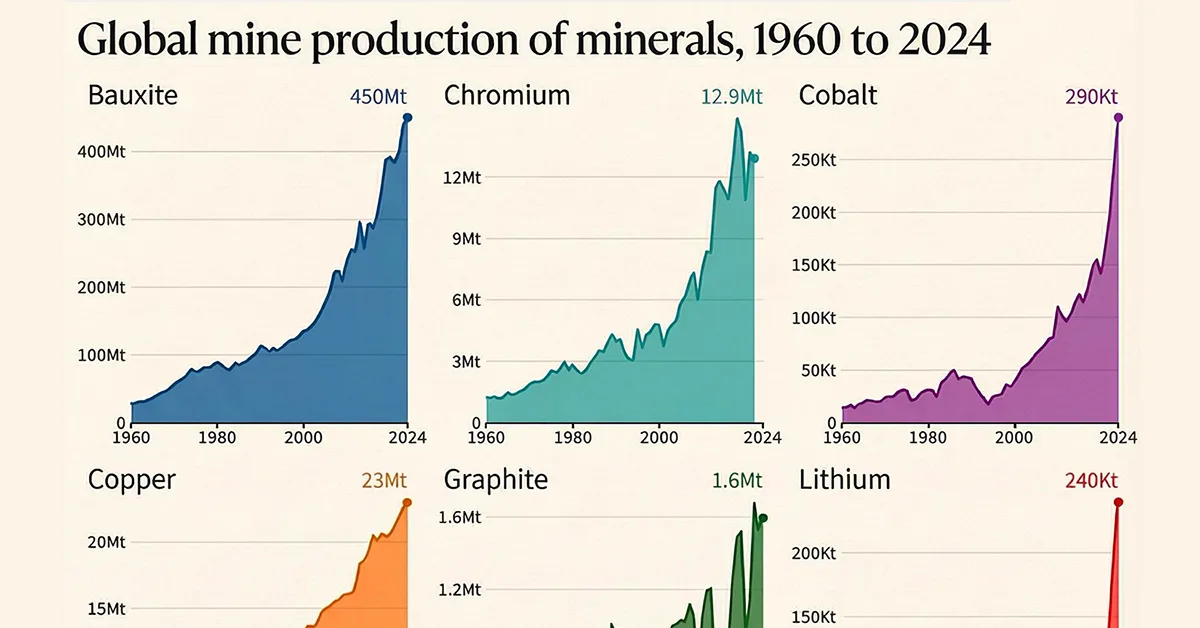
Charted: The Explosive Growth of Critical Minerals
Key Takeaways
- Global production of key minerals has surged since 1960, with lithium, rare earths, and nickel seeing especially sharp growth.
- The rise of EVs, batteries, renewable energy, and AI infrastructure is accelerating demand for critical minerals worldwide.
- Copper and iron ore still dominate by scale, highlighting how traditional industrial materials remain essential to global growth.
Global mineral production has climbed dramatically over the last six decades as industrialization, urbanization, and electrification reshape the global economy.
The fastest growth is now occurring in minerals tied to the energy transition. Lithium production, for example, has surged from almost nothing in 1960 to 240,000 tonnes in 2024, while rare earth output has also accelerated sharply amid rising demand for EVs, batteries, wind turbines, and advanced electronics.
The visualization above, created by DataCanvas using data from Our World in Data, tracks global mine production across major minerals from 1960 through 2024.
Growth in Critical Minerals Since 1960
Copper, iron ore, and phosphate rock dominate global output by volume, while lithium and rare earth production have accelerated rapidly in recent years as clean energy demand rises.
At the same time, traditional industrial minerals continue to underpin infrastructure growth across emerging economies.
| Mineral | Unit | 1960 | 1980 | 2000 | 2024 |
|---|---|---|---|---|---|
| Aluminum (bauxite) | million tonnes | 31 | 88 | 180 | 410 |
| Copper | million tonnes | 4 | 8 | 13 | 23 |
| Gold | tonnes | 1,000 | 1,200 | 2,600 | 3,300 |
| Iron ore | million tonnes | 230 | 900 | 1,100 | 2,700 |
| Lead | million tonnes | 2 | 3.5 | 3.1 | 4.5 |
| Lithium | thousand tonnes | 0 | 0 | 13 | 240 |
| Nickel | million tonnes | 0.4 | 0.8 | 1.1 | 3.7 |
| Phosphate rock | million tonnes | 40 | 140 | 130 | 240 |
| Rare earth elements | thousand tonnes | 5 | 25 | 80 | 390 |
| Silver | thousand tonnes | 7 | 9 | 19 | 26 |
| Tin | thousand tonnes | 200 | 250 | 200 | 370 |
| Uranium | thousand tonnes | 20 | 70 | 35 | 58 |
| Zinc | million tonnes | 3 | 5.5 | 9 | 12 |
The Long Boom in Mineral Production
Since 1960, global mine production has climbed alongside population growth, industrialization, and rising living standards. China’s rapid economic expansion in the 2000s played an especially important role, fueling massive demand for iron ore, coal, copper, and cement-related minerals.
Today, another structural shift is underway: the global energy transition. Technologies like electric vehicles, wind turbines, solar panels, and battery storage require far larger quantities of minerals than fossil fuel-based energy systems.
- Electric vehicles require large amounts of lithium, nickel, cobalt, and graphite.
- Power grids and renewable infrastructure are heavily copper-intensive.
- Rare earth elements are essential for high-performance magnets used in wind turbines and electronics.
This growing demand has elevated “critical minerals” into a strategic priority for governments worldwide, with supply chains increasingly viewed through both economic and national security lenses. Access to these materials is becoming a defining issue for both industrial competitiveness and energy security.
Mining’s Economic and Environmental Tradeoffs
Mining remains a major economic engine. Nations rich in mineral resources, including, but not limited to, Australia, Chile, Peru, and the Democratic Republic of Congo, have become deeply integrated into global supply chains.
At the same time, the industry faces mounting environmental scrutiny. Mining operations can consume vast amounts of energy and water while generating emissions, waste, and land disturbance. According to the World Resources Institute, scaling mineral extraction responsibly will require stronger environmental safeguards and more sustainable production methods.
Most analysts do not believe the world is “running out” of key minerals. Instead, the challenge is that many of the highest-grade and easiest-to-access deposits have already been developed. As a result, producers increasingly need more energy, capital, and processing to extract the same amount of material.
What the Future of Mining Could Look Like
Looking ahead, global mineral production is expected to keep rising as electrification, AI infrastructure, and urban development continue to expand. The U.S. Geological Survey and other institutions have highlighted growing competition to secure stable supplies of critical minerals amid geopolitical tensions.
Innovation could reshape the industry. Ultimately, the future of mining will likely hinge on balancing three competing priorities:
- Meeting rapidly growing material demand
- Reducing environmental impacts
- Building resilient and diversified supply chains
As the global economy becomes increasingly electrified, digitized, and AI-driven, critical minerals may become as strategically important as oil was in previous decades.