China’s Solar Exports Shift Toward Asia and Africa Despite Tax Rebate Cuts

Like
Liked

Date:

China’s solar exports are changing direction. While shipments to Europe and the Middle East slowed in June, exports to Southeast Asia, South Asia, and Africa continued to grow, showing that demand for affordable Chinese solar equipment remains strong in emerging markets.
Reuters reported that the country’s latest customs data also suggests that China’s decision to remove export tax rebates is beginning to affect overall shipments. Total exports declined for the second straight month after the policy change took effect on April 1.
Even so, China remains the world’s dominant solar manufacturing hub, producing more than 80% of global solar PV components and supplying countries that are rapidly expanding renewable energy capacity.
Asia and Africa Drive China’s Solar Export Growth

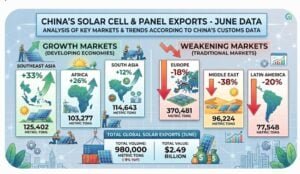
According to China’s customs data, exports of solar cells and panels to Southeast Asia increased 33% year over year to 125,402 metric tons in June.

Africa also emerged as a major growth market, with exports rising 26% to 103,277 metric tons, while shipments to South Asia climbed 12% to 114,643 metric tons.

In contrast, demand weakened across several traditional markets:

  • Exports to Europe fell 18% to 370,481 metric tons
  • Shipments to the Middle East dropped 38% to 96,224 metric tons
  • Exports to Latin America declined 20% to 77,548 metric tons

Despite strong demand in developing economies, China’s total solar exports fell 9% year over year to 980,000 metric tons, worth $2.49 billion in June.

Measured by the number of units exported, shipments dropped 16.5% to 743.2 million solar products, marking the second consecutive monthly decline since the country ended its value-added tax (VAT) export rebate for photovoltaic products.

china solar import data
Data Source: GACC

Why China’s Solar Exports Are Slowing

The recent decline follows a major policy change announced earlier this year.

China eliminated VAT export rebates for photovoltaic products beginning April 1, 2026. The government also reduced export rebates for battery products from 9% to 6% through the end of 2026 before removing them completely from January 1, 2027.

The policy is aimed at reducing excessive competition among Chinese manufacturers and easing trade tensions created by ultra-low-priced exports.

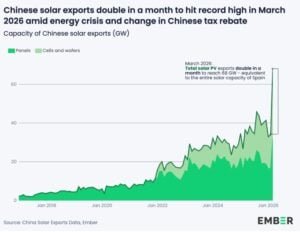
Before the rebate ended, buyers rushed to secure supplies. China’s solar exports surged in March and remained strong in April, even after the policy took effect, as many overseas customers had placed orders in advance.

June’s figures now suggest that the market is beginning to normalize after that rush.

China Still Leads Global Solar Manufacturing

Although exports have slowed, China’s position in the global solar industry remains unmatched.

According to the International Energy Agency (IEA), China accounts for more than 80% of global manufacturing capacity across nearly every stage of the solar supply chain, including polysilicon, wafers, solar cells, and modules.

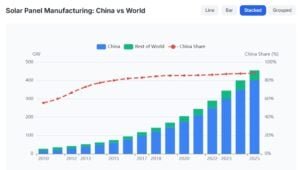
  • Data from IEA and BloombergNEF further says that China manufactured 400 GW of solar panels in 2025, 87.9% of global capacity. From 55.6% in 2010, China dominates solar manufacturing.
China
Source: chinadata.live

The country has invested more than $50 billion in solar manufacturing since 2011, helping drive down panel prices by over 80% worldwide and making solar power the cheapest source of new electricity in many regions.

The IEA also notes that China continues to dominate global exports despite increasing efforts by the United States, Europe, and India to develop domestic manufacturing capacity.

Its latest Energy Technology Perspectives report estimates that China still controls roughly 60% to 85% of production capacity across major clean energy supply chains, with even higher shares in some manufacturing steps.

Emerging Markets Become Key Customers

The latest export data highlights a broader shift in global solar demand.

Many developing countries are expanding renewable energy to improve electricity access while reducing dependence on imported fossil fuels.

Africa has become one of the fastest-growing destinations for Chinese solar equipment because falling panel prices have made large-scale solar projects increasingly affordable. Although China’s removal of export rebates may gradually increase equipment costs, analysts expect solar to remain one of the lowest-cost power options across much of the continent.

Similarly, Southeast Asian and South Asian countries continue to install record amounts of solar capacity as electricity demand rises alongside economic growth.

Energy think tank Ember has also observed growing demand from Asia and Africa, noting that Chinese customs data increasingly reflects these regions’ expanding role in the global solar market.

china solar
Source: Ember

Europe’s Demand Is Cooling

Europe remains China’s largest export destination, but imports are slowing.

The region installed record amounts of solar capacity over the past few years, leading to high inventory levels. Combined with slower economic growth and efforts to diversify supply chains, this has reduced new purchases from China.

Trade restrictions have also reshaped global supply chains.

The United States has imposed higher tariffs on solar products originating from several Southeast Asian countries with significant Chinese manufacturing, encouraging companies to relocate production and redirect exports toward other markets.

What Comes Next?

China’s June export data suggests that the country’s solar industry is entering a new phase.

The end of export tax rebates is reducing shipment volumes after months of exceptionally strong sales. However, demand from emerging economies is helping offset weaker purchases from Europe and other mature markets.

As countries continue investing in clean electricity, China is expected to remain the world’s largest supplier of solar equipment. Even with changing trade policies and growing competition from other manufacturing hubs, its scale, established supply chains, and low production costs continue to give it a significant advantage.

The latest figures also highlight an important trend: the next wave of global solar growth is increasingly coming from Asia and Africa, where expanding electricity demand and falling renewable energy costs are accelerating the transition to clean power.

The post China’s Solar Exports Shift Toward Asia and Africa Despite Tax Rebate Cuts appeared first on Carbon Credits.

ALT-Lab-Ad-1

Recent Articles