

Chinese electric-vehicle makers are finding a new way to monetize their lead in electrification: selling regulatory carbon credits to global automakers that need them to meet emissions rules. XPENG is the latest example.
The Chinese EV maker has signed carbon credit agreements with Porsche and other international automakers covering the European Union, the UK, and Australia, according to recent reports. The total transaction value is expected to exceed 1 billion yuan ($149 million), while XPENG expects to receive more than 500 million yuan ($74.5 million) from carbon-credit trading in 2026. An XPENG vice president confirmed the figures publicly.
The development points to a wider shift in the global auto industry. Chinese manufacturers are no longer only exporting electric cars. Their growing EV sales are also creating regulatory assets that other automakers can use to manage fleet emissions.
Europe’s Carbon Rules Put a Price on EV Advantage
The European Union’s CO₂ rules are the main driver behind this market. Under the current framework, new passenger cars registered in the EU face a fleet-wide target of 93.6 grams of CO₂ per kilometer for 2025–2029. The target falls to 49.5 g/km from 2030 to 2034, before reaching 0 g/km from 2035 under the existing regulation.
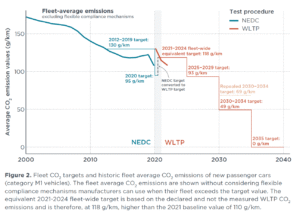
Automakers can form emissions pools. This allows manufacturers with lower fleet emissions to combine their results with manufacturers that have higher emissions. The system creates a financial value for automakers that sell large numbers of zero-emission vehicles.
The EU also applies an excess-emissions premium of €95 for each gram of CO₂ per kilometer above the applicable target for each new vehicle, subject to the rules governing the relevant compliance period. For manufacturers selling large numbers of higher-emission vehicles, surplus credits from EV-heavy manufacturers can therefore have significant financial value.
The system is already operating at scale. In 2025, several major automakers formed pools involving Tesla, while Mercedes established a pool involving Volvo Cars, Polestar and Smart.
- SEE MORE: EU’s 2025 Emission Rules Led Tesla and Mercedes to Pool Carbon Credits to Avoid $15.6 Billion Fine
XPENG is now entering this market as a supplier of compliance capacity.
XPENG and Porsche Open a New China-Europe Link
The most notable agreement involves Porsche.
According to an official European Commission filing cited in recent reporting, Porsche withdrew from the Volkswagen Group’s internal emissions pool and established an independent, open pool for 2026 and 2027, with XPENG as a key partner. Financial terms have not been disclosed.
The structure is important because Porsche has a large portfolio of performance and premium vehicles, while XPENG’s fleet is centered on battery-electric vehicles.
- In a regulatory emissions pool, the calculation is straightforward: more zero-emission vehicles can lower the average emissions of the combined fleet.
XPENG therefore gains another source of revenue from its EV sales without needing to sell the credits as conventional voluntary carbon offsets. That distinction matters.
These are regulatory CO₂ compliance credits, created by vehicle-emissions rules. They are not the same as voluntary carbon credits generated by projects such as forests, methane capture, or direct air capture.
China’s EV Boom Is Creating the Credit Supply
XPENG’s ability to generate credits comes from the rapid expansion of its electric vehicle business. The International Energy Agency estimates that global electric car sales exceeded 20 million units in 2025, up 20% from 2024. One in four new cars sold worldwide was electric.
China remained the largest EV market, with more than 13 million electric cars sold in 2025. Nearly 55% of all new cars sold in China were electric. Chinese manufacturers also accounted for 60% of global electric car sales in 2025.
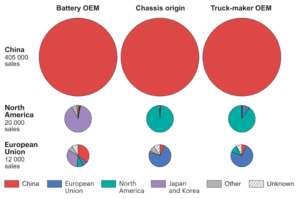
The production advantage is just as large. China produced about 16 million electric cars in 2025, nearly 75% of global EV output. Chinese electric car exports more than doubled to over 2.5 million units.
Europe is becoming an increasingly important destination.
Sales of Chinese-made electric cars in Europe increased by almost 50% in 2025 to about 940,000 units, according to the IEA. Chinese brands accounted for more than 70% of Chinese-made EV imports into the EU, up from 50% in 2023. This expanding overseas EV fleet is also expanding the potential pool of regulatory credits.
XPENG’s Global EV Expansion Adds Another Revenue Stream
XPENG’s overseas business is expanding rapidly. The company delivered 45,008 vehicles outside China in 2025, up 96% year over year, while total deliveries reached 429,445, up 126%. It was selling vehicles in 60 countries and regions by year-end.
In Q2 2026, overseas sales topped 20,000 vehicles for the first time, up 81% year over year. Overseas revenue accounted for more than 25% of first-half revenue, with an average selling price above €40,000.
XPENG has also expanded its partnership with Volkswagen, which acquired a 4.99% stake for about $700 million in 2023. Their first jointly developed model entered mass production in March 2026.
The growing overseas EV business can therefore support both vehicle sales and XPENG’s ability to generate compliance value in regulated markets.
Leapmotor Shows XPENG Is Not Alone
XPENG is not the first Chinese automaker to monetize surplus emissions performance. Leapmotor transferred EU carbon credits to Stellantis for European and UK sales, generating 1.11 billion yuan ($165 million) in 2025. Its 2026 credit trading cap was later raised to 2.8 billion yuan ($417 million).
Tesla has used the same model for years, reporting about $2 billion in regulatory credit revenue in 2025, down from $2.76 billion in 2024.
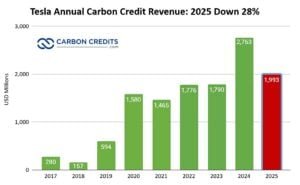
For EV makers, regulatory credits can provide additional revenue. For automakers with higher fleet emissions, they can offer another compliance tool. However, their value remains dependent on emissions rules, pooling arrangements, and future regulatory changes.
XPENG’s Carbon Strategy Extends Beyond Credit Sales
XPENG’s carbon strategy extends beyond regulatory credits. Its 2025 ESG report targets a 9% reduction in lifecycle carbon emissions per passenger vehicle by 2027 from 2023 levels, alongside a 38% reduction in operational carbon emissions intensity.
The company aims for carbon neutrality across its product lifecycle and corporate operations by 2050.
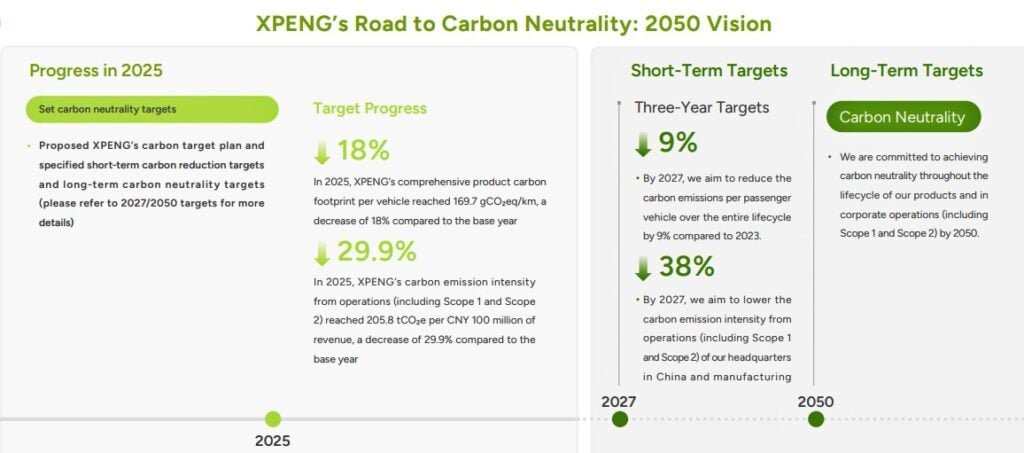
In 2025, XPENG reported a product carbon footprint of 169.7 grams of CO₂e per kilometer, down 18% from 2023. Operational carbon emissions intensity fell 29.9% to 205.8 tonnes of CO₂e per CNY 100 million.
It also recorded 73,000 MWh of clean energy consumption and 106,000 MWh of photovoltaic generation. XPENG estimates its 2025 vehicles will avoid more than 6 million tonnes of lifecycle greenhouse-gas emissions compared with conventional vehicles.
More EVs Mean a Bigger Compliance Credit Pool
The expanding EV market provides the underlying supply of these compliance assets. The IEA expects global electric-car sales to reach about 23 million vehicles in 2026, or roughly 28% of total car sales. EVs could account for about one-third of European sales and nearly 60% of China’s market.
- By 2035, the global EV fleet could exceed 450 million vehicles under the IEA’s Current Policies Scenario.
Europe’s fleet is also becoming cleaner. Average CO₂ emissions from new passenger cars fell 28% between 2019 and 2024, while zero-emission vehicles accounted for 14.5% of new registrations in 2024.
As EV adoption rises and emissions rules tighten, the market for regulatory carbon credit transfers could expand.
Chinese EV Makers Are Turning Electrification Into a New Asset Class
XPENG’s agreements with Porsche and other international automakers show how China’s EV advantage is creating a new source of commercial value. Chinese EV exports exceeded 2.5 million vehicles, and Europe imported about 940,000 Chinese-made EVs.
Against this backdrop, XPENG expects more than 500 million yuan ($74.5 million) in carbon credit revenue in 2026. For European automakers, these credits provide another compliance tool as emissions standards tighten. For Chinese EV makers, they create an additional revenue stream from their growing zero-emission vehicle fleets.
Chinese automakers are therefore increasingly selling not only electric vehicles into Europe, but also the emissions-compliance value created by those vehicles.
The post Chinese EV Makers Sell Carbon Credits to Porsche and Other Europe’s Auto Giants appeared first on Carbon Credits.


