
Fusarium basal rot has usurped the stem and bulb nematode as the greatest challenge to conventional garlic growers.
“Fusarium basal rot is the big issue, and not only in Ontario or Canada, but it’s the biggest issue in garlic production in most of the United States,” Mary Ruth McDonald told attendees at the Garlic Growers’ June field day. “And from what I hear, it seems to be the biggest problem in Europe, as well.”
Why it matters
The Clean Seed Program has cleared viruses out of Ontario garlic for years. McDonald’s trial found the same tissue culture does nothing for fusarium, which can sit symptomless in a plant until conditions trigger bulb dry rot. The one site that stayed clean at 10 weeks was conventional seed, not clean.
Two species, two problems
The professor of plant agriculture at the University of Guelph said the garlic Clean Seed Program run out of New Liskeard’s Superior Plant Upgrading and Distribution (SPUD) Unit, has been very effective in eliminating virus threats in conventional garlic using meristem tissues to culture clean seed.
In theory, it could clear fusarium, but McDonald said it’s not quite that simple.
Over the last year, McDonald ran a trial assessing fusarium infection rates in garlic seed available in Ontario and where along the seed increase process it might become infected.
“We want(ed) to find out how much fusarium was there, if there was infection, and also to determine what species of fusarium were causing infection,” she explained. “Because, of course, just to make it more complicated, there’s more than one species that can cause this disease.”
Determining the species is a critical step in defining how to manage the disease.
“The one we normally expect to see is Fusarium oxysporum. It’s very specific to garlic and onions; it doesn’t have a wide host range,” McDonald stated.
Fusarium proliferatum has a wide range of hosts, including wheat, corn and other crops, and tends to be the most aggressive, causing significant disease and damage on garlic.
The trial confirmed both.
Storage challenges
A 2020 research paper by Christel Leyronas, led by INRAE, France’s National Research Institute for Agriculture, Food and the Environment, indicates that Fusarium proliferatum caused 94 per cent of storage rot cases in French garlic. It degraded the roots, caused bulb rot and brown spots on the cloves, which appeared about two months into storage. Fusarium oxysporum was responsible for the remaining six per cent.
Sampling Ontario seed
Working with Travis Cranmer, Ontario Ministry of Agriculture, Food and Agribusiness vegetable crop specialist, McDonald procured Ontario field garlic samples from the SPUD Unit’s Clean Seed program roundels that had been increased for three years in the field. She also tested conventional seed from different sites, commercial seed-sourced garlic and a few roundels directly from the Clean Seed program.
“Because we’re all aware of how precious and valuable these (Clean Seed) roundels are, we didn’t want to waste too many by plating them,” she clarified.
The goal was to see how much fusarium load, if any, the samples carried and what the spread risk was for commercial seed.
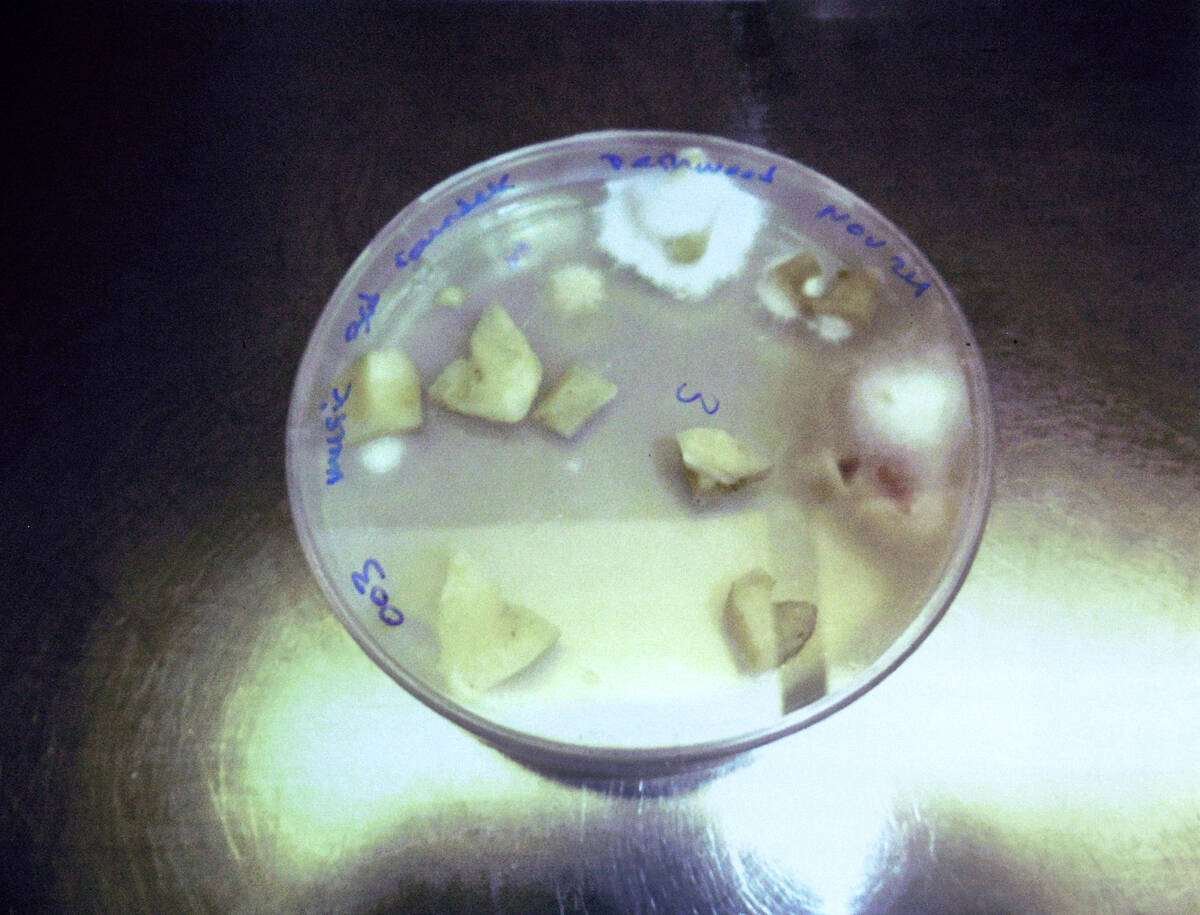
McDonald disinfected cloves before dividing them into three parts: the basal plate, the middle of the clove and the tip.
“Fusarium tends to infect the basal plate most, but it can infect different parts of the clove,” she explained, adding that a fusarium selective medium was introduced during the trial.
What the plates showed
The plates were observed at two weeks, and, through what McDonald called a happy accident, again at 10 weeks after they were left over Christmas break.
“In many cases, we found more growth after 10 weeks than we did after two weeks,” she said, pointing to an image and adding. “When we get this white fuzzy growth, we transfer it again onto a different (rice) medium, that allows us to figure out which species we’re looking at.”
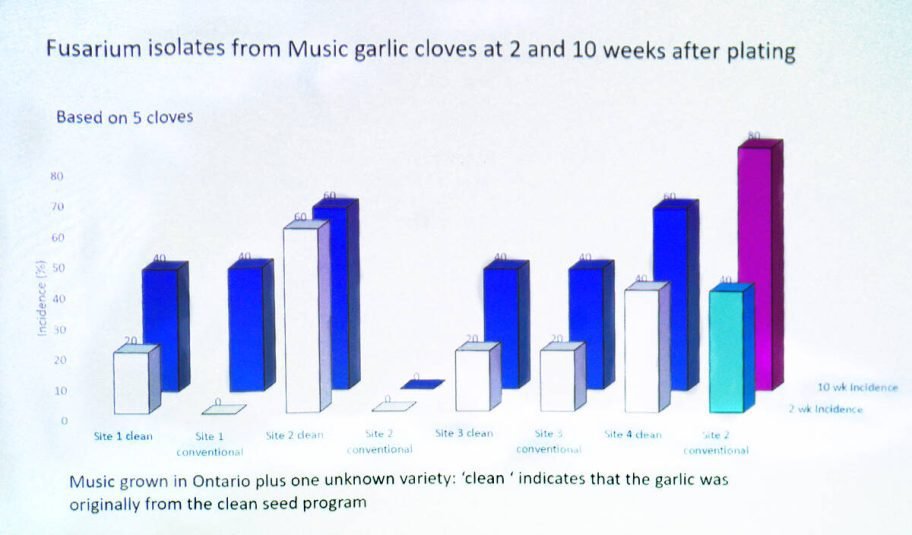
The Music variety cloves, both clean and conventional garlic from four different sites, showed that conventional sites one and two had no fusarium growth at the two-week point; the other sites, clean or conventional, did.
At the 10-week stage, site two conventional remained clean, with every other sample showing various rates of fusarium infection.
McDonald commented that one site having no fusarium was positive; the surprising aspect was that it was a conventional site, not a clean-seed one.
“Sadly, the tissue culture did not seem to have an effect on the levels of fusarium we were finding,” she said. “When we looked at the cloves from the commercial seed, after two weeks, there were a whole lot that we didn’t find any infection at all, so that looked kind of promising, kind of positive.”
The commercial garlic seed’s organic and non-organic Purple Stripe, Music and Rocamble samples showed no fusarium growth at two weeks — the best result within that time frame. At the 10-week marker, all commercial garlic seed showed signs of infection. Two of the five Clean Seed roundels showed infection at the two-week mark.
In the end, Fusarium proliferatum accounted for 88 per cent of the infections, with Fusarium oxysporum the remaining 12 per cent, although both were identified in the samples.
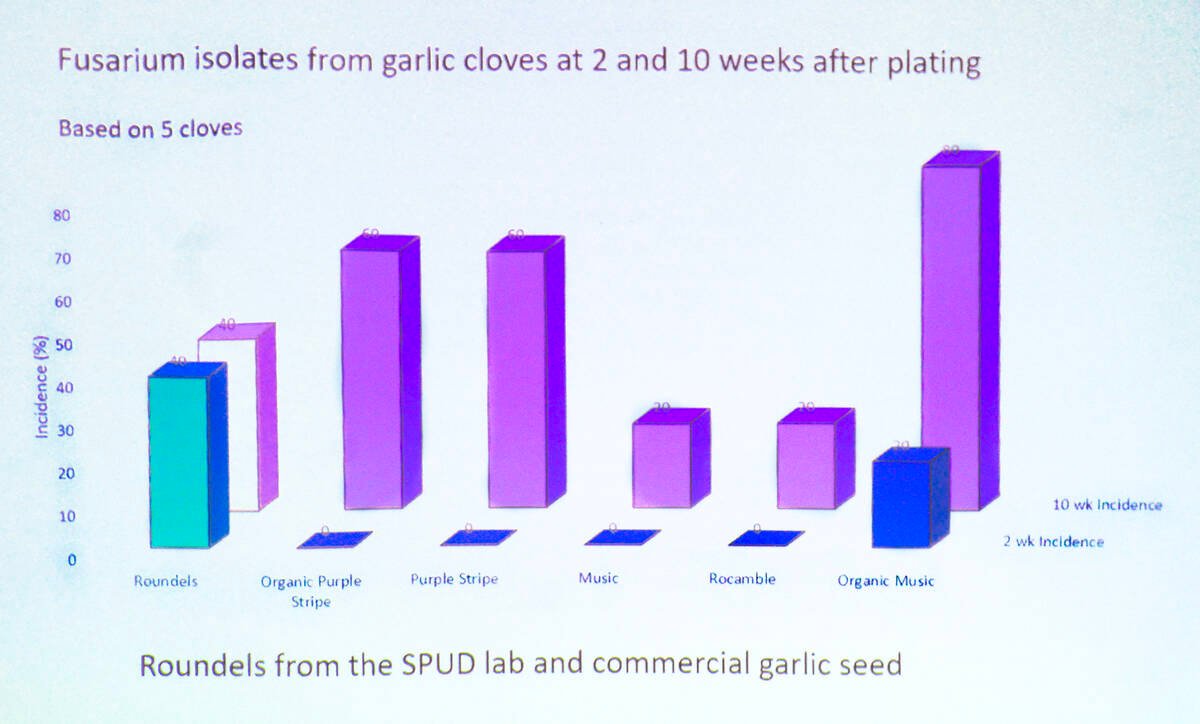
“This isn’t a really extensive sample, but if we’re finding infection on five cloves that we took at random from 10 different bulbs, it does mean that fusarium is there,” McDonald stated. “The percentages we can’t be as clear about.”
Impossible to clean?
Leyronas’ research hypothesized that garlic is naturally infected with fusarium without causing disease or symptoms, and because of that, it may be impossible to “clean” it from garlic.
Instead, the focus is on figuring out what triggers the fusarium to switch on and rot the bulb after existing for generations in the garlic without disease or symptoms.
McDonald said the University of California Davis College of Agricultural and Environmental Sciences Fight Fusarium project is focused on reducing fusarium garlic losses through improved in-field and post-harvest management, improving genetic-resistance-based management resources and developing a rapid, accurate in-plant diagnosis, soil and seed testing toolkit for the fusarium pathogens. As a consultant, McDonald said results will be available to Ontario growers as the project progresses.
For Ontario, McDonald said fusarium infection assessments will continue with bulbs planted in fusarium-free soil and set to be harvested over July and August.
Building on the Fight Fusarium project, McDonald said research into methods that identify clean, uninfected garlic will continue to build a stronger clean seed program.
The post Clean seed isn’t clearing fusarium from Ontario garlic appeared first on Farmtario.


