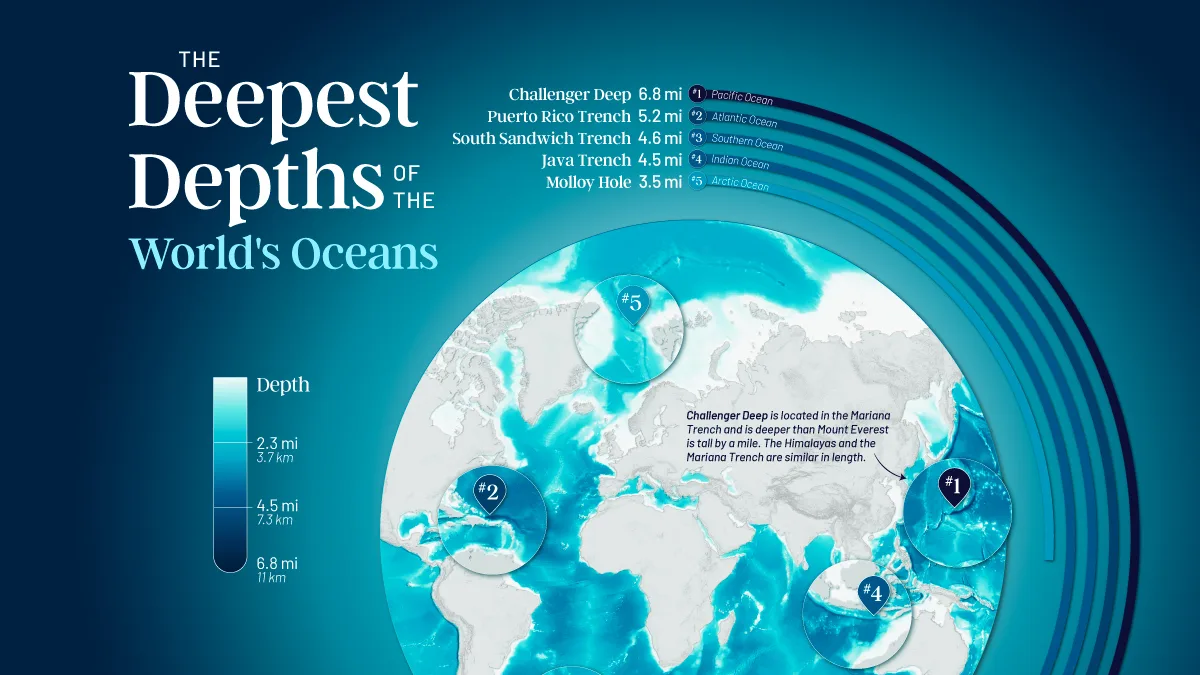
Ranked: The Deepest Points in the World’s Oceans
See visuals like this from many other data creators on our Voronoi app. Download it for free on iOS or Android and discover incredible data-driven charts from a variety of trusted sources.
Key Takeaways
- Challenger Deep in the Pacific Ocean reaches 6.8 miles below sea level, making it deeper than Mount Everest is tall.
- The Pacific’s deepest point is about 30% deeper than the Atlantic Ocean’s deepest location.
- The Arctic Ocean’s Molloy Hole is the shallowest entry in the ranking at 3.5 miles, nearly half the depth of Challenger Deep.
The ocean floor contains some of Earth’s most extreme environments, with trenches and deep basins extending miles below sea level.
This visualization ranks the deepest known point in each of the world’s five oceans, highlighting the exceptional depth of the Pacific Ocean’s Mariana Trench.
The data for this visualization comes from Earth-Science Reviews and covers the Pacific, Atlantic, Southern, Indian, and Arctic Oceans.
The Deepest Ocean Points on Earth
Challenger Deep in the Mariana Trench reaches 6.8 miles (10.9 kilometers) below sea level, about one mile farther than Mount Everest is tall. It is the deepest known point in Earth’s oceans and illustrates the extraordinary scale of the Pacific’s trench system.
The data table below ranks the deepest known point in each ocean:
| Rank | Deepest Point | Ocean | Depth in miles | Depth in meters |
|---|---|---|---|---|
| 1 | Challenger Deep (Mariana Trench) | Pacific Ocean | 6.79 | 10,925 |
| 2 | Puerto Rico Trench | Atlantic Ocean | 5.22 | 8,408 |
| 3 | South Sandwich Trench | Southern Ocean | 4.59 | 7,385 |
| 4 | Java Trench | Indian Ocean | 4.53 | 7,290 |
| 5 | Molloy Hole | Arctic Ocean | 3.52 | 5,669 |
Although every location in this ranking is exceptionally deep, Challenger Deep occupies a class of its own.
The next-deepest entry, the Puerto Rico Trench in the Atlantic Ocean, reaches 5.2 miles below sea level. In other words, Challenger Deep is 30% deeper.
How Depths Compare Across the Five Oceans
Due to its highly active tectonic subduction zones, the Pacific Ocean’s western rim contains many of the world’s deepest trenches. Challenger Deep only narrowly exceeds other deep Pacific locations, including the Tonga Trench and Philippine Trench, which reach roughly 6.7 and 6.5 miles, respectively.
The Atlantic Ocean’s Puerto Rico Trench and the Southern Ocean’s South Sandwich Trench, ranked second and third, are separated by 0.6 miles (0.97 kilometers).
The South Sandwich Trench and the Indian Ocean’s Java Trench are separated by just 0.06 miles (95 meters), the smallest gap in the ranking.
The Arctic Ocean’s Molloy Hole is still extremely deep at 3.5 miles, but the Mariana Trench extends nearly twice as far below sea level.
Why Measuring the Deep Ocean Is Difficult
Accurately measuring the deepest parts of the ocean remains challenging. An estimated 99.999% of the deep ocean remains visually unexplored. These areas are remote, completely dark, cold, highly pressurized, and often shaped by complex seafloor terrain.
Because of these conditions, some values in the dataset are listed as approximations, including the depths of the South Sandwich Trench and Java Trench.
This uncertainty highlights how little of the deep ocean has been directly observed. Despite advances in sonar mapping and deep-sea exploration, vast areas remain unseen, leaving room for future discoveries beneath the ocean’s surface.
Learn More on the Voronoi App 
If you enjoyed today’s post, check out Ranked: The World’s Deepest Caves on Voronoi, the new app from Visual Capitalist.