
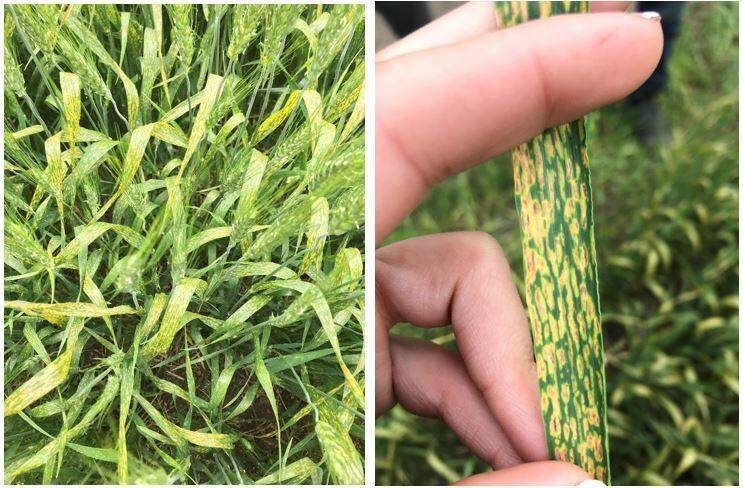
A prolonged stretch of cloudy weather has intensified physiological fleck in Ontario’s winter wheat crop this year. The condition typically develops after extended periods of low light followed by sudden exposure to bright, sunny conditions.
Joanna Follings, cereals specialist with the Ontario Ministry of Agriculture, Food and Agribusiness, said this season was particularly challenging, with cloudy conditions persisting well into early summer. Follings added that Ontario has seen a noticeable increase in flecking cases since 2018, a trend that may continue as weather patterns shift.
“It’s been a bit of a recurring phenomenon in the last few years, and essentially it is what it is. It’s not predictable, and that’s the challenge with it,” she said.
Flecking occurs when wheat leaf cuticles thin under prolonged cloudy conditions. When weather conditions shift to bright sunlight, free radicals — unstable molecules that can damage plant cells — form in the leaf and cause flecking.
“It essentially acts like a sunburn,” Follings said, noting that the unpredictability also stems from physiological fleck being variety dependent.
She said flecking is typically identified around flag leaf timing, when yield losses are generally minimal. However, it can appear much earlier, causing leaves to brown and potentially having a greater impact on yield.
Until now, Follings said limited research has been conducted by breeders to prevent physiological fleck. Farmers have generally relied on selecting varieties that appear to have lower susceptibility to reduce its impact.
She said this is beginning to change, with more seed companies incorporating physiological fleck tolerance into their breeding programs.
“Seed companies are trying to identify if there’s a variety where it gets very severe flecking, that may not be something that is ideal for farmers,” she said, noting that developing more tolerant varieties will be a long-term project.
Is it fleck or fungi?
Another challenge for researchers and farmers has been differentiating physiological fleck from disease.
In a 2021 Field Crop News report, Follings identified several key features to help distinguish between the two. Flecking typically appears more uniformly across a field compared with disease symptoms. She also noted diseases tend to start at the bottom of the plant, while flecking generally appears higher on the plant.
Follings told Farmtario that researchers in the United States have developed preventative measures that may help reduce the impact of physiological fleck in winter wheat. Researchers found that plants with higher chloride concentrations at heading tended to experience less flecking.
As a result, some researchers have suggested applying potassium chloride or magnesium chloride in the spring to reduce flecking severity.
“Application of 20 to 40 pounds of chloride is somewhere to start, and (farmers) could do that in replicated strips and see if perhaps that’s a way to help manage it. They seem to have found that an application of a chloride fertilizer helped reduce physiological flecking,” Follings said.
Observations in Canada have found that fungicides are not effective in preventing or reducing physiological fleck.
“This year, in particular, I think it’s worse than we’ve seen in a while, just because of how cloudy it was this year. If we continue to have this type of weather pattern, then absolutely it is something we’re going to have to continue to try and manage going forward through varieties, as well as maybe trying some of these chloride applications to help reduce our risk,” she said.
Unlike diseases, the impact of flecking is driven primarily by weather conditions, Follings said. As Ontario experiences more frequent cool, cloudy springs followed by rapid transitions to hot summer conditions, she expects flecking cases to become increasingly common.
The post Cloudy spring intensifies physiological fleck in Ontario winter wheat appeared first on Farmtario.


