

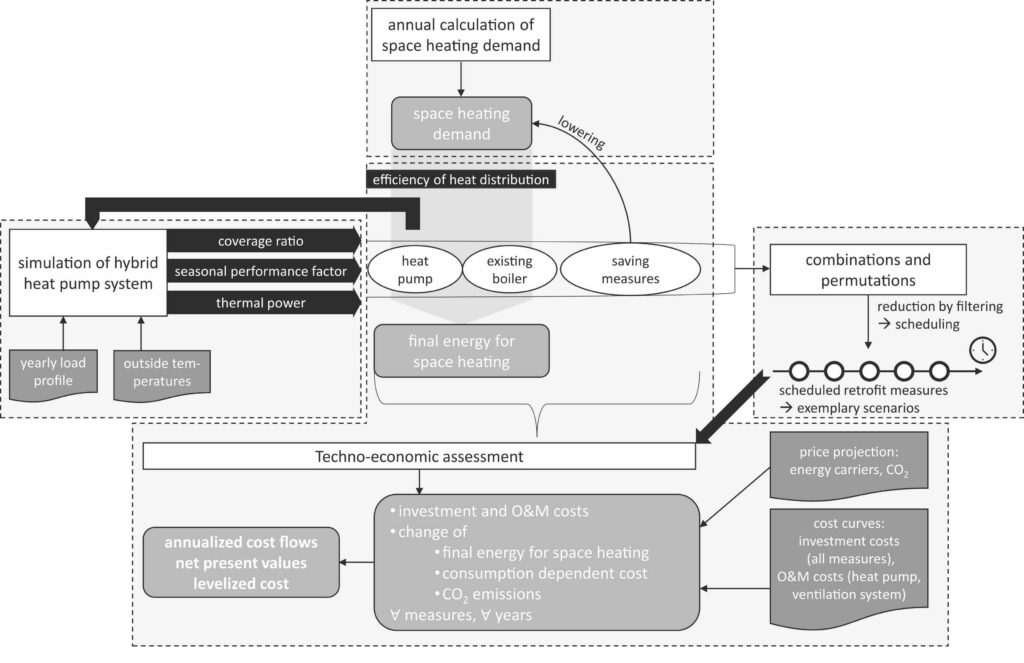
A research team in Germany has developed a new framework for grouping and scheduling building retrofit measures involving hybrid heat pump systems. The hybrid system combines a newly installed air-to-water heat pump with an existing fossil fuel boiler, which covers the remaining heating demand. The proposed approach combines a techno-economic assessment of retrofit measures with simulations of hybrid system operation at different stages of the retrofit process.
“The scope of the study extends beyond considering the interdependencies between retrofit measures over time resulting from different bundling and sequencing strategies,” corresponding author Tim Schaffitzel told pv magazine.
“The framework also considers how the operating pattern of the hybrid heat pump changes depending on the retrofit measures implemented at each stage,” he added. “It therefore combines a techno-economic assessment of the retrofit measures with detailed simulations of the hybrid heat pump system throughout the transition period.”
The framework assesses five measures: the installation of an air-to-water heat pump, roof insulation, wall insulation, window replacement, and ventilation with heat recovery. It compares different combinations and sequences by calculating heating demand at each stage and simulating the shares supplied by the heat pump and existing boiler. The researchers then combine these results with investment and operating costs to calculate the net present value, payback period and levelized cost of each measure and retrofit roadmap.
“With five retrofit measures, there are theoretically 541 possible roadmaps based on different combinations of bundling and sequencing,” Schaffitzel said. “In practice, however, constraints such as financing limit the number of realistic retrofit roadmaps.”
The team applied these restrictions to an 888 m² municipal sports and event hall built in 1975 in Reutlingen, Germany. The building uses a 339 kW oil boiler installed in 2002, with heat distributed through radiators and a ventilation system without heat recovery.
The researchers limited each bundle to two measures and required the heat pump and roof renovation to be implemented within the first two stages. These constraints reduced the 541 theoretical roadmaps to 18, from which the researchers selected three scenarios for detailed assessment.
In Scenario 1, the heat pump and ventilation heat-recovery system were installed in 2026, followed by roof insulation in 2028 and wall insulation and window replacement in 2030. Scenario 2 paired the heat pump with roof insulation in 2026, followed by heat recovery in 2028 and the remaining measures in 2030. Scenario 3 combined roof insulation and heat recovery in 2026, added the heat pump in 2028, and completed the wall and window upgrades in 2030.
Scenario 3 achieved the highest net present value (NPV), at €89.71 ($102.90)/m², compared with €80.25/m² for Scenario 2 and €76.94/m² for Scenario 1. The researchers attributed the result to the large, early reduction in heating demand achieved by combining roof insulation with heat recovery. The scenario also resulted in the lowest cumulative heating demand over the retrofit period. All individual measures except wall insulation were found to be economically viable.
“A notable finding is that the levelized cost of saved energy and changing the heating system (LCSE/LCCH) and net present value are substantially more sensitive to changes in investment costs than to energy price variations,” Schaffitzel said.
He added that heat pump sizing can also have significant implications for the economics of a retrofit. “Given that heating systems are often oversized rather than undersized, the implications of oversizing for economic viability, as represented by LCSE, are considerable,” he said. “An oversized heat pump improves the LCSE because oversizing reduces the seasonal performance factor. Consequently, the higher electricity consumption increases the energy carrier cost savings, which represent the cash flow of the retrofit measures.”
The framework is described in the study “Impact of bundling and sequencing of measures in retrofit roadmaps with hybrid heat pump systems – A case study for a municipal non-residential building in Germany,” published in Energy Reports. The research team included scientists from Germany’s University of Stuttgart and Reutlingen University.
The post Cost-effective pathways for hybrid heat pump retrofits appeared first on pv magazine Global.


